 Add to Chrome
 Add to Firefox
 Add to Edge
Bayesian meta-learning for modeling Alzheimer's disease progression
Jun 01, 2026
Predicting whether an individual with Alzheimer's disease will experience mild or severe disease progression is essential for personalized treatment. Typically, practitioners seek to predict the distribution of a discrete disease score, conditional on an individual's current MRI volume and their historical disease trajectory. Classical statistical regression models and single-task neural networks are not well-suited for this purpose because fitting separate models is infeasible (since each individual typically has few observations), while ignoring individual-level correlation leads to poor generalization. Meta-learning, in contrast, provides a natural avenue to dynamically predict distributions without retraining and model nonlinear relationships between the outcome and covariates. Motivated by this, we propose a Bayesian meta-learner that is trained on multiple individuals but tailors the predictive disease score distribution to each individual's historical data. Our model predicts on unseen individuals without retraining, scales linearly with the number of historical observations, and is guaranteed to be less overconfident when predicting long-term disease scores compared to its deterministic counterpart. On real-world data from the Alzheimer's Disease Neuroimaging Initiative (ADNI) database, our model achieves performance competitive with both single-task models and deterministic meta-learners, while substantially improving performance when predicting long-term disease progression.

Diffusion-based Denoising Beats Vanilla Score Matching in Parameter Estimation: A Theoretical Explanation
May 21, 2026Score matching is an alternative to maximum likelihood estimation when the normalizing constant is unknown or too costly to evaluate. However, vanilla score matching has shown to be inefficient relative to maximum likelihood estimation for multimodal distributions with well-separated modes, which are commonly encountered in practical applications. We compare a novel diffusion-based denoising score matching estimator (DDSME) to the vanilla score matching estimator (SME) in this scenario. In particular, we prove statistical guarantees for both estimators, showing that the error bound for the vanilla SME worsens when the separation between the modes increases, which can be avoided in case of the DDSME with suitable hyperparameter tuning. This provides a novel theoretical explanation for the superior behavior of diffusion-based score matching over the vanilla version.
Point Cloud Sequence Encoding for Material-conditioned Graph Network Simulators
May 20, 2026Graph Network Simulators (GNSs) have emerged as powerful surrogates for complex physics-based simulation, offering inherent differentiability and orders-of-magnitude speedups over traditional solvers. However, GNSs typically assume access to the underlying material parameters, such as stiffness or viscosity, severely limiting their utility in realistic experimental settings. While recent meta-learning approaches address the parameter dependency by inferring properties from mesh trajectories, reconstructing a mesh from an observed scene is challenging. In this work, we introduce Point Cloud Encoding for Accurate Context Handling (PEACH), a novel framework that applies in-context learning on point clouds to adapt a learned simulator to unseen physical properties during inference. Our approach relies on a novel spatio-temporal point cloud sequence encoder, as well as two forms of auxiliary supervision to help improve simulation fidelity. We demonstrate that PEACH is capable of accurate zero-shot sim-to-real transfer on a challenging, dynamic scene. Experiments on simulation scenes show that PEACH even outperforms mesh-based baselines on prediction accuracy, while being much more practical for real-world deployment.
From Model Uncertainty to Human Attention: Localization-Aware Visual Cues for Scalable Annotation Review
May 12, 2026High-quality labeled data is essential for training robust machine learning models, yet obtaining annotations at scale remains expensive. AI-assisted annotation has therefore become standard in large-scale labeling workflows. However, in tasks where model predictions carry two independent components, a class label and spatial boundaries, a model may classify an object with high confidence while mislocalizing it. Existing AI-assisted workflows offer annotators no signal about where spatial errors are most likely. Without such guidance, humans may systematically underinspect subtly misplaced boxes. We address this by studying the effect of visualizing spatial uncertainty via a purpose-built interface. In a controlled study with 120 participants, those receiving uncertainty cues achieve higher label quality while being faster overall. A box-level analysis confirms that the cues redirect annotator effort toward high-uncertainty predictions and away from well-localized boxes. These findings establish localization uncertainty as a lever to improve human-in-the-loop annotation. Code is available at https://mos-ks.github.io/MUHA/.
QDSB: Quantized Diffusion Schrödinger Bridges
May 12, 2026Learning generative models in settings where the source and target distributions are only specified through unpaired samples is gaining in importance. Here, one frequently-used model are Schrödinger bridges (SB), which represent the most likely evolution between both endpoint distributions. To accelerate training, simulation-free SBs avoid the path simulation of the original SB models. However, learning simulation-free SBs requires paired data; a coupling of the source and target samples is obtained as the solution of the entropic optimal transport (OT) problem. As obtaining the optimal global coupling is infeasible in many practical cases, the entropic OT problem is iteratively solved on minibatches instead. Still, the repeated cost remains substantial and the locality can distort the global transport geometry. We propose quantized diffusion Schrödinger bridges (QDSB), which compute the endpoint coupling on anchor-quantized endpoint distributions and lift the resulting plan back to original data points through cell-wise sampling. We show that the regularized optimal coupling is stable w.r.t. anchor quantization, with an error controlled by the quality of the anchor approximation. In real-world experiments, QDSB matches the sample quality of existing baselines, requiring substantially less time. Code and data are available at github.com/mathefuchs/qdsb.
Semi-structured multi-state delinquency model for mortgage default
Mar 27, 2026We propose a semi-structured discrete-time multi-state model to analyse mortgage delinquency transitions. This model combines an easy-to-understand structured additive predictor, which includes linear effects and smooth functions of time and covariates, with a flexible neural network component that captures complex nonlinearities and higher-order interactions. To ensure identifiability when covariates are present in both components, we orthogonalise the unstructured part relative to the structured design. For discrete-time competing transitions, we derive exact transformations that map binary logistic models to valid competing transition probabilities, avoiding the need for continuous-time approximations. In simulations, our framework effectively recovers structured baseline and covariate effects while using the neural component to detect interaction patterns. We demonstrate the method using the Freddie Mac Single-Family Loan-Level Dataset, employing an out-of-time test design. Compared with a structured generalised additive benchmark, the semi-structured model provides modest but consistent gains in discrimination across the earliest prediction spans, while maintaining similar Brier scores. Adding macroeconomic indicators provides limited incremental benefit in this out-of-time evaluation and does not materially change the estimated borrower-, loan-, or duration-driven effects. Overall, semi-structured multi-state modelling offers a practical compromise between transparent effect estimates and flexible pattern learning, with potential applications beyond credit-transition forecasting.
Scalable Learning of Multivariate Distributions via Coresets
Mar 20, 2026Efficient and scalable non-parametric or semi-parametric regression analysis and density estimation are of crucial importance to the fields of statistics and machine learning. However, available methods are limited in their ability to handle large-scale data. We address this issue by developing a novel coreset construction for multivariate conditional transformation models (MCTMs) to enhance their scalability and training efficiency. To the best of our knowledge, these are the first coresets for semi-parametric distributional models. Our approach yields substantial data reduction via importance sampling. It ensures with high probability that the log-likelihood remains within multiplicative error bounds of $(1\pm\varepsilon)$ and thereby maintains statistical model accuracy. Compared to conventional full-parametric models, where coresets have been incorporated before, our semi-parametric approach exhibits enhanced adaptability, particularly in scenarios where complex distributions and non-linear relationships are present, but not fully understood. To address numerical problems associated with normalizing logarithmic terms, we follow a geometric approximation based on the convex hull of input data. This ensures feasible, stable, and accurate inference in scenarios involving large amounts of data. Numerical experiments demonstrate substantially improved computational efficiency when handling large and complex datasets, thus laying the foundation for a broad range of applications within the statistics and machine learning communities.
Depth as Prior Knowledge for Object Detection
Feb 05, 2026Detecting small and distant objects remains challenging for object detectors due to scale variation, low resolution, and background clutter. Safety-critical applications require reliable detection of these objects for safe planning. Depth information can improve detection, but existing approaches require complex, model-specific architectural modifications. We provide a theoretical analysis followed by an empirical investigation of the depth-detection relationship. Together, they explain how depth causes systematic performance degradation and why depth-informed supervision mitigates it. We introduce DepthPrior, a framework that uses depth as prior knowledge rather than as a fused feature, providing comparable benefits without modifying detector architectures. DepthPrior consists of Depth-Based Loss Weighting (DLW) and Depth-Based Loss Stratification (DLS) during training, and Depth-Aware Confidence Thresholding (DCT) during inference. The only overhead is the initial cost of depth estimation. Experiments across four benchmarks (KITTI, MS COCO, VisDrone, SUN RGB-D) and two detectors (YOLOv11, EfficientDet) demonstrate the effectiveness of DepthPrior, achieving up to +9% mAP$_S$ and +7% mAR$_S$ for small objects, with inference recovery rates as high as 95:1 (true vs. false detections). DepthPrior offers these benefits without additional sensors, architectural changes, or performance costs. Code is available at https://github.com/mos-ks/DepthPrior.
BaGGLS: A Bayesian Shrinkage Framework for Interpretable Modeling of Interactions in High-Dimensional Biological Data
Nov 19, 2025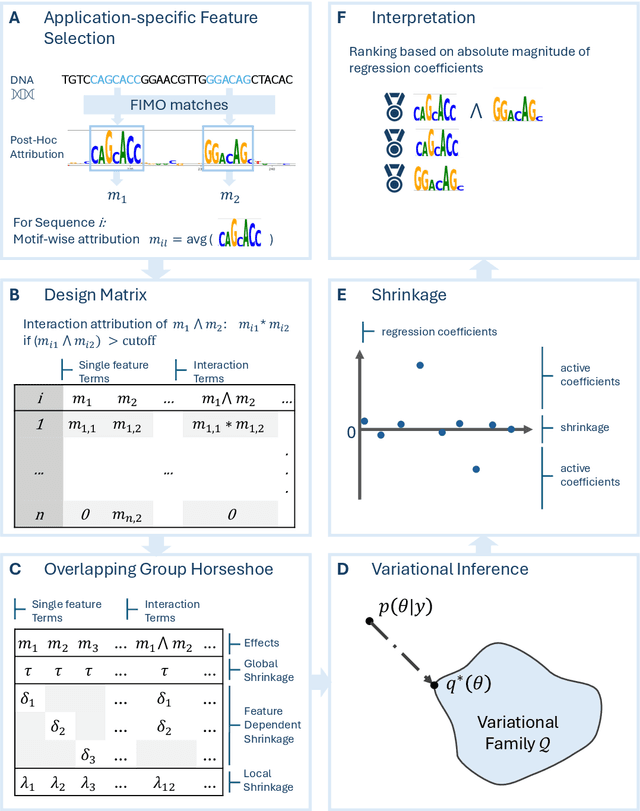
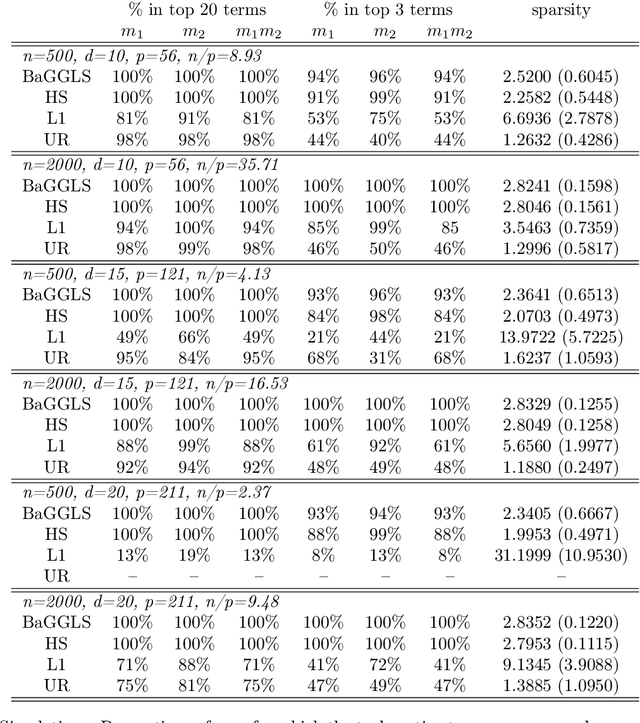
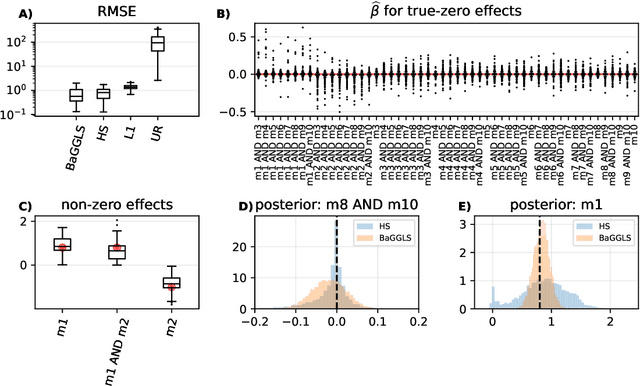
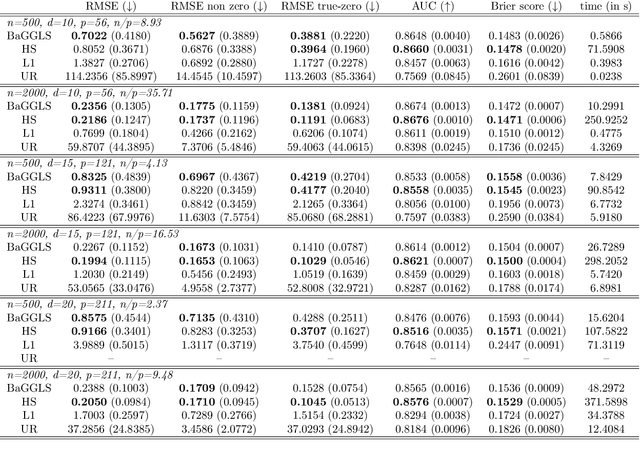
Biological data sets are often high-dimensional, noisy, and governed by complex interactions among sparse signals. This poses major challenges for interpretability and reliable feature selection. Tasks such as identifying motif interactions in genomics exemplify these difficulties, as only a small subset of biologically relevant features (e.g., motifs) are typically active, and their effects are often non-linear and context-dependent. While statistical approaches often result in more interpretable models, deep learning models have proven effective in modeling complex interactions and prediction accuracy, yet their black-box nature limits interpretability. We introduce BaGGLS, a flexible and interpretable probabilistic binary regression model designed for high-dimensional biological inference involving feature interactions. BaGGLS incorporates a Bayesian group global-local shrinkage prior, aligned with the group structure introduced by interaction terms. This prior encourages sparsity while retaining interpretability, helping to isolate meaningful signals and suppress noise. To enable scalable inference, we employ a partially factorized variational approximation that captures posterior skewness and supports efficient learning even in large feature spaces. In extensive simulations, we can show that BaGGLS outperforms the other methods with regard to interaction detection and is many times faster than MCMC sampling under the horseshoe prior. We also demonstrate the usefulness of BaGGLS in the context of interaction discovery from motif scanner outputs and noisy attribution scores from deep learning models. This shows that BaGGLS is a promising approach for uncovering biologically relevant interaction patterns, with potential applicability across a range of high-dimensional tasks in computational biology.
Streamlining the Development of Active Learning Methods in Real-World Object Detection
Aug 27, 2025Active learning (AL) for real-world object detection faces computational and reliability challenges that limit practical deployment. Developing new AL methods requires training multiple detectors across iterations to compare against existing approaches. This creates high costs for autonomous driving datasets where the training of one detector requires up to 282 GPU hours. Additionally, AL method rankings vary substantially across validation sets, compromising reliability in safety-critical transportation systems. We introduce object-based set similarity ($\mathrm{OSS}$), a metric that addresses these challenges. $\mathrm{OSS}$ (1) quantifies AL method effectiveness without requiring detector training by measuring similarity between training sets and target domains using object-level features. This enables the elimination of ineffective AL methods before training. Furthermore, $\mathrm{OSS}$ (2) enables the selection of representative validation sets for robust evaluation. We validate our similarity-based approach on three autonomous driving datasets (KITTI, BDD100K, CODA) using uncertainty-based AL methods as a case study with two detector architectures (EfficientDet, YOLOv3). This work is the first to unify AL training and evaluation strategies in object detection based on object similarity. $\mathrm{OSS}$ is detector-agnostic, requires only labeled object crops, and integrates with existing AL pipelines. This provides a practical framework for deploying AL in real-world applications where computational efficiency and evaluation reliability are critical. Code is available at https://mos-ks.github.io/publications/.