 Add to Chrome
 Add to Firefox
 Add to Edge
Diffusion-based Denoising Beats Vanilla Score Matching in Parameter Estimation: A Theoretical Explanation
May 21, 2026
Score matching is an alternative to maximum likelihood estimation when the normalizing constant is unknown or too costly to evaluate. However, vanilla score matching has shown to be inefficient relative to maximum likelihood estimation for multimodal distributions with well-separated modes, which are commonly encountered in practical applications. We compare a novel diffusion-based denoising score matching estimator (DDSME) to the vanilla score matching estimator (SME) in this scenario. In particular, we prove statistical guarantees for both estimators, showing that the error bound for the vanilla SME worsens when the separation between the modes increases, which can be avoided in case of the DDSME with suitable hyperparameter tuning. This provides a novel theoretical explanation for the superior behavior of diffusion-based score matching over the vanilla version.

Dropout Regularization in Extended Generalized Linear Models based on Double Exponential Families
May 11, 2023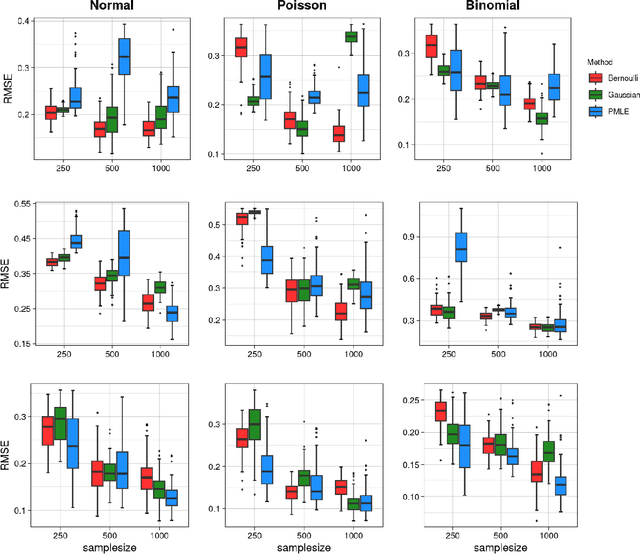
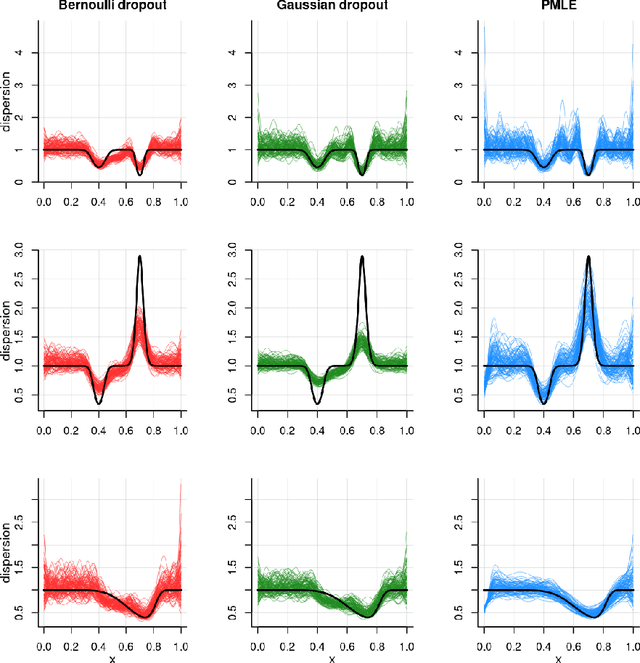
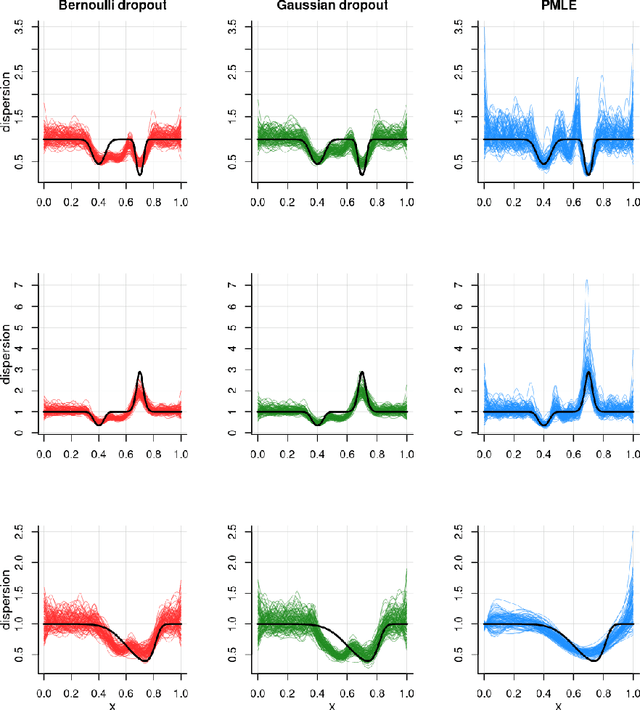
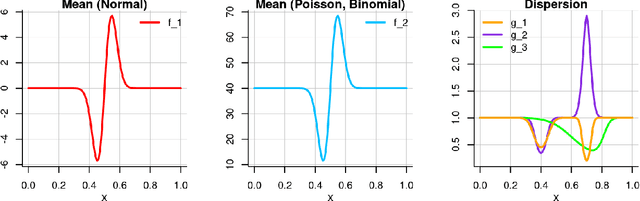
Even though dropout is a popular regularization technique, its theoretical properties are not fully understood. In this paper we study dropout regularization in extended generalized linear models based on double exponential families, for which the dispersion parameter can vary with the features. A theoretical analysis shows that dropout regularization prefers rare but important features in both the mean and dispersion, generalizing an earlier result for conventional generalized linear models. Training is performed using stochastic gradient descent with adaptive learning rate. To illustrate, we apply dropout to adaptive smoothing with B-splines, where both the mean and dispersion parameters are modelled flexibly. The important B-spline basis functions can be thought of as rare features, and we confirm in experiments that dropout is an effective form of regularization for mean and dispersion parameters that improves on a penalized maximum likelihood approach with an explicit smoothness penalty.