 Add to Chrome
 Add to Firefox
 Add to Edge
Bayesian meta-learning for modeling Alzheimer's disease progression
Jun 01, 2026
Predicting whether an individual with Alzheimer's disease will experience mild or severe disease progression is essential for personalized treatment. Typically, practitioners seek to predict the distribution of a discrete disease score, conditional on an individual's current MRI volume and their historical disease trajectory. Classical statistical regression models and single-task neural networks are not well-suited for this purpose because fitting separate models is infeasible (since each individual typically has few observations), while ignoring individual-level correlation leads to poor generalization. Meta-learning, in contrast, provides a natural avenue to dynamically predict distributions without retraining and model nonlinear relationships between the outcome and covariates. Motivated by this, we propose a Bayesian meta-learner that is trained on multiple individuals but tailors the predictive disease score distribution to each individual's historical data. Our model predicts on unseen individuals without retraining, scales linearly with the number of historical observations, and is guaranteed to be less overconfident when predicting long-term disease scores compared to its deterministic counterpart. On real-world data from the Alzheimer's Disease Neuroimaging Initiative (ADNI) database, our model achieves performance competitive with both single-task models and deterministic meta-learners, while substantially improving performance when predicting long-term disease progression.

Marginally calibrated response distributions for end-to-end learning in autonomous driving
Oct 03, 2021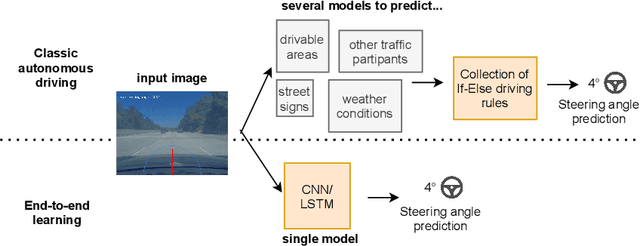
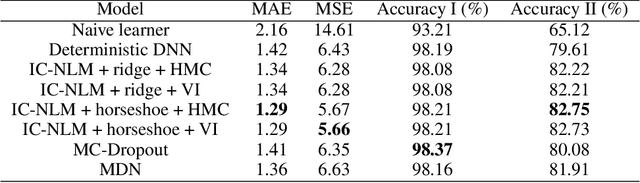
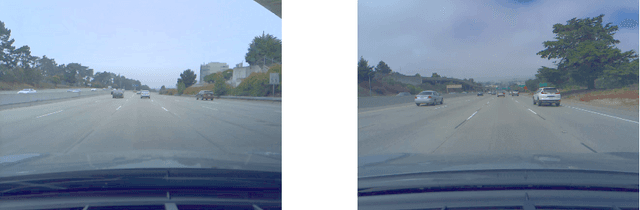
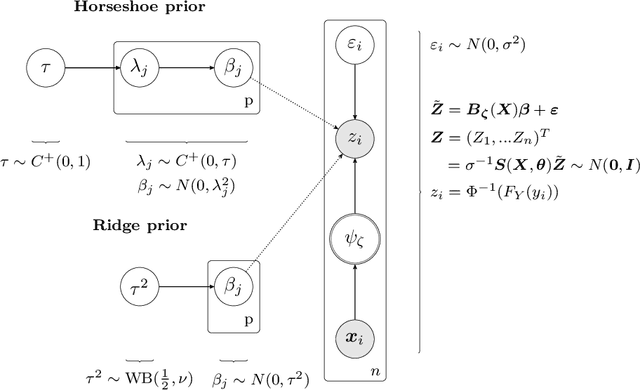
End-to-end learners for autonomous driving are deep neural networks that predict the instantaneous steering angle directly from images of the ahead-lying street. These learners must provide reliable uncertainty estimates for their predictions in order to meet safety requirements and initiate a switch to manual control in areas of high uncertainty. Yet end-to-end learners typically only deliver point predictions, since distributional predictions are associated with large increases in training time or additional computational resources during prediction. To address this shortcoming we investigate efficient and scalable approximate inference for the implicit copula neural linear model of Klein, Nott and Smith (2021) in order to quantify uncertainty for the predictions of end-to-end learners. The result are densities for the steering angle that are marginally calibrated, i.e.~the average of the estimated densities equals the empirical distribution of steering angles. To ensure the scalability to large $n$ regimes, we develop efficient estimation based on variational inference as a fast alternative to computationally intensive, exact inference via Hamiltonian Monte Carlo. We demonstrate the accuracy and speed of the variational approach in comparison to Hamiltonian Monte Carlo on two end-to-end learners trained for highway driving using the comma2k19 data set. The implicit copula neural linear model delivers accurate calibration, high-quality prediction intervals and allows to identify overconfident learners. Our approach also contributes to the explainability of black-box end-to-end learners, since predictive densities can be used to understand which steering actions the end-to-end learner sees as valid.