 Add to Chrome
 Add to Firefox
 Add to Edge
GISTBench: Evaluating LLM User Understanding via Evidence-Based Interest Verification
Mar 31, 2026
We introduce GISTBench, a benchmark for evaluating Large Language Models' (LLMs) ability to understand users from their interaction histories in recommendation systems. Unlike traditional RecSys benchmarks that focus on item prediction accuracy, our benchmark evaluates how well LLMs can extract and verify user interests from engagement data. We propose two novel metric families: Interest Groundedness (IG), decomposed into precision and recall components to separately penalize hallucinated interest categories and reward coverage, and Interest Specificity (IS), which assesses the distinctiveness of verified LLM-predicted user profiles. We release a synthetic dataset constructed on real user interactions on a global short-form video platform. Our dataset contains both implicit and explicit engagement signals and rich textual descriptions. We validate our dataset fidelity against user surveys, and evaluate eight open-weight LLMs spanning 7B to 120B parameters. Our findings reveal performance bottlenecks in current LLMs, particularly their limited ability to accurately count and attribute engagement signals across heterogeneous interaction types.

SplitFlow: Flow Decomposition for Inversion-Free Text-to-Image Editing
Oct 29, 2025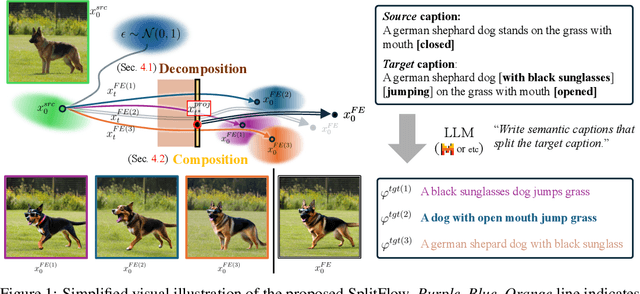
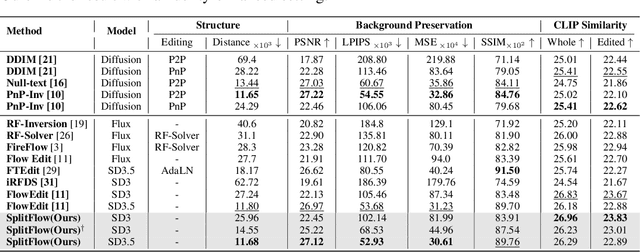
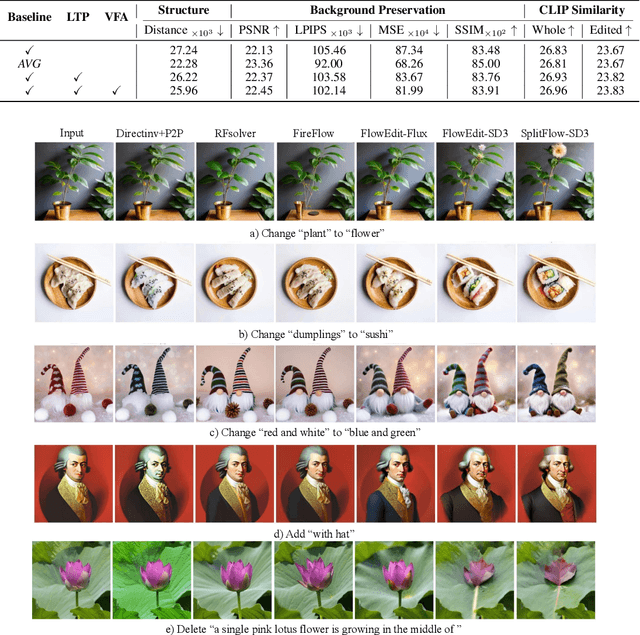
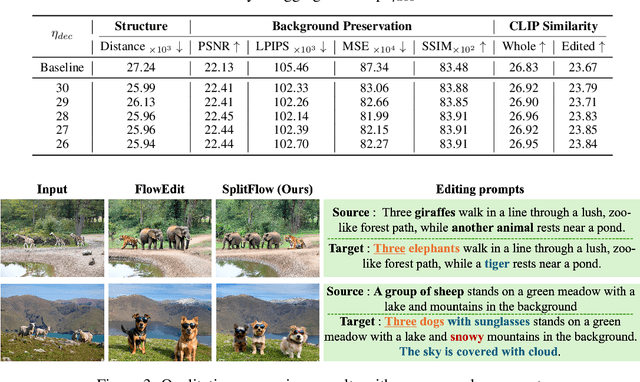
Rectified flow models have become a de facto standard in image generation due to their stable sampling trajectories and high-fidelity outputs. Despite their strong generative capabilities, they face critical limitations in image editing tasks: inaccurate inversion processes for mapping real images back into the latent space, and gradient entanglement issues during editing often result in outputs that do not faithfully reflect the target prompt. Recent efforts have attempted to directly map source and target distributions via ODE-based approaches without inversion; however,these methods still yield suboptimal editing quality. In this work, we propose a flow decomposition-and-aggregation framework built upon an inversion-free formulation to address these limitations. Specifically, we semantically decompose the target prompt into multiple sub-prompts, compute an independent flow for each, and aggregate them to form a unified editing trajectory. While we empirically observe that decomposing the original flow enhances diversity in the target space, generating semantically aligned outputs still requires consistent guidance toward the full target prompt. To this end, we design a projection and soft-aggregation mechanism for flow, inspired by gradient conflict resolution in multi-task learning. This approach adaptively weights the sub-target velocity fields, suppressing semantic redundancy while emphasizing distinct directions, thereby preserving both diversity and consistency in the final edited output. Experimental results demonstrate that our method outperforms existing zero-shot editing approaches in terms of semantic fidelity and attribute disentanglement. The code is available at https://github.com/Harvard-AI-and-Robotics-Lab/SplitFlow.