 Add to Chrome
 Add to Firefox
 Add to Edge
Arbor: Tree Search as a Cognition Layer for Autonomous Agents
Jun 10, 2026
Arbor is a multi-agent framework that introduces structured tree search as a cognition layer for autonomous agents operating in large, stateful action spaces. Prior autonomous optimization systems operate on isolated targets with stateless evaluation. Arbor instead maintains an explicit search tree of scored hypotheses that serves as the shared working memory across agents, evolving with every measurement, treating failures as diagnostic signal that reshapes subsequent exploration, and expanding as prior successes shift the bottleneck distribution. We validate Arbor on full-stack LLM inference optimization, a domain where achieving peak performance has historically required coordinated effort from engineering teams across the application, framework, compiler, kernel, and hardware stack. Arbor pairs an Orchestrator agent, which drives optimization by delegating to Domain Specialists across the inference stack, with a Critic agent that safeguards stability through root-cause analysis, introspection, and measurement validation -- a checks-and-balances architecture where neither agent can unilaterally drive the system. Agent capabilities are decomposed into hard skills (domain expertise) and soft skills (coordination protocols that determine how contributions compose), enabling fully autonomous multi-day campaigns. Arbor achieves up to 193% inference throughput-latency Pareto improvement over vendor-optimized baselines, while a single agent without the harness plateaus at +33% throughput improvement and crashes irrecoverably within hours. Arbor generalizes to multiple generations of hardware platform, and run-to-run variance is within 2 percentage points demonstrating that the method is hardware-agnostic and reproducible.

Yi-Lightning Technical Report
Dec 03, 2024


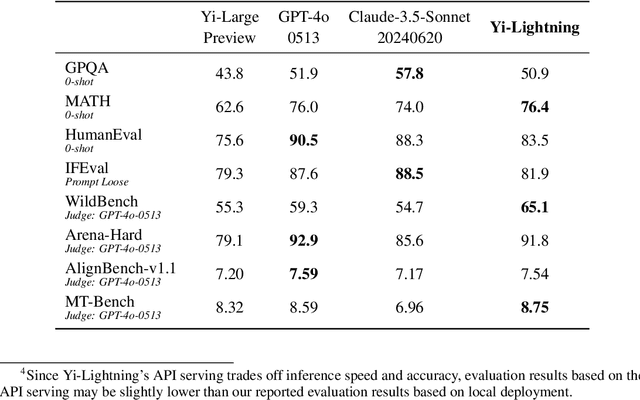
This technical report presents Yi-Lightning, our latest flagship large language model (LLM). It achieves exceptional performance, ranking 6th overall on Chatbot Arena, with particularly strong results (2nd to 4th place) in specialized categories including Chinese, Math, Coding, and Hard Prompts. Yi-Lightning leverages an enhanced Mixture-of-Experts (MoE) architecture, featuring advanced expert segmentation and routing mechanisms coupled with optimized KV-caching techniques. Our development process encompasses comprehensive pre-training, supervised fine-tuning (SFT), and reinforcement learning from human feedback (RLHF), where we devise deliberate strategies for multi-stage training, synthetic data construction, and reward modeling. Furthermore, we implement RAISE (Responsible AI Safety Engine), a four-component framework to address safety issues across pre-training, post-training, and serving phases. Empowered by our scalable super-computing infrastructure, all these innovations substantially reduce training, deployment and inference costs while maintaining high-performance standards. With further evaluations on public academic benchmarks, Yi-Lightning demonstrates competitive performance against top-tier LLMs, while we observe a notable disparity between traditional, static benchmark results and real-world, dynamic human preferences. This observation prompts a critical reassessment of conventional benchmarks' utility in guiding the development of more intelligent and powerful AI systems for practical applications. Yi-Lightning is now available through our developer platform at https://platform.lingyiwanwu.com.
Generative modeling of Sparse Approximate Inverse Preconditioners
May 17, 2024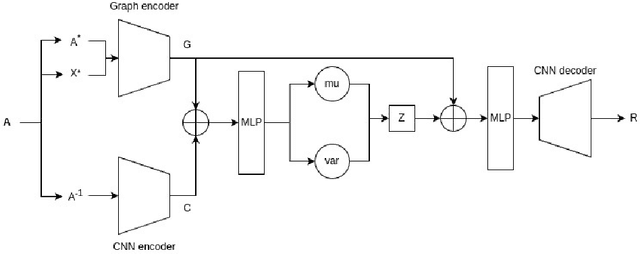
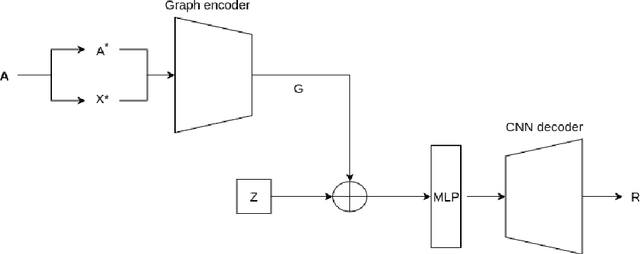
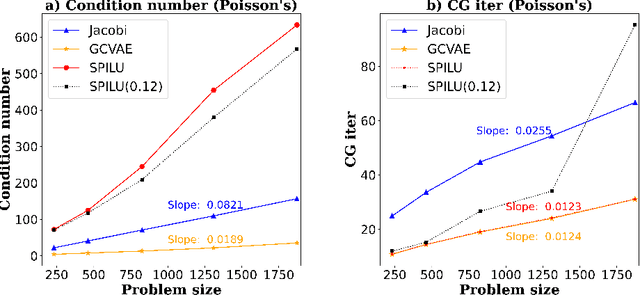
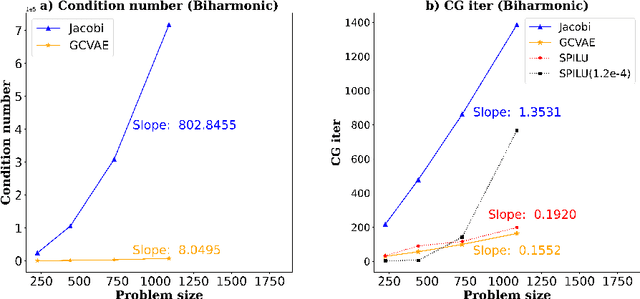
We present a new deep learning paradigm for the generation of sparse approximate inverse (SPAI) preconditioners for matrix systems arising from the mesh-based discretization of elliptic differential operators. Our approach is based upon the observation that matrices generated in this manner are not arbitrary, but inherit properties from differential operators that they discretize. Consequently, we seek to represent a learnable distribution of high-performance preconditioners from a low-dimensional subspace through a carefully-designed autoencoder, which is able to generate SPAI preconditioners for these systems. The concept has been implemented on a variety of finite element discretizations of second- and fourth-order elliptic partial differential equations with highly promising results.