 Add to Chrome
 Add to Firefox
 Add to Edge
Partial Motion Imitation for Learning Cart Pushing with Legged Manipulators
Mar 27, 2026
Loco-manipulation is a key capability for legged robots to perform practical mobile manipulation tasks, such as transporting and pushing objects, in real-world environments. However, learning robust loco-manipulation skills remains challenging due to the difficulty of maintaining stable locomotion while simultaneously performing precise manipulation behaviors. This work proposes a partial imitation learning approach that transfers the locomotion style learned from a locomotion task to cart loco-manipulation. A robust locomotion policy is first trained with extensive domain and terrain randomization, and a loco-manipulation policy is then learned by imitating only lower-body motions using a partial adversarial motion prior. We conduct experiments demonstrating that the learned policy successfully pushes a cart along diverse trajectories in IsaacLab and transfers effectively to MuJoCo. We also compare our method to several baselines and show that the proposed approach achieves more stable and accurate loco-manipulation behaviors.

AdaptManip: Learning Adaptive Whole-Body Object Lifting and Delivery with Online Recurrent State Estimation
Feb 16, 2026This paper presents Adaptive Whole-body Loco-Manipulation, AdaptManip, a fully autonomous framework for humanoid robots to perform integrated navigation, object lifting, and delivery. Unlike prior imitation learning-based approaches that rely on human demonstrations and are often brittle to disturbances, AdaptManip aims to train a robust loco-manipulation policy via reinforcement learning without human demonstrations or teleoperation data. The proposed framework consists of three coupled components: (1) a recurrent object state estimator that tracks the manipulated object in real time under limited field-of-view and occlusions; (2) a whole-body base policy for robust locomotion with residual manipulation control for stable object lifting and delivery; and (3) a LiDAR-based robot global position estimator that provides drift-robust localization. All components are trained in simulation using reinforcement learning and deployed on real hardware in a zero-shot manner. Experimental results show that AdaptManip significantly outperforms baseline methods, including imitation learning-based approaches, in adaptability and overall success rate, while accurate object state estimation improves manipulation performance even under occlusion. We further demonstrate fully autonomous real-world navigation, object lifting, and delivery on a humanoid robot.
Unsupervised Skill Discovery as Exploration for Learning Agile Locomotion
Aug 12, 2025Exploration is crucial for enabling legged robots to learn agile locomotion behaviors that can overcome diverse obstacles. However, such exploration is inherently challenging, and we often rely on extensive reward engineering, expert demonstrations, or curriculum learning - all of which limit generalizability. In this work, we propose Skill Discovery as Exploration (SDAX), a novel learning framework that significantly reduces human engineering effort. SDAX leverages unsupervised skill discovery to autonomously acquire a diverse repertoire of skills for overcoming obstacles. To dynamically regulate the level of exploration during training, SDAX employs a bi-level optimization process that autonomously adjusts the degree of exploration. We demonstrate that SDAX enables quadrupedal robots to acquire highly agile behaviors including crawling, climbing, leaping, and executing complex maneuvers such as jumping off vertical walls. Finally, we deploy the learned policy on real hardware, validating its successful transfer to the real world.
PrivilegedDreamer: Explicit Imagination of Privileged Information for Rapid Adaptation of Learned Policies
Feb 17, 2025Numerous real-world control problems involve dynamics and objectives affected by unobservable hidden parameters, ranging from autonomous driving to robotic manipulation, which cause performance degradation during sim-to-real transfer. To represent these kinds of domains, we adopt hidden-parameter Markov decision processes (HIP-MDPs), which model sequential decision problems where hidden variables parameterize transition and reward functions. Existing approaches, such as domain randomization, domain adaptation, and meta-learning, simply treat the effect of hidden parameters as additional variance and often struggle to effectively handle HIP-MDP problems, especially when the rewards are parameterized by hidden variables. We introduce Privileged-Dreamer, a model-based reinforcement learning framework that extends the existing model-based approach by incorporating an explicit parameter estimation module. PrivilegedDreamer features its novel dual recurrent architecture that explicitly estimates hidden parameters from limited historical data and enables us to condition the model, actor, and critic networks on these estimated parameters. Our empirical analysis on five diverse HIP-MDP tasks demonstrates that PrivilegedDreamer outperforms state-of-the-art model-based, model-free, and domain adaptation learning algorithms. Additionally, we conduct ablation studies to justify the inclusion of each component in the proposed architecture.
Understanding Expectations for a Robotic Guide Dog for Visually Impaired People
Jan 08, 2025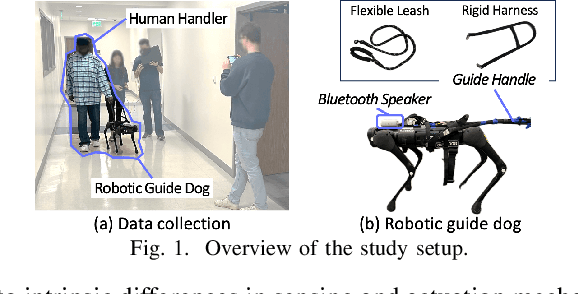
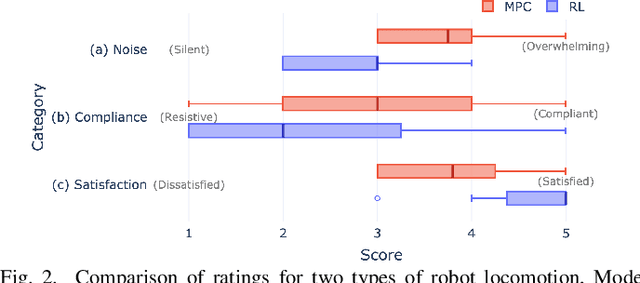
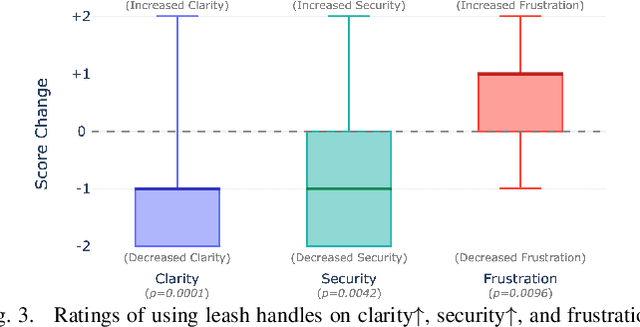
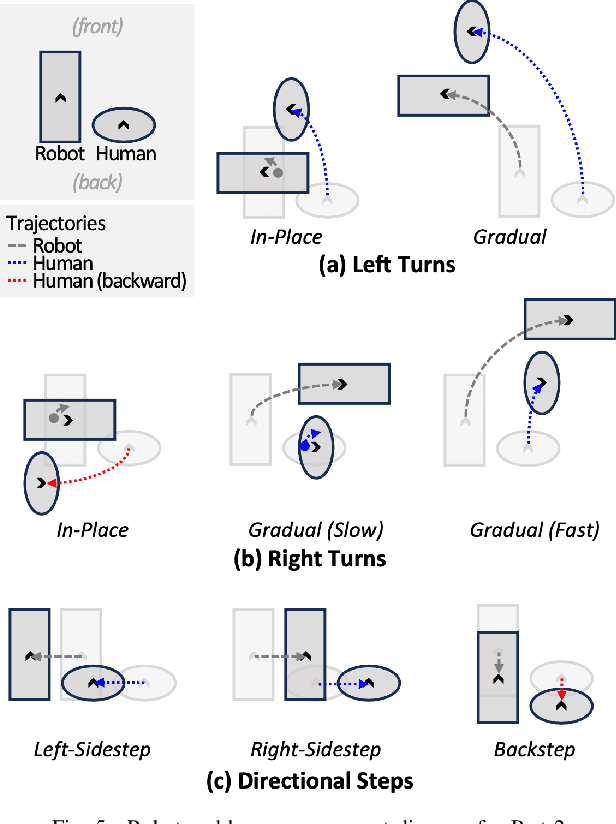
Robotic guide dogs hold significant potential to enhance the autonomy and mobility of blind or visually impaired (BVI) individuals by offering universal assistance over unstructured terrains at affordable costs. However, the design of robotic guide dogs remains underexplored, particularly in systematic aspects such as gait controllers, navigation behaviors, interaction methods, and verbal explanations. Our study addresses this gap by conducting user studies with 18 BVI participants, comprising 15 cane users and three guide dog users. Participants interacted with a quadrupedal robot and provided both quantitative and qualitative feedback. Our study revealed several design implications, such as a preference for a learning-based controller and a rigid handle, gradual turns with asymmetric speeds, semantic communication methods, and explainability. The study also highlighted the importance of customization to support users with diverse backgrounds and preferences, along with practical concerns such as battery life, maintenance, and weather issues. These findings offer valuable insights and design implications for future research and development of robotic guide dogs.