 Add to Chrome
 Add to Firefox
 Add to Edge
UGV-Conditioned Multi-UAV Informative Planning on a Shared Exposure Belief
Jun 10, 2026
Safe ground navigation in large, threat-augmented environments requires aerial support that actively reduces the risks that a ground vehicle faces along its route. Existing aerial reconnaissance systems focus on mapping or covering the environment, but do not direct sensing toward regions that are most relevant for ground vehicle safety. In this paper, we address the problem of coordinating a team of unmanned aerial vehicles (UAVs) to improve the safety of an unmanned ground vehicle (UGV) navigating through unknown threat zones. A key aspect of our approach is a shared exposure belief that is updated online from aerial observations and used jointly by the UAV team and the ground vehicle. This enables us to direct aerial sensing towards route-relevant regions while allowing the UGV to replan around newly revealed threats. We coordinate the UAV team through spatial region assignment to avoid redundant sensing. Simulation experiments show that our approach reduces cumulative UGV exposure by 38% compared to a system that does not account for hazard levels, and reduces redundant aerial coverage from 38.8% to 3.7% under our multi-UAV coordination scheme.

EAAE: Energy-Aware Autonomous Exploration for UAVs in Unknown 3D Environments
Mar 16, 2026Battery-powered multirotor unmanned aerial vehicles (UAVs) can rapidly map unknown environments, but mission performance is often limited by energy rather than geometry alone. Standard exploration policies that optimise for coverage or time can therefore waste energy through manoeuvre-heavy trajectories. In this paper, we address energy-aware autonomous 3D exploration for multirotor UAVs in initially unknown environments. We propose Energy-Aware Autonomous Exploration (EAAE), a modular frontier-based framework that makes energy an explicit decision variable during frontier selection. EAAE clusters frontiers into view-consistent regions, plans dynamically feasible candidate trajectories to the most informative clusters, and predicts their execution energy using an offline power estimation loop. The next target is then selected by minimising predicted trajectory energy while preserving exploration progress through a dual-layer planning architecture for safe execution. We evaluate EAAE in a full exploration pipeline with a rotor-speed-based power model across simulated 3D environments of increasing complexity. Compared to representative distance-based and information gain-based frontier baselines, EAAE consistently reduces total energy consumption while maintaining competitive exploration time and comparable map quality, providing a practical drop-in energy-aware layer for frontier exploration.
Perception-Aware Autonomous Exploration in Feature-Limited Environments
Mar 16, 2026Autonomous exploration in unknown environments typically relies on onboard state estimation for localisation and mapping. Existing exploration methods primarily maximise coverage efficiency, but often overlook that visual-inertial odometry (VIO) performance strongly depends on the availability of robust visual features. As a result, exploration policies can drive a robot into feature-sparse regions where tracking degrades, leading to odometry drift, corrupted maps, and mission failure. We propose a hierarchical perception-aware exploration framework for a stereo-equipped unmanned aerial vehicle (UAV) that explicitly couples exploration progress with feature observability. Our approach (i) associates each candidate frontier with an expected feature quality using a global feature map, and prioritises visually informative subgoals, and (ii) optimises a continuous yaw trajectory along the planned motion to maintain stable feature tracks. We evaluate our method in simulation across environments with varying texture levels and in real-world indoor experiments with largely textureless walls. Compared to baselines that ignore feature quality and/or do not optimise continuous yaw, our method maintains more reliable feature tracking, reduces odometry drift, and achieves on average 30\% higher coverage before the odometry error exceeds specified thresholds.
Learning Humanoid Locomotion with Perceptive Internal Model
Nov 21, 2024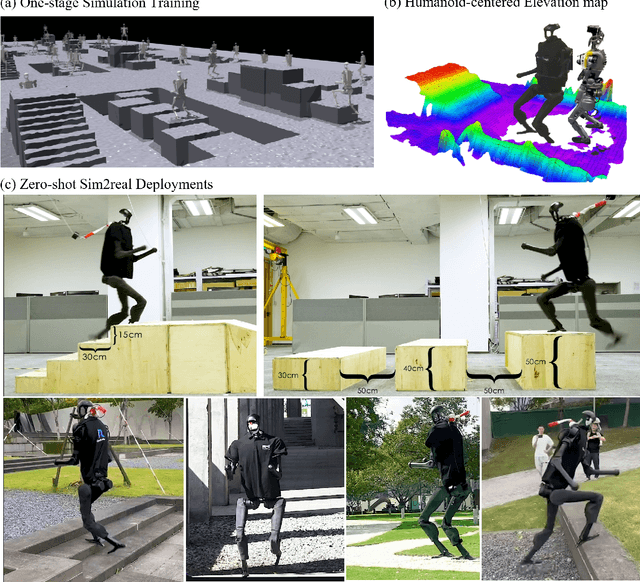
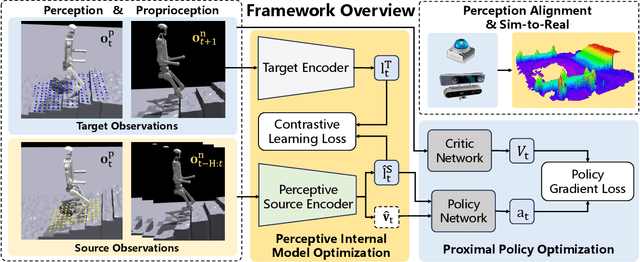
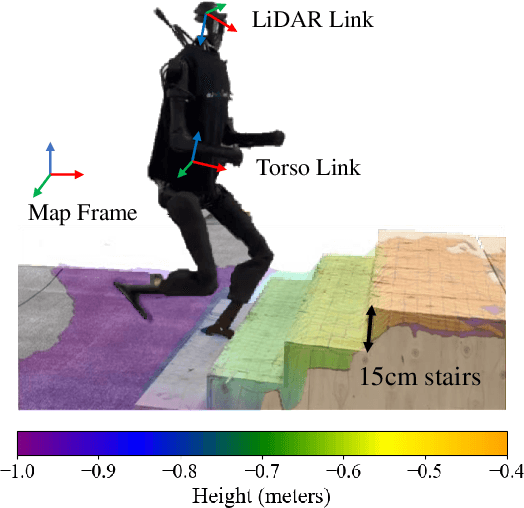
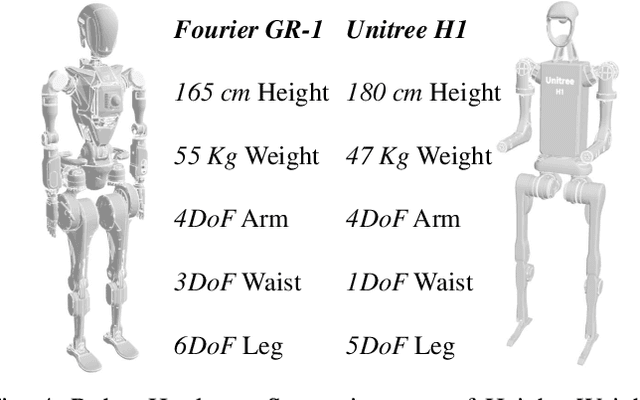
In contrast to quadruped robots that can navigate diverse terrains using a "blind" policy, humanoid robots require accurate perception for stable locomotion due to their high degrees of freedom and inherently unstable morphology. However, incorporating perceptual signals often introduces additional disturbances to the system, potentially reducing its robustness, generalizability, and efficiency. This paper presents the Perceptive Internal Model (PIM), which relies on onboard, continuously updated elevation maps centered around the robot to perceive its surroundings. We train the policy using ground-truth obstacle heights surrounding the robot in simulation, optimizing it based on the Hybrid Internal Model (HIM), and perform inference with heights sampled from the constructed elevation map. Unlike previous methods that directly encode depth maps or raw point clouds, our approach allows the robot to perceive the terrain beneath its feet clearly and is less affected by camera movement or noise. Furthermore, since depth map rendering is not required in simulation, our method introduces minimal additional computational costs and can train the policy in 3 hours on an RTX 4090 GPU. We verify the effectiveness of our method across various humanoid robots, various indoor and outdoor terrains, stairs, and various sensor configurations. Our method can enable a humanoid robot to continuously climb stairs and has the potential to serve as a foundational algorithm for the development of future humanoid control methods.
Decentralized Multi-Agent Trajectory Planning in Dynamic Environments with Spatiotemporal Occupancy Grid Maps
Apr 24, 2024This paper proposes a decentralized trajectory planning framework for the collision avoidance problem of multiple micro aerial vehicles (MAVs) in environments with static and dynamic obstacles. The framework utilizes spatiotemporal occupancy grid maps (SOGM), which forecast the occupancy status of neighboring space in the near future, as the environment representation. Based on this representation, we extend the kinodynamic A* and the corridor-constrained trajectory optimization algorithms to efficiently tackle static and dynamic obstacles with arbitrary shapes. Collision avoidance between communicating robots is integrated by sharing planned trajectories and projecting them onto the SOGM. The simulation results show that our method achieves competitive performance against state-of-the-art methods in dynamic environments with different numbers and shapes of obstacles. Finally, the proposed method is validated in real experiments.
Evaluating Dynamic Environment Difficulty for Obstacle Avoidance Benchmarking
Apr 23, 2024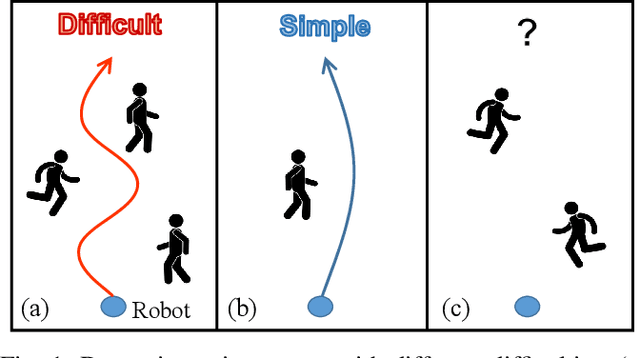
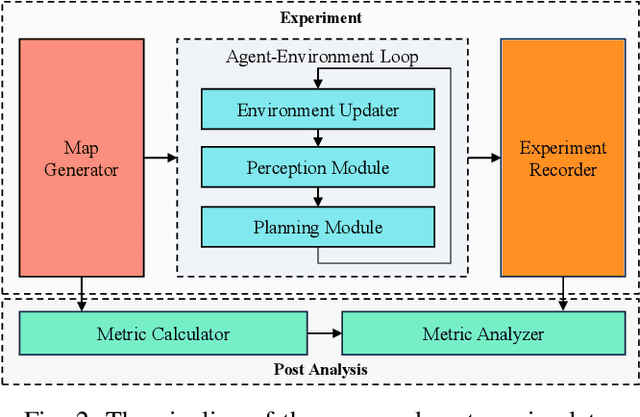
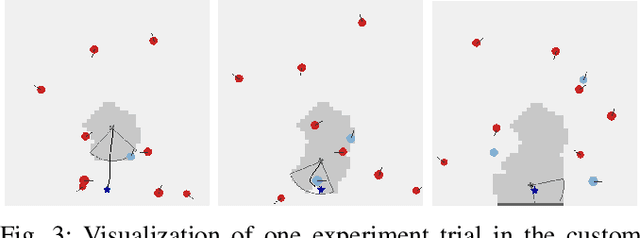
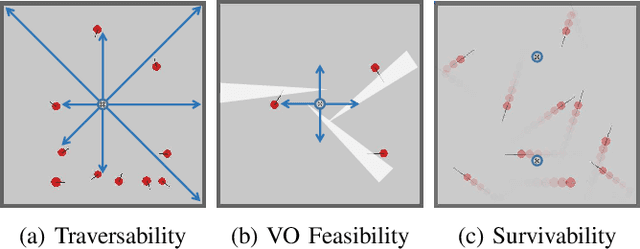
Dynamic obstacle avoidance is a popular research topic for autonomous systems, such as micro aerial vehicles and service robots. Accurately evaluating the performance of dynamic obstacle avoidance methods necessitates the establishment of a metric to quantify the environment's difficulty, a crucial aspect that remains unexplored. In this paper, we propose four metrics to measure the difficulty of dynamic environments. These metrics aim to comprehensively capture the influence of obstacles' number, size, velocity, and other factors on the difficulty. We compare the proposed metrics with existing static environment difficulty metrics and validate them through over 1.5 million trials in a customized simulator. This simulator excludes the effects of perception and control errors and supports different motion and gaze planners for obstacle avoidance. The results indicate that the survivability metric outperforms and establishes a monotonic relationship between the success rate, with a Spearman's Rank Correlation Coefficient (SRCC) of over 0.9. Specifically, for every planner, lower survivability leads to a higher success rate. This metric not only facilitates fair and comprehensive benchmarking but also provides insights for refining collision avoidance methods, thereby furthering the evolution of autonomous systems in dynamic environments.