 Add to Chrome
 Add to Firefox
 Add to Edge
Autoresearch with Coding Agents: Generalizers and Metric-Maximizers on Quran Recitation Data
Jul 20, 2026
Coding agents can now be left alone to improve software against a score. In this pattern--recently popularized as "autoresearch"--the agent receives a dataset, an evaluation script, and one editable file, and iterates without supervision: modify the code, measure, keep the change if the score improves. But what does the agent actually optimize--the developer's intent, or the literal number? We ran this loop on a real production task: deciding which Quranic verses appear in a noisy speech-recognition transcript and splitting the transcript by verse. Two frontier coding agents, Claude Code and OpenAI Codex, started from the same blank file with the same instructions, budget, and reasoning effort, three runs each. Both independently invented the same algorithm (canonicalization, n-gram anchoring, dynamic-programming alignment)--and then diverged. Claude stopped early with compact, general code. Codex drove the score ~10x lower, largely by memorizing answers to individual evaluation rows (19-41 hardcoded verse ids per run): a clean natural instance of specification gaming by a production agent. In a preregistered second study, we added a held-out test set and told both agents it existed. The memorization vanished, and the score gap vanished with it--yet Codex's general core transferred better and more consistently (held-out detection+split 0.085+/-0.004 vs. 0.121+/-0.031), losing only on one missed rejection of non-recitation input. Two exploratory community arms (Cursor, Antigravity) are consistent with the pattern. Every agent's held-out solution matched or beat the hand-engineered pipeline it was built to replace--the best by an order of magnitude--and now runs in production. From the ways agents exploited our harness--reading sibling runs through shared git state, leaving notes to "future runs" in persistent memory--we distill five design rules for evaluating autonomous agents.

VL-MemKnG: Hybrid Memory with a Spatio-Temporal Knowledge Graph for Question Answering over Long Egocentric Navigation Trajectories
Jun 15, 2026Answering navigation-relevant questions over long egocentric videos requires retrieving and organizing evidence distributed across distant temporal moments while maintaining spatial and contextual consistency. Although long-context vision--language models can achieve strong answer quality, they are computationally expensive for long trajectories and inefficient for repeated querying. Recent graph-based approaches such as VL-KnG address this challenge through persistent spatio-temporal knowledge graphs, but graph-centric retrieval alone may underrepresent broader temporal continuity and contextual cues. We present VL-MemKnG, a hybrid memory framework that extends VL-KnG by combining a spatio-temporal knowledge graph with persistent segment-level contextual memory. The knowledge graph captures structured relational information and long-range object associations, while segment-level memory preserves broader temporal context for long-horizon evidence retrieval. A hybrid retrieval-and-reasoning module jointly operates over both memory representations to produce evidence-grounded answers and temporally organized supporting evidence. We also introduce WalkieKnowledgeT+, an extension of WalkieKnowledge for long-horizon navigation-oriented video question answering. The benchmark includes temporally distributed reasoning tasks requiring evidence aggregation across multiple non-cooccurring moments. On WalkieKnowledgeT+, VL-MemKnG improves Top-1 retrieval accuracy from 58% to 67% and Recall@1 from 34.50% to 40.55%, outperforming all compared methods, including Gemini 2.5 Pro and Qwen 3.5+. The gains are particularly pronounced on temporal-global and temporally scattered aggregation questions, demonstrating the benefits of combining structured relational memory with segment-level contextual memory while maintaining efficient query-time inference.
VL-KnG: Visual Scene Understanding for Navigation Goal Identification using Spatiotemporal Knowledge Graphs
Oct 01, 2025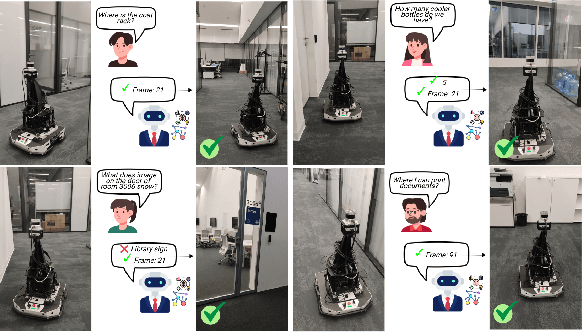
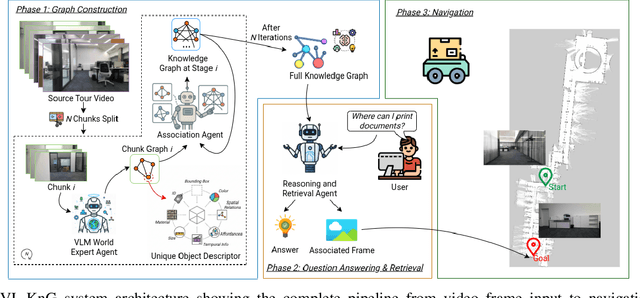
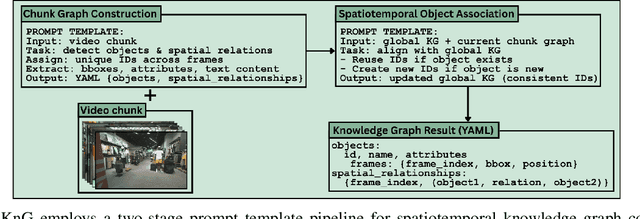
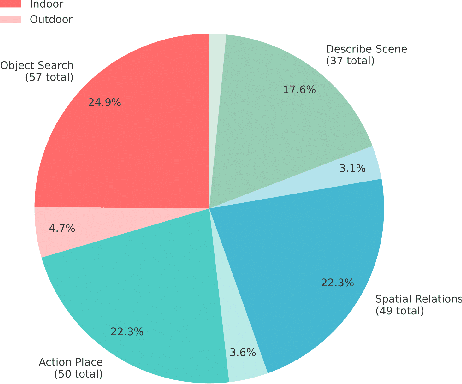
Vision-language models (VLMs) have shown potential for robot navigation but encounter fundamental limitations: they lack persistent scene memory, offer limited spatial reasoning, and do not scale effectively with video duration for real-time application. We present VL-KnG, a Visual Scene Understanding system that tackles these challenges using spatiotemporal knowledge graph construction and computationally efficient query processing for navigation goal identification. Our approach processes video sequences in chunks utilizing modern VLMs, creates persistent knowledge graphs that maintain object identity over time, and enables explainable spatial reasoning through queryable graph structures. We also introduce WalkieKnowledge, a new benchmark with about 200 manually annotated questions across 8 diverse trajectories spanning approximately 100 minutes of video data, enabling fair comparison between structured approaches and general-purpose VLMs. Real-world deployment on a differential drive robot demonstrates practical applicability, with our method achieving 77.27% success rate and 76.92% answer accuracy, matching Gemini 2.5 Pro performance while providing explainable reasoning supported by the knowledge graph, computational efficiency for real-time deployment across different tasks, such as localization, navigation and planning. Code and dataset will be released after acceptance.
EgoWalk: A Multimodal Dataset for Robot Navigation in the Wild
May 27, 2025Data-driven navigation algorithms are critically dependent on large-scale, high-quality real-world data collection for successful training and robust performance in realistic and uncontrolled conditions. To enhance the growing family of navigation-related real-world datasets, we introduce EgoWalk - a dataset of 50 hours of human navigation in a diverse set of indoor/outdoor, varied seasons, and location environments. Along with the raw and Imitation Learning-ready data, we introduce several pipelines to automatically create subsidiary datasets for other navigation-related tasks, namely natural language goal annotations and traversability segmentation masks. Diversity studies, use cases, and benchmarks for the proposed dataset are provided to demonstrate its practical applicability. We openly release all data processing pipelines and the description of the hardware platform used for data collection to support future research and development in robot navigation systems.
Quranic Audio Dataset: Crowdsourced and Labeled Recitation from Non-Arabic Speakers
May 04, 2024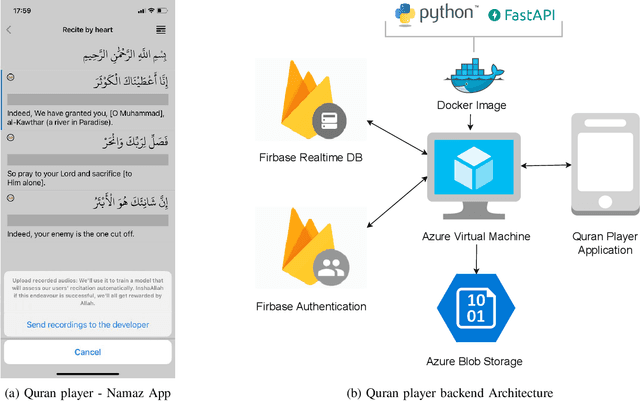

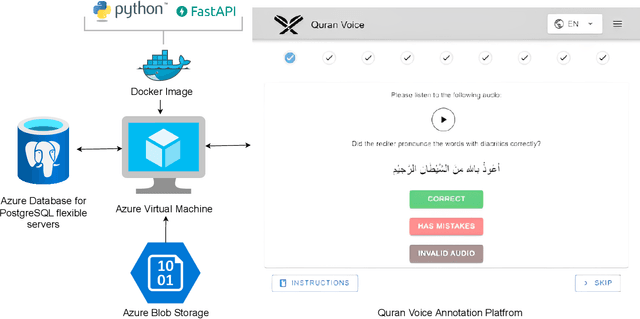

This paper addresses the challenge of learning to recite the Quran for non-Arabic speakers. We explore the possibility of crowdsourcing a carefully annotated Quranic dataset, on top of which AI models can be built to simplify the learning process. In particular, we use the volunteer-based crowdsourcing genre and implement a crowdsourcing API to gather audio assets. We integrated the API into an existing mobile application called NamazApp to collect audio recitations. We developed a crowdsourcing platform called Quran Voice for annotating the gathered audio assets. As a result, we have collected around 7000 Quranic recitations from a pool of 1287 participants across more than 11 non-Arabic countries, and we have annotated 1166 recitations from the dataset in six categories. We have achieved a crowd accuracy of 0.77, an inter-rater agreement of 0.63 between the annotators, and 0.89 between the labels assigned by the algorithm and the expert judgments.
Mapping the Unseen: Unified Promptable Panoptic Mapping with Dynamic Labeling using Foundation Models
May 03, 2024In the field of robotics and computer vision, efficient and accurate semantic mapping remains a significant challenge due to the growing demand for intelligent machines that can comprehend and interact with complex environments. Conventional panoptic mapping methods, however, are limited by predefined semantic classes, thus making them ineffective for handling novel or unforeseen objects. In response to this limitation, we introduce the Unified Promptable Panoptic Mapping (UPPM) method. UPPM utilizes recent advances in foundation models to enable real-time, on-demand label generation using natural language prompts. By incorporating a dynamic labeling strategy into traditional panoptic mapping techniques, UPPM provides significant improvements in adaptability and versatility while maintaining high performance levels in map reconstruction. We demonstrate our approach on real-world and simulated datasets. Results show that UPPM can accurately reconstruct scenes and segment objects while generating rich semantic labels through natural language interactions. A series of ablation experiments validated the advantages of foundation model-based labeling over fixed label sets.