 Add to Chrome
 Add to Firefox
 Add to Edge
VL-MemKnG: Hybrid Memory with a Spatio-Temporal Knowledge Graph for Question Answering over Long Egocentric Navigation Trajectories
Jun 15, 2026
Answering navigation-relevant questions over long egocentric videos requires retrieving and organizing evidence distributed across distant temporal moments while maintaining spatial and contextual consistency. Although long-context vision--language models can achieve strong answer quality, they are computationally expensive for long trajectories and inefficient for repeated querying. Recent graph-based approaches such as VL-KnG address this challenge through persistent spatio-temporal knowledge graphs, but graph-centric retrieval alone may underrepresent broader temporal continuity and contextual cues. We present VL-MemKnG, a hybrid memory framework that extends VL-KnG by combining a spatio-temporal knowledge graph with persistent segment-level contextual memory. The knowledge graph captures structured relational information and long-range object associations, while segment-level memory preserves broader temporal context for long-horizon evidence retrieval. A hybrid retrieval-and-reasoning module jointly operates over both memory representations to produce evidence-grounded answers and temporally organized supporting evidence. We also introduce WalkieKnowledgeT+, an extension of WalkieKnowledge for long-horizon navigation-oriented video question answering. The benchmark includes temporally distributed reasoning tasks requiring evidence aggregation across multiple non-cooccurring moments. On WalkieKnowledgeT+, VL-MemKnG improves Top-1 retrieval accuracy from 58% to 67% and Recall@1 from 34.50% to 40.55%, outperforming all compared methods, including Gemini 2.5 Pro and Qwen 3.5+. The gains are particularly pronounced on temporal-global and temporally scattered aggregation questions, demonstrating the benefits of combining structured relational memory with segment-level contextual memory while maintaining efficient query-time inference.

VL-KnG: Visual Scene Understanding for Navigation Goal Identification using Spatiotemporal Knowledge Graphs
Oct 01, 2025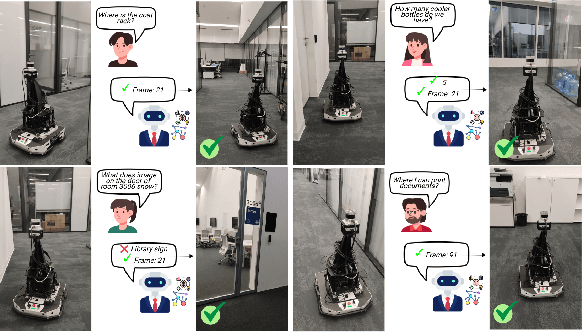
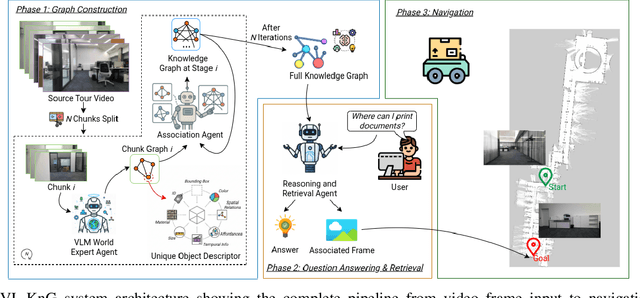
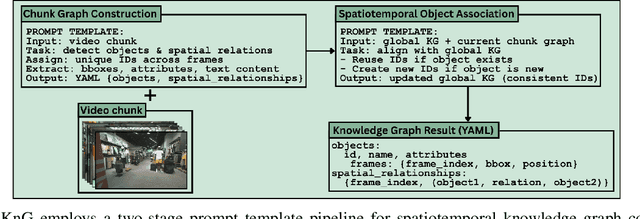
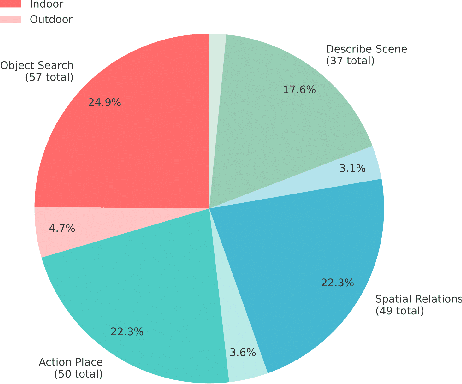
Vision-language models (VLMs) have shown potential for robot navigation but encounter fundamental limitations: they lack persistent scene memory, offer limited spatial reasoning, and do not scale effectively with video duration for real-time application. We present VL-KnG, a Visual Scene Understanding system that tackles these challenges using spatiotemporal knowledge graph construction and computationally efficient query processing for navigation goal identification. Our approach processes video sequences in chunks utilizing modern VLMs, creates persistent knowledge graphs that maintain object identity over time, and enables explainable spatial reasoning through queryable graph structures. We also introduce WalkieKnowledge, a new benchmark with about 200 manually annotated questions across 8 diverse trajectories spanning approximately 100 minutes of video data, enabling fair comparison between structured approaches and general-purpose VLMs. Real-world deployment on a differential drive robot demonstrates practical applicability, with our method achieving 77.27% success rate and 76.92% answer accuracy, matching Gemini 2.5 Pro performance while providing explainable reasoning supported by the knowledge graph, computational efficiency for real-time deployment across different tasks, such as localization, navigation and planning. Code and dataset will be released after acceptance.