 Add to Chrome
 Add to Firefox
 Add to Edge
MuViSeg: Multi-View Segment Correspondences from Dense Geometry Priors
Jul 20, 2026
Classical image correspondence is solved at the level of sparse keypoints or dense pixels, but the systems that consume these matches - object-level mapping, topological navigation, scene-graph maintenance - reason about whole objects. Recent work narrows this gap by matchng directly at the level of instance segments: a class-agnostic segmenter partitions each image, and per-segment descriptors are obtained by pooling features from large 3D foundation models over the masks. We build on this segment-level matching paradigm and propose three learned matching heads: a LightGlue-style attention head with DoubleSoftmax scoring on frozen MASt3R descriptors; a DPT-style multi-scale fusion module that exposes layered spatial detail from the VGGT foundation model before pooling; and - as our main contribution - a multi-view extension that performs joint self-attention over segments drawn from several views at once, recovering transitive correspondences that strictly pairwise matchers cannot reach. Under a stratified zero-shot protocol on Replica and Virtual KITTI 2 with controlled viewpoint baselines from 0 deg to 180 deg, the LightGlue-style head improves over a parameter-free Sinkhorn matcher on the same MASt3R backbone by +4.85 AUPRC on Replica and +25.9 AUPRC on Virtual KITTI 2. Dropped into the RoboHop topological navigation pipeline on the Habitat-Matterport 3D (HM3D) Instance Image Navigation benchmark without retraining, our multi-view variant raises success rate from 50% to 70%, and our LightGlue-style head raises SPL from 45.7 to 59.1.

PixelNav: Towards Model-based Vision-Only Navigation with Topological Graphs
Jul 28, 2025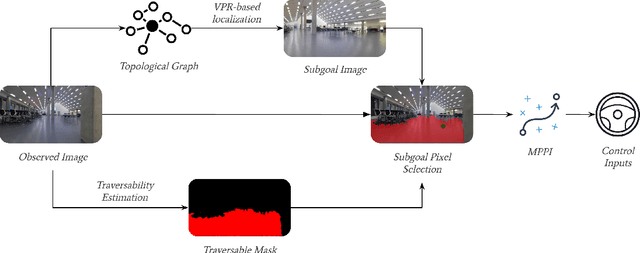
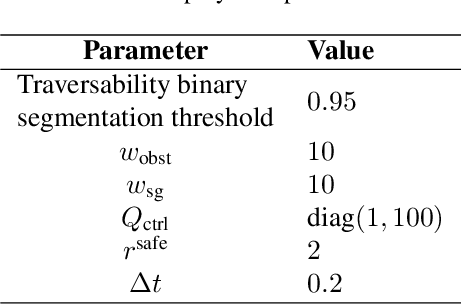
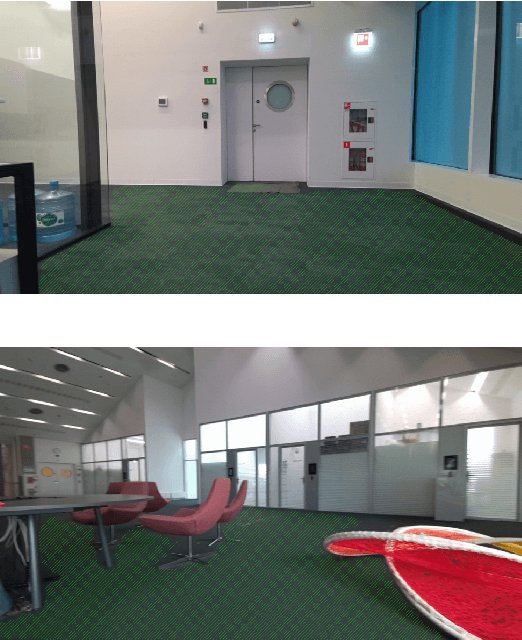
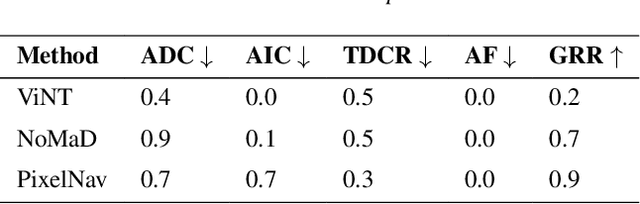
This work proposes a novel hybrid approach for vision-only navigation of mobile robots, which combines advances of both deep learning approaches and classical model-based planning algorithms. Today, purely data-driven end-to-end models are dominant solutions to this problem. Despite advantages such as flexibility and adaptability, the requirement of a large amount of training data and limited interpretability are the main bottlenecks for their practical applications. To address these limitations, we propose a hierarchical system that utilizes recent advances in model predictive control, traversability estimation, visual place recognition, and pose estimation, employing topological graphs as a representation of the target environment. Using such a combination, we provide a scalable system with a higher level of interpretability compared to end-to-end approaches. Extensive real-world experiments show the efficiency of the proposed method.
EgoWalk: A Multimodal Dataset for Robot Navigation in the Wild
May 27, 2025Data-driven navigation algorithms are critically dependent on large-scale, high-quality real-world data collection for successful training and robust performance in realistic and uncontrolled conditions. To enhance the growing family of navigation-related real-world datasets, we introduce EgoWalk - a dataset of 50 hours of human navigation in a diverse set of indoor/outdoor, varied seasons, and location environments. Along with the raw and Imitation Learning-ready data, we introduce several pipelines to automatically create subsidiary datasets for other navigation-related tasks, namely natural language goal annotations and traversability segmentation masks. Diversity studies, use cases, and benchmarks for the proposed dataset are provided to demonstrate its practical applicability. We openly release all data processing pipelines and the description of the hardware platform used for data collection to support future research and development in robot navigation systems.