 Add to Chrome
 Add to Firefox
 Add to Edge
Autoresearch with Coding Agents: Generalizers and Metric-Maximizers on Quran Recitation Data
Jul 20, 2026
Coding agents can now be left alone to improve software against a score. In this pattern--recently popularized as "autoresearch"--the agent receives a dataset, an evaluation script, and one editable file, and iterates without supervision: modify the code, measure, keep the change if the score improves. But what does the agent actually optimize--the developer's intent, or the literal number? We ran this loop on a real production task: deciding which Quranic verses appear in a noisy speech-recognition transcript and splitting the transcript by verse. Two frontier coding agents, Claude Code and OpenAI Codex, started from the same blank file with the same instructions, budget, and reasoning effort, three runs each. Both independently invented the same algorithm (canonicalization, n-gram anchoring, dynamic-programming alignment)--and then diverged. Claude stopped early with compact, general code. Codex drove the score ~10x lower, largely by memorizing answers to individual evaluation rows (19-41 hardcoded verse ids per run): a clean natural instance of specification gaming by a production agent. In a preregistered second study, we added a held-out test set and told both agents it existed. The memorization vanished, and the score gap vanished with it--yet Codex's general core transferred better and more consistently (held-out detection+split 0.085+/-0.004 vs. 0.121+/-0.031), losing only on one missed rejection of non-recitation input. Two exploratory community arms (Cursor, Antigravity) are consistent with the pattern. Every agent's held-out solution matched or beat the hand-engineered pipeline it was built to replace--the best by an order of magnitude--and now runs in production. From the ways agents exploited our harness--reading sibling runs through shared git state, leaving notes to "future runs" in persistent memory--we distill five design rules for evaluating autonomous agents.

Quranic Audio Dataset: Crowdsourced and Labeled Recitation from Non-Arabic Speakers
May 04, 2024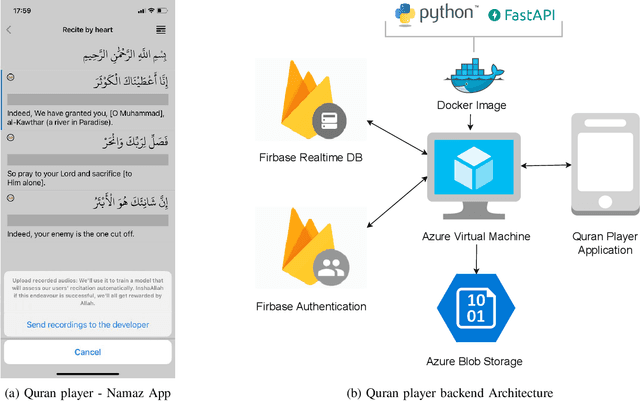

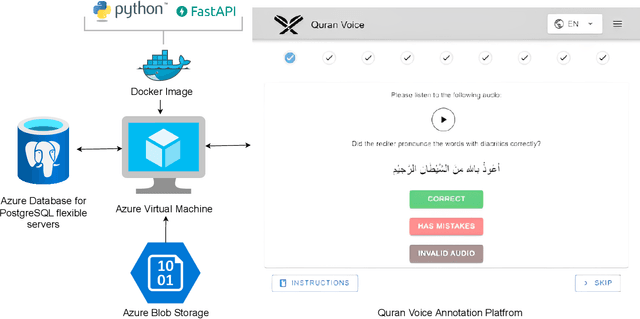

This paper addresses the challenge of learning to recite the Quran for non-Arabic speakers. We explore the possibility of crowdsourcing a carefully annotated Quranic dataset, on top of which AI models can be built to simplify the learning process. In particular, we use the volunteer-based crowdsourcing genre and implement a crowdsourcing API to gather audio assets. We integrated the API into an existing mobile application called NamazApp to collect audio recitations. We developed a crowdsourcing platform called Quran Voice for annotating the gathered audio assets. As a result, we have collected around 7000 Quranic recitations from a pool of 1287 participants across more than 11 non-Arabic countries, and we have annotated 1166 recitations from the dataset in six categories. We have achieved a crowd accuracy of 0.77, an inter-rater agreement of 0.63 between the annotators, and 0.89 between the labels assigned by the algorithm and the expert judgments.