 Add to Chrome
 Add to Firefox
 Add to Edge
Learning to Reason with Curriculum I: Provable Benefits of Autocurriculum
Mar 18, 2026
Chain-of-thought reasoning, where language models expend additional computation by producing thinking tokens prior to final responses, has driven significant advances in model capabilities. However, training these reasoning models is extremely costly in terms of both data and compute, as it involves collecting long traces of reasoning behavior from humans or synthetic generators and further post-training the model via reinforcement learning. Are these costs fundamental, or can they be reduced through better algorithmic design? We show that autocurriculum, where the model uses its own performance to decide which problems to focus training on, provably improves upon standard training recipes for both supervised fine-tuning (SFT) and reinforcement learning (RL). For SFT, we show that autocurriculum requires exponentially fewer reasoning demonstrations than non-adaptive fine-tuning, by focusing teacher supervision on prompts where the current model struggles. For RL fine-tuning, autocurriculum decouples the computational cost from the quality of the reference model, reducing the latter to a burn-in cost that is nearly independent of the target accuracy. These improvements arise purely from adaptive data selection, drawing on classical techniques from boosting and learning from counterexamples, and requiring no assumption on the distribution or difficulty of prompts.

PcLast: Discovering Plannable Continuous Latent States
Nov 06, 2023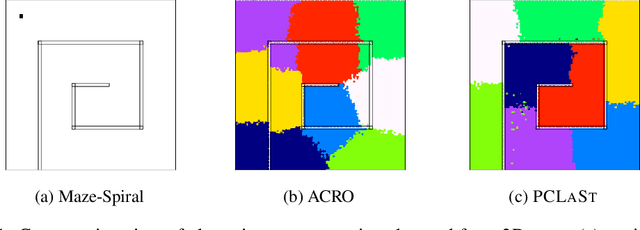
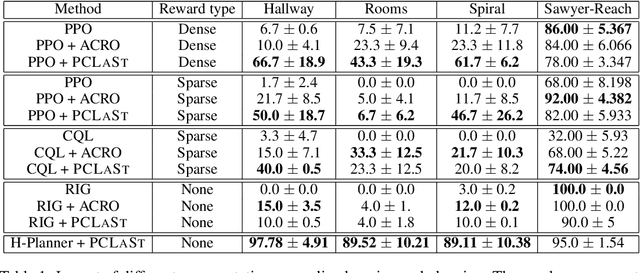
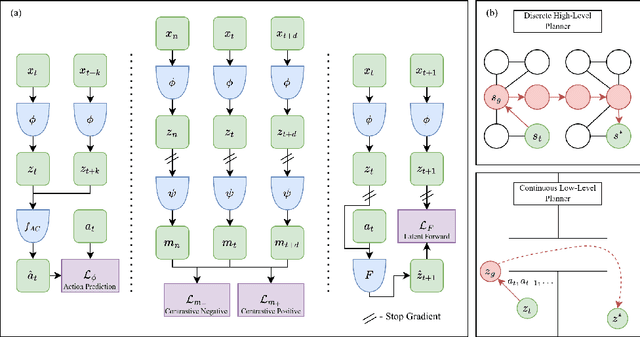
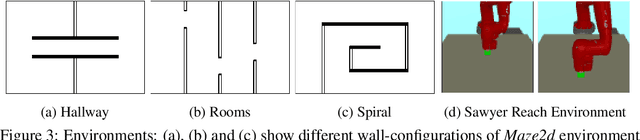
Goal-conditioned planning benefits from learned low-dimensional representations of rich, high-dimensional observations. While compact latent representations, typically learned from variational autoencoders or inverse dynamics, enable goal-conditioned planning they ignore state affordances, thus hampering their sample-efficient planning capabilities. In this paper, we learn a representation that associates reachable states together for effective onward planning. We first learn a latent representation with multi-step inverse dynamics (to remove distracting information); and then transform this representation to associate reachable states together in $\ell_2$ space. Our proposals are rigorously tested in various simulation testbeds. Numerical results in reward-based and reward-free settings show significant improvements in sampling efficiency, and yields layered state abstractions that enable computationally efficient hierarchical planning.