 Add to Chrome
 Add to Firefox
 Add to Edge
Leveraging Gradient Reversal Loss and Multitask Learning for Datasets-Aware Audio Deepfake Detection
Jul 27, 2026
Recent advances in speech synthesis and voice conversion, which pose threats to security and privacy, have underscored the need for deepfake detection technology. Although existing detection systems achieve strong performance on individual datasets, they often fail to generalize across diverse datasets. Prior methods for improving generalization, including data augmentation, adversarial training on auxiliary factors such as language or codec types, and Mixture-of-Experts (MoE), are limited by predefined augmentation coverage, difficulties in obtaining auxiliary factors, and substantial model complexity. In this work, we propose a practical dataset-aware framework for deepfake detection. Our method targets heterogeneous datasets for which auxiliary annotations such as language, codec, or spoofing method may not be consistently available. We therefore rely only on dataset identity as a naturally available supervisory signal for multitask (MT) and gradient reversal layer (GRL) training, allowing the model to investigate both dataset-aware multitask supervision and adversarial suppression of dataset-specific information. We conduct experiments following the 2025 Speech DeepFake Arena benchmark protocol, evaluating our model across multiple evaluation datasets and reporting aggregate performance in terms of Equal Error Rate (EER), including Average EER and Pooled EER. Compared with the baseline, MT reduces Average EER by 13.14% relatively, while GRL reduces Pooled EER by 5.32% relatively. These results demonstrate that our method can improve aggregate detection performance across heterogeneous evaluation datasets, offering a practical solution for deploying reliable deepfake detection systems on diverse and unseen real-world data.

Spoken DialogSum: An Emotion-Rich Conversational Dataset for Spoken Dialogue Summarization
Dec 17, 2025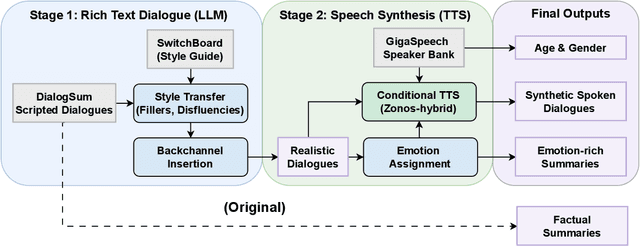
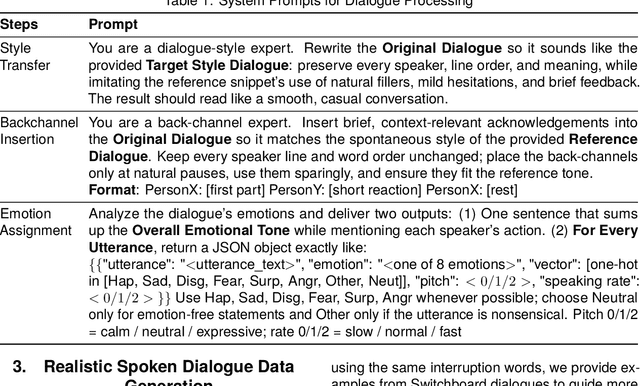
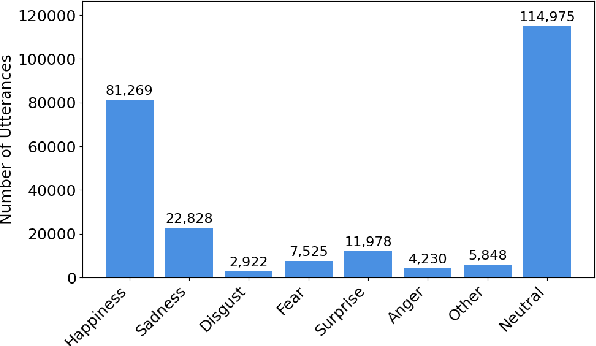
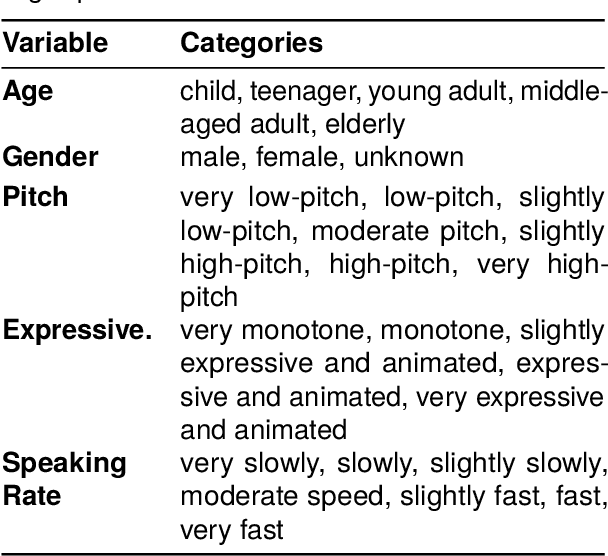
Recent audio language models can follow long conversations. However, research on emotion-aware or spoken dialogue summarization is constrained by the lack of data that links speech, summaries, and paralinguistic cues. We introduce Spoken DialogSum, the first corpus aligning raw conversational audio with factual summaries, emotion-rich summaries, and utterance-level labels for speaker age, gender, and emotion. The dataset is built in two stages: first, an LLM rewrites DialogSum scripts with Switchboard-style fillers and back-channels, then tags each utterance with emotion, pitch, and speaking rate. Second, an expressive TTS engine synthesizes speech from the tagged scripts, aligned with paralinguistic labels. Spoken DialogSum comprises 13,460 emotion-diverse dialogues, each paired with both a factual and an emotion-focused summary. We release an online demo at https://fatfat-emosum.github.io/EmoDialog-Sum-Audio-Samples/, with plans to release the full dataset in the near future. Baselines show that an Audio-LLM raises emotional-summary ROUGE-L by 28% relative to a cascaded ASR-LLM system, confirming the value of end-to-end speech modeling.