 Add to Chrome
 Add to Firefox
 Add to Edge
Personalized Longitudinal Medical Report Generation via Temporally-Aware Federated Adaptation
Feb 23, 2026
Longitudinal medical report generation is clinically important yet remains challenging due to strict privacy constraints and the evolving nature of disease progression. Although federated learning (FL) enables collaborative training without data sharing, existing FL methods largely overlook longitudinal dynamics by assuming stationary client distributions, making them unable to model temporal shifts across visits or patient-specific heterogeneity-ultimately leading to unstable optimization and suboptimal report generation. We introduce Federated Temporal Adaptation (FTA), a federated setting that explicitly accounts for the temporal evolution of client data. Building upon this setting, we propose FedTAR, a framework that integrates demographic-driven personalization with time-aware global aggregation. FedTAR generates lightweight LoRA adapters from demographic embeddings and performs temporal residual aggregation, where updates from different visits are weighted by a meta-learned temporal policy optimized via first-order MAML. Experiments on J-MID (1M exams) and MIMIC-CXR demonstrate consistent improvements in linguistic accuracy, temporal coherence, and cross-site generalization, establishing FedTAR as a robust and privacy-preserving paradigm for federated longitudinal modeling.

Privacy-Aware Continual Self-Supervised Learning on Multi-Window Chest Computed Tomography for Domain-Shift Robustness
Oct 31, 2025We propose a novel continual self-supervised learning (CSSL) framework for simultaneously learning diverse features from multi-window-obtained chest computed tomography (CT) images and ensuring data privacy. Achieving a robust and highly generalizable model in medical image diagnosis is challenging, mainly because of issues, such as the scarcity of large-scale, accurately annotated datasets and domain shifts inherent to dynamic healthcare environments. Specifically, in chest CT, these domain shifts often arise from differences in window settings, which are optimized for distinct clinical purposes. Previous CSSL frameworks often mitigated domain shift by reusing past data, a typically impractical approach owing to privacy constraints. Our approach addresses these challenges by effectively capturing the relationship between previously learned knowledge and new information across different training stages through continual pretraining on unlabeled images. Specifically, by incorporating a latent replay-based mechanism into CSSL, our method mitigates catastrophic forgetting due to domain shifts during continual pretraining while ensuring data privacy. Additionally, we introduce a feature distillation technique that integrates Wasserstein distance-based knowledge distillation (WKD) and batch-knowledge ensemble (BKE), enhancing the ability of the model to learn meaningful, domain-shift-robust representations. Finally, we validate our approach using chest CT images obtained across two different window settings, demonstrating superior performance compared with other approaches.
Continual Self-supervised Learning Considering Medical Domain Knowledge in Chest CT Images
Jan 08, 2025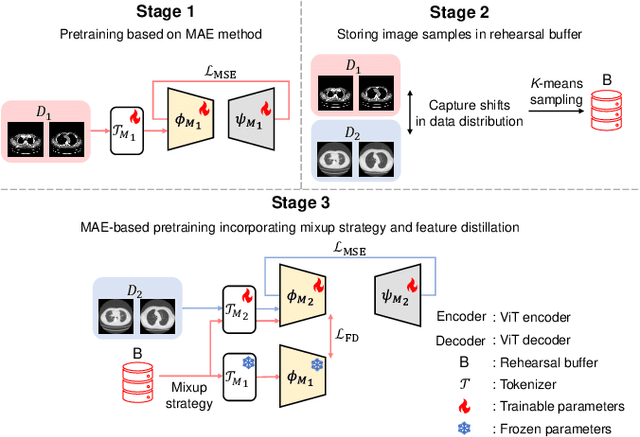
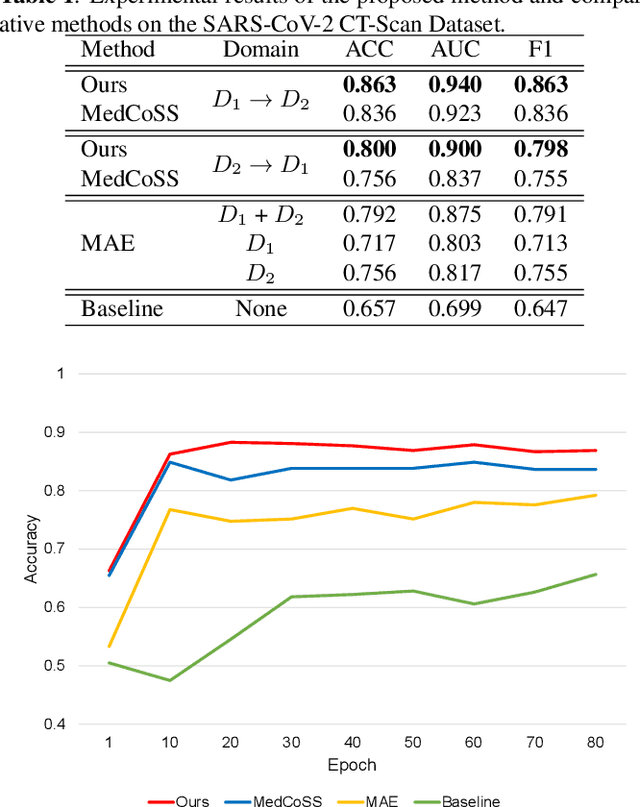

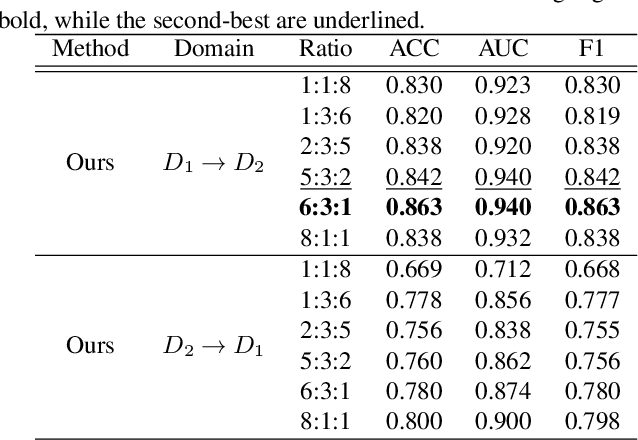
We propose a novel continual self-supervised learning method (CSSL) considering medical domain knowledge in chest CT images. Our approach addresses the challenge of sequential learning by effectively capturing the relationship between previously learned knowledge and new information at different stages. By incorporating an enhanced DER into CSSL and maintaining both diversity and representativeness within the rehearsal buffer of DER, the risk of data interference during pretraining is reduced, enabling the model to learn more richer and robust feature representations. In addition, we incorporate a mixup strategy and feature distillation to further enhance the model's ability to learn meaningful representations. We validate our method using chest CT images obtained under two different imaging conditions, demonstrating superior performance compared to state-of-the-art methods.
DeepSeek-V3 Technical Report
Dec 27, 2024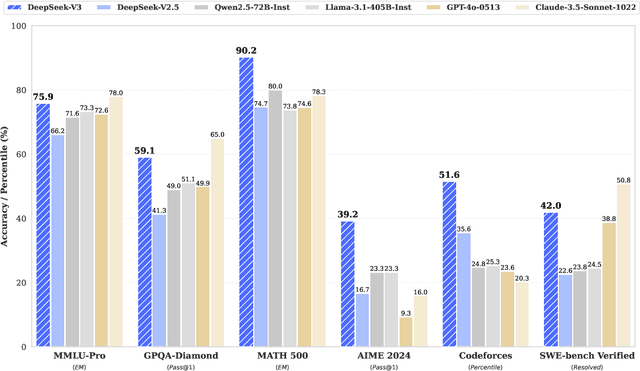


We present DeepSeek-V3, a strong Mixture-of-Experts (MoE) language model with 671B total parameters with 37B activated for each token. To achieve efficient inference and cost-effective training, DeepSeek-V3 adopts Multi-head Latent Attention (MLA) and DeepSeekMoE architectures, which were thoroughly validated in DeepSeek-V2. Furthermore, DeepSeek-V3 pioneers an auxiliary-loss-free strategy for load balancing and sets a multi-token prediction training objective for stronger performance. We pre-train DeepSeek-V3 on 14.8 trillion diverse and high-quality tokens, followed by Supervised Fine-Tuning and Reinforcement Learning stages to fully harness its capabilities. Comprehensive evaluations reveal that DeepSeek-V3 outperforms other open-source models and achieves performance comparable to leading closed-source models. Despite its excellent performance, DeepSeek-V3 requires only 2.788M H800 GPU hours for its full training. In addition, its training process is remarkably stable. Throughout the entire training process, we did not experience any irrecoverable loss spikes or perform any rollbacks. The model checkpoints are available at https://github.com/deepseek-ai/DeepSeek-V3.
Fire-Flyer AI-HPC: A Cost-Effective Software-Hardware Co-Design for Deep Learning
Aug 26, 2024


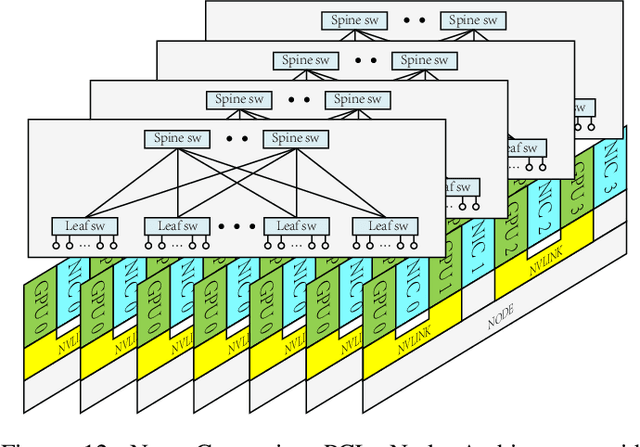
The rapid progress in Deep Learning (DL) and Large Language Models (LLMs) has exponentially increased demands of computational power and bandwidth. This, combined with the high costs of faster computing chips and interconnects, has significantly inflated High Performance Computing (HPC) construction costs. To address these challenges, we introduce the Fire-Flyer AI-HPC architecture, a synergistic hardware-software co-design framework and its best practices. For DL training, we deployed the Fire-Flyer 2 with 10,000 PCIe A100 GPUs, achieved performance approximating the DGX-A100 while reducing costs by half and energy consumption by 40%. We specifically engineered HFReduce to accelerate allreduce communication and implemented numerous measures to keep our Computation-Storage Integrated Network congestion-free. Through our software stack, including HaiScale, 3FS, and HAI-Platform, we achieved substantial scalability by overlapping computation and communication. Our system-oriented experience from DL training provides valuable insights to drive future advancements in AI-HPC.
DeepSeek LLM: Scaling Open-Source Language Models with Longtermism
Jan 05, 2024
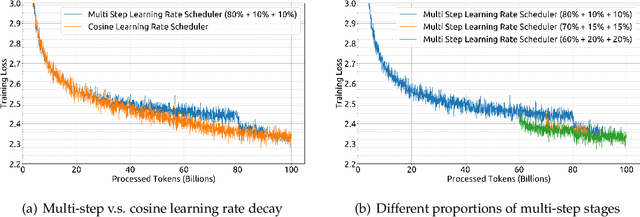


The rapid development of open-source large language models (LLMs) has been truly remarkable. However, the scaling law described in previous literature presents varying conclusions, which casts a dark cloud over scaling LLMs. We delve into the study of scaling laws and present our distinctive findings that facilitate scaling of large scale models in two commonly used open-source configurations, 7B and 67B. Guided by the scaling laws, we introduce DeepSeek LLM, a project dedicated to advancing open-source language models with a long-term perspective. To support the pre-training phase, we have developed a dataset that currently consists of 2 trillion tokens and is continuously expanding. We further conduct supervised fine-tuning (SFT) and Direct Preference Optimization (DPO) on DeepSeek LLM Base models, resulting in the creation of DeepSeek Chat models. Our evaluation results demonstrate that DeepSeek LLM 67B surpasses LLaMA-2 70B on various benchmarks, particularly in the domains of code, mathematics, and reasoning. Furthermore, open-ended evaluations reveal that DeepSeek LLM 67B Chat exhibits superior performance compared to GPT-3.5.