 Add to Chrome
 Add to Firefox
 Add to Edge
Personalized Longitudinal Medical Report Generation via Temporally-Aware Federated Adaptation
Feb 23, 2026
Longitudinal medical report generation is clinically important yet remains challenging due to strict privacy constraints and the evolving nature of disease progression. Although federated learning (FL) enables collaborative training without data sharing, existing FL methods largely overlook longitudinal dynamics by assuming stationary client distributions, making them unable to model temporal shifts across visits or patient-specific heterogeneity-ultimately leading to unstable optimization and suboptimal report generation. We introduce Federated Temporal Adaptation (FTA), a federated setting that explicitly accounts for the temporal evolution of client data. Building upon this setting, we propose FedTAR, a framework that integrates demographic-driven personalization with time-aware global aggregation. FedTAR generates lightweight LoRA adapters from demographic embeddings and performs temporal residual aggregation, where updates from different visits are weighted by a meta-learned temporal policy optimized via first-order MAML. Experiments on J-MID (1M exams) and MIMIC-CXR demonstrate consistent improvements in linguistic accuracy, temporal coherence, and cross-site generalization, establishing FedTAR as a robust and privacy-preserving paradigm for federated longitudinal modeling.

Privacy-Aware Continual Self-Supervised Learning on Multi-Window Chest Computed Tomography for Domain-Shift Robustness
Oct 31, 2025We propose a novel continual self-supervised learning (CSSL) framework for simultaneously learning diverse features from multi-window-obtained chest computed tomography (CT) images and ensuring data privacy. Achieving a robust and highly generalizable model in medical image diagnosis is challenging, mainly because of issues, such as the scarcity of large-scale, accurately annotated datasets and domain shifts inherent to dynamic healthcare environments. Specifically, in chest CT, these domain shifts often arise from differences in window settings, which are optimized for distinct clinical purposes. Previous CSSL frameworks often mitigated domain shift by reusing past data, a typically impractical approach owing to privacy constraints. Our approach addresses these challenges by effectively capturing the relationship between previously learned knowledge and new information across different training stages through continual pretraining on unlabeled images. Specifically, by incorporating a latent replay-based mechanism into CSSL, our method mitigates catastrophic forgetting due to domain shifts during continual pretraining while ensuring data privacy. Additionally, we introduce a feature distillation technique that integrates Wasserstein distance-based knowledge distillation (WKD) and batch-knowledge ensemble (BKE), enhancing the ability of the model to learn meaningful, domain-shift-robust representations. Finally, we validate our approach using chest CT images obtained across two different window settings, demonstrating superior performance compared with other approaches.
Continual Self-supervised Learning Considering Medical Domain Knowledge in Chest CT Images
Jan 08, 2025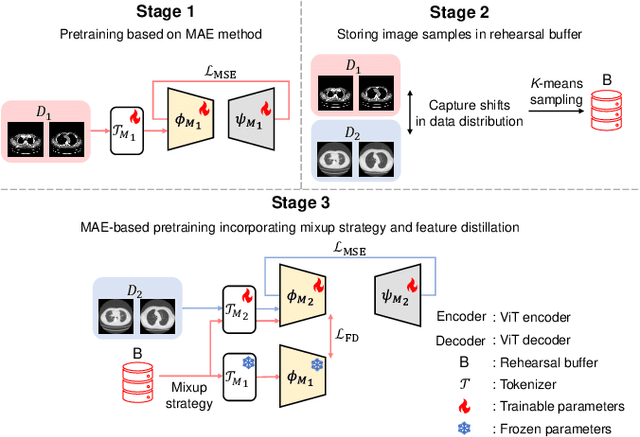
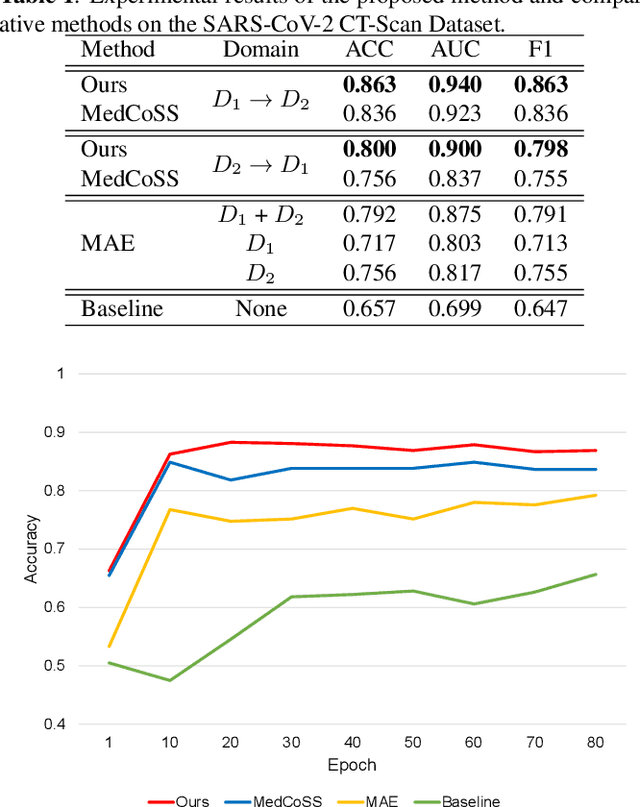

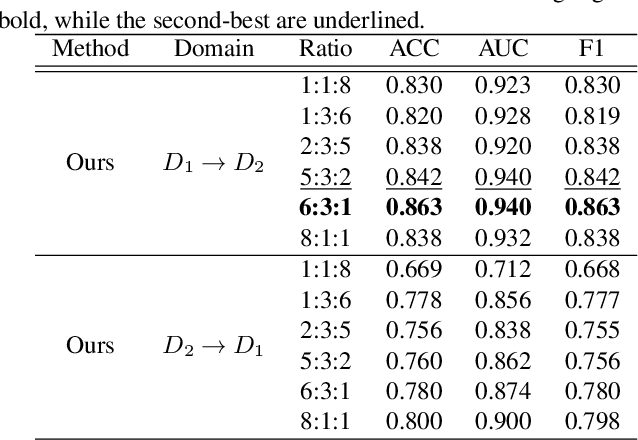
We propose a novel continual self-supervised learning method (CSSL) considering medical domain knowledge in chest CT images. Our approach addresses the challenge of sequential learning by effectively capturing the relationship between previously learned knowledge and new information at different stages. By incorporating an enhanced DER into CSSL and maintaining both diversity and representativeness within the rehearsal buffer of DER, the risk of data interference during pretraining is reduced, enabling the model to learn more richer and robust feature representations. In addition, we incorporate a mixup strategy and feature distillation to further enhance the model's ability to learn meaningful representations. We validate our method using chest CT images obtained under two different imaging conditions, demonstrating superior performance compared to state-of-the-art methods.