 Add to Chrome
 Add to Firefox
 Add to Edge
KEMO: Event-Driven Keyframe Memory for Long-Horizon Robot Manipulation with VLA Policies
Jun 22, 2026
Long-horizon robot manipulation remains challenging because similar observations may occur at different execution stages, while the appropriate action depends on previously completed operations. Memory can address this ambiguity by enabling policies to infer task progress from execution history. However, existing memory-augmented approaches often either retain dense histories that require compression or rely primarily on recent context that may discard earlier task-relevant events. In this work, we propose propose KEMO, a lightweight plug-in memory framework that automatically selectively preserves keyframes associated with task-relevant state changes for VLA policies. KEMO combines robot kinematics with visual filtering to detect events, encodes the selected keyframes as compact temporally ordered memory tokens, and integrates them with current visual features through cross-attention and gated residual fusion for VLA training. The detected events also define higher-weight training samples near critical transitions. We evaluate KEMO on various real-world dual-arm manipulation tasks spanning 2 to 6 scored subtasks, and trajectory length ranging from 830 steps to 2846 execution steps (durations from 28 to 95 seconds). Compared with the memory-free baseline (e.g., $π_{0.5}$), KEMO improves aggregate Task Success Rate by 23.6\% and Stage Completion Rate by 34.1\%. Ablations show that event-driven keyframe selection outperforms uniform sampling and recent-frame retention, while the proposed gated fusion and keyframe-aligned loss weighting provide complementary gains.

RoboFAC: A Comprehensive Framework for Robotic Failure Analysis and Correction
May 18, 2025Vision-Language-Action (VLA) models have recently advanced robotic manipulation by translating natural-language instructions and image information into sequential control actions. However, these models often underperform in open-world scenarios, as they are predominantly trained on successful expert demonstrations and exhibit a limited capacity for failure recovery. In this work, we present a Robotic Failure Analysis and Correction (RoboFAC) framework to address this issue. Firstly, we construct RoboFAC dataset comprising 9,440 erroneous manipulation trajectories and 78,623 QA pairs across 16 diverse tasks and 53 scenes in both simulation and real-world environments. Leveraging our dataset, we develop RoboFAC model, which is capable of Task Understanding, Failure Analysis and Failure Correction. Experimental results demonstrate that the RoboFAC model outperforms GPT-4o by 34.1% on our evaluation benchmark. Furthermore, we integrate the RoboFAC model into a real-world VLA control pipeline as an external supervision providing correction instructions, yielding a 29.1% relative improvement on average on four real-world tasks. The results show that our RoboFAC framework effectively handles robotic failures and assists the VLA model in recovering from failures.
CFR-RL: Traffic Engineering with Reinforcement Learning in SDN
Apr 24, 2020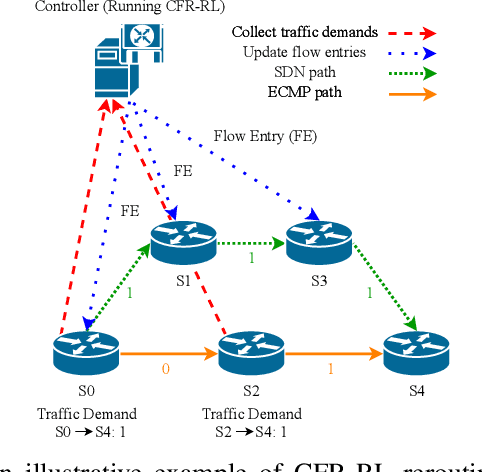
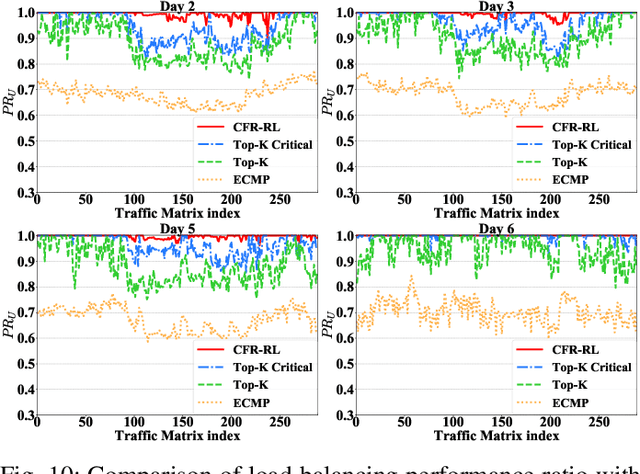
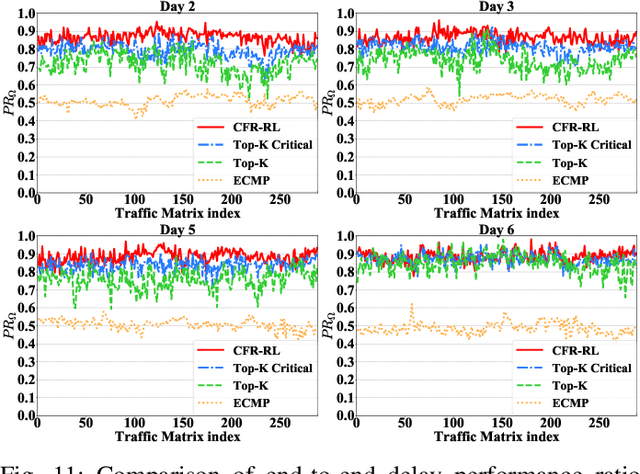
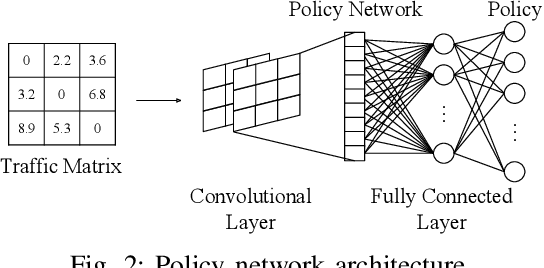
Traditional Traffic Engineering (TE) solutions can achieve the optimal or near-optimal performance by rerouting as many flows as possible. However, they do not usually consider the negative impact, such as packet out of order, when frequently rerouting flows in the network. To mitigate the impact of network disturbance, one promising TE solution is forwarding the majority of traffic flows using Equal-Cost Multi-Path (ECMP) and selectively rerouting a few critical flows using Software-Defined Networking (SDN) to balance link utilization of the network. However, critical flow rerouting is not trivial because the solution space for critical flow selection is enormous. Moreover, it is impossible to design a heuristic algorithm for this problem based on fixed and simple rules, since rule-based heuristics are unable to adapt to the changes of the traffic matrix and network dynamics. In this paper, we propose CFR-RL (Critical Flow Rerouting-Reinforcement Learning), a Reinforcement Learning-based scheme that learns a policy to select critical flows for each given traffic matrix automatically. CFR-RL then reroutes these selected critical flows to balance link utilization of the network by formulating and solving a simple Linear Programming (LP) problem. Extensive evaluations show that CFR-RL achieves near-optimal performance by rerouting only 10%-21.3% of total traffic.