 Add to Chrome
 Add to Firefox
 Add to Edge
Dynamic Modeling, Parameter Identification and Numerical Analysis of Flexible Cables in Flexibly Connected Dual-AUV Systems
Feb 05, 2026
This research presents a dynamic modeling framework and parameter identification methods for describing the highly nonlinear behaviors of flexibly connected dual-AUV systems. The modeling framework is established based on the lumped mass method, integrating axial elasticity, bending stiffness, added mass and hydrodynamic forces, thereby accurately capturing the time-varying response of the forces and cable configurations. To address the difficulty of directly measuring material-related and hydrodynamic coefficients, this research proposes a parameter identification method that combines the physical model with experimental data. High-precision inversion of the equivalent Youngs modulus and hydrodynamic coefficients is performed through tension experiments under multiple configurations, effectively demonstrating that the identified model maintains predictive consistency in various operational conditions. Further numerical analysis indicates that the dynamic properties of flexible cable exhibit significant nonlinear characteristics, which are highly dependent on material property variations and AUV motion conditions. This nonlinear dynamic behavior results in two typical response states, slack and taut, which are jointly determined by boundary conditions and hydrodynamic effects, significantly affecting the cable configuration and endpoint loads. In this research, the dynamics of flexible cables under complex boundary conditions is revealed, providing a theoretical foundation for the design, optimization and further control research of similar systems.

Underwater motions analysis and control of a coupling-tiltable unmanned aerial-aquatic quadrotor
Dec 12, 2023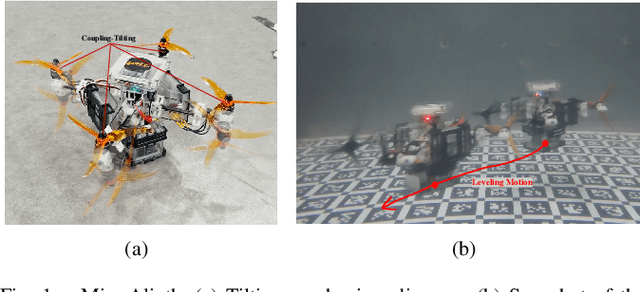
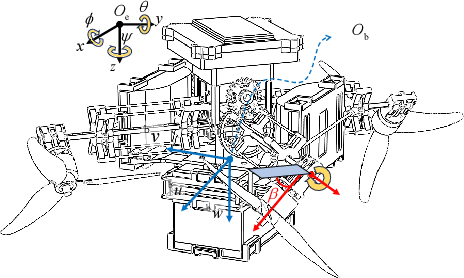
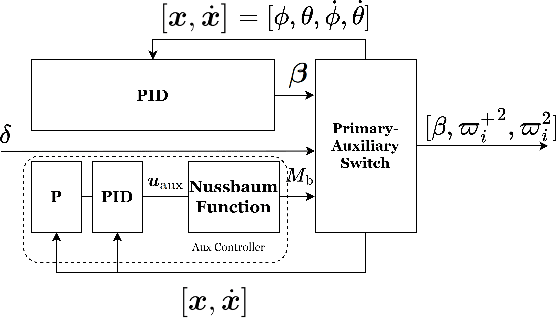
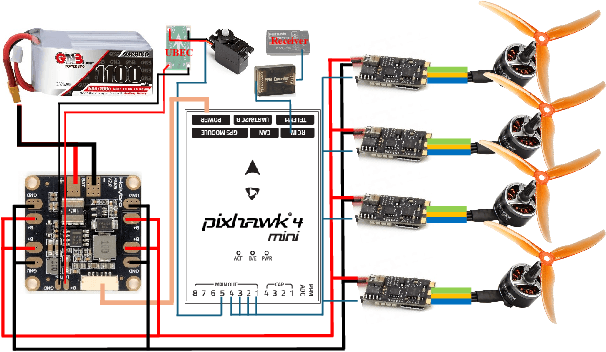
This paper proposes a method for analyzing a series of potential motions in a coupling-tiltable aerial-aquatic quadrotor based on its nonlinear dynamics. Some characteristics and constraints derived by this method are specified as Singular Thrust Tilt Angles (STTAs), utilizing to generate motions including planar motions. A switch-based control scheme addresses issues of control direction uncertainty inherent to the mechanical structure by incorporating a saturated Nussbaum function. A high-fidelity simulation environment incorporating a comprehensive hydrodynamic model is built based on a Hardware-In-The-Loop (HITL) setup with Gazebo and a flight control board. The experiments validate the effectiveness of the absolute and quasi planar motions, which cannot be achieved by conventional quadrotors, and demonstrate stable performance when the pitch or roll angle is activated in the auxiliary control channel.
TJ-FlyingFish: Design and Implementation of an Aerial-Aquatic Quadrotor with Tiltable Propulsion Units
Feb 07, 2023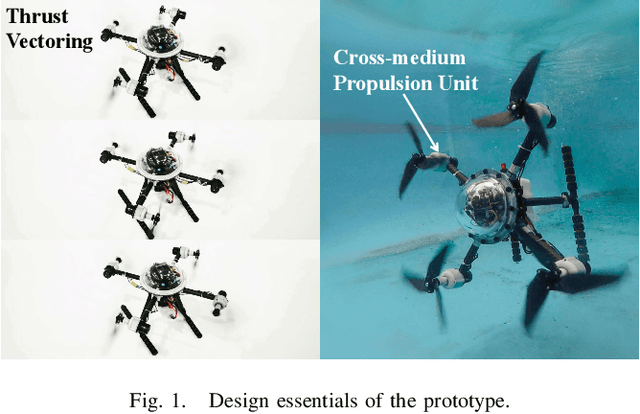
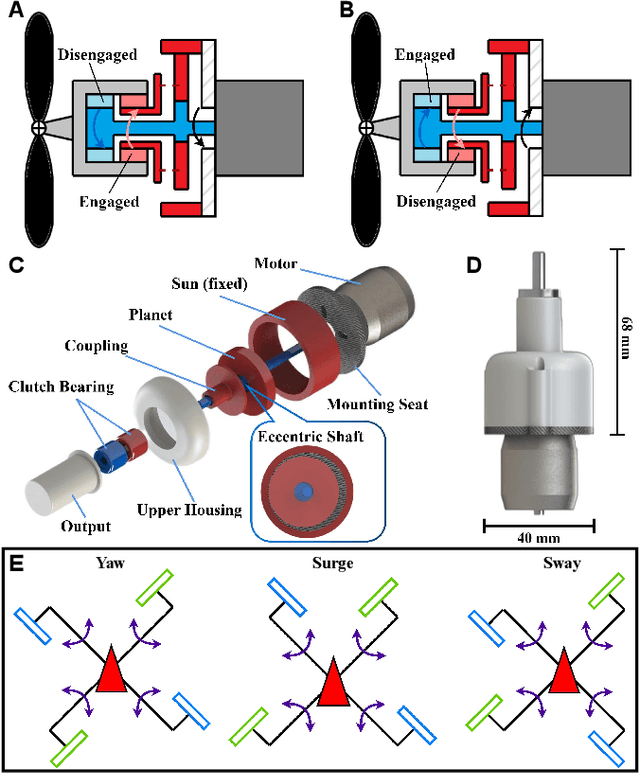
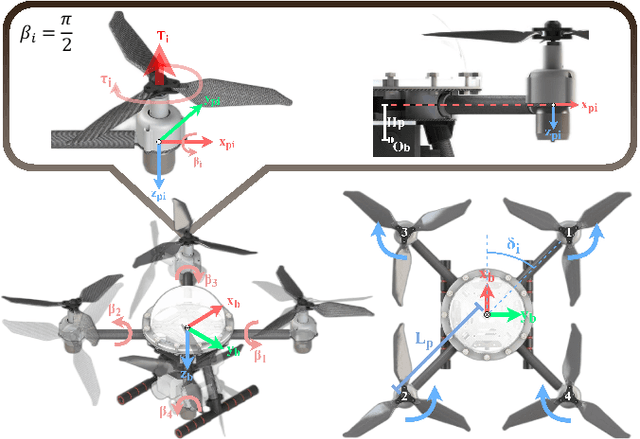
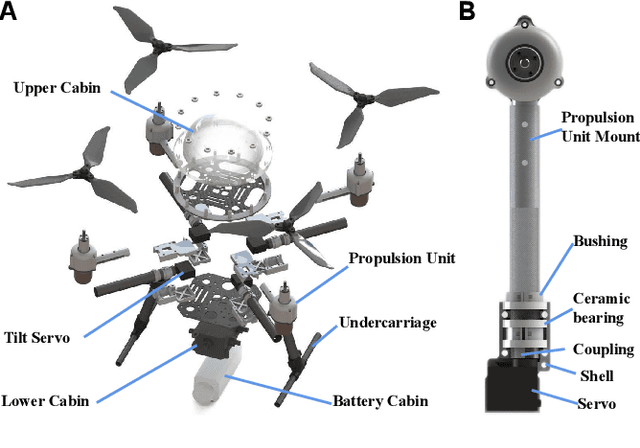
Aerial-aquatic vehicles are capable to move in the two most dominant fluids, making them more promising for a wide range of applications. We propose a prototype with special designs for propulsion and thruster configuration to cope with the vast differences in the fluid properties of water and air. For propulsion, the operating range is switched for the different mediums by the dual-speed propulsion unit, providing sufficient thrust and also ensuring output efficiency. For thruster configuration, thrust vectoring is realized by the rotation of the propulsion unit around the mount arm, thus enhancing the underwater maneuverability. This paper presents a quadrotor prototype of this concept and the design details and realization in practice.