 Add to Chrome
 Add to Firefox
 Add to Edge
DuoMo: Dual Motion Diffusion for World-Space Human Reconstruction
Mar 03, 2026
We present DuoMo, a generative method that recovers human motion in world-space coordinates from unconstrained videos with noisy or incomplete observations. Reconstructing such motion requires solving a fundamental trade-off: generalizing from diverse and noisy video inputs while maintaining global motion consistency. Our approach addresses this problem by factorizing motion learning into two diffusion models. The camera-space model first estimates motion from videos in camera coordinates. The world-space model then lifts this initial estimate into world coordinates and refines it to be globally consistent. Together, the two models can reconstruct motion across diverse scenes and trajectories, even from highly noisy or incomplete observations. Moreover, our formulation is general, generating the motion of mesh vertices directly and bypassing parametric models. DuoMo achieves state-of-the-art performance. On EMDB, our method obtains a 16% reduction in world-space reconstruction error while maintaining low foot skating. On RICH, it obtains a 30% reduction in world-space error. Project page: https://yufu-wang.github.io/duomo/

TAVA: Template-free Animatable Volumetric Actors
Jun 21, 2022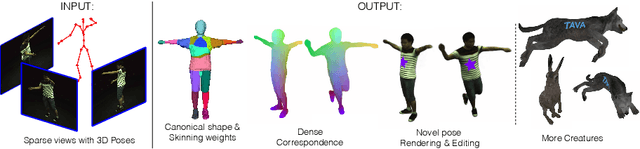
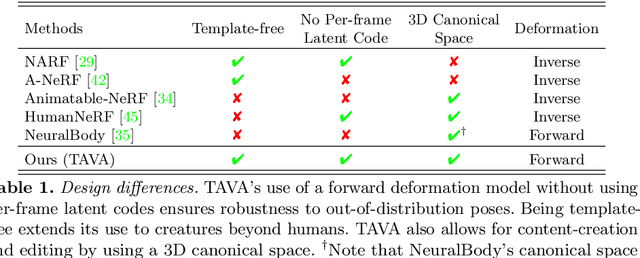
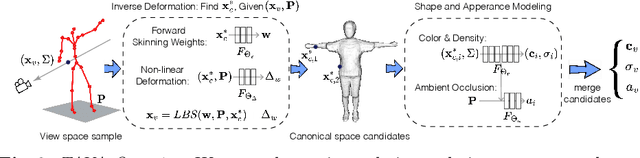
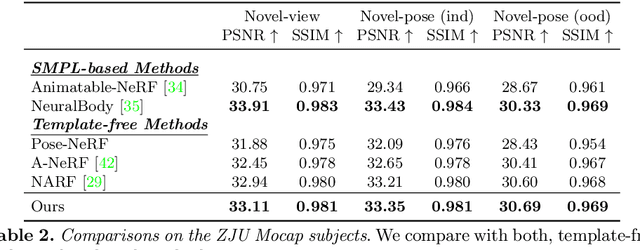
Coordinate-based volumetric representations have the potential to generate photo-realistic virtual avatars from images. However, virtual avatars also need to be controllable even to a novel pose that may not have been observed. Traditional techniques, such as LBS, provide such a function; yet it usually requires a hand-designed body template, 3D scan data, and limited appearance models. On the other hand, neural representation has been shown to be powerful in representing visual details, but are under explored on deforming dynamic articulated actors. In this paper, we propose TAVA, a method to create T emplate-free Animatable Volumetric Actors, based on neural representations. We rely solely on multi-view data and a tracked skeleton to create a volumetric model of an actor, which can be animated at the test time given novel pose. Since TAVA does not require a body template, it is applicable to humans as well as other creatures such as animals. Furthermore, TAVA is designed such that it can recover accurate dense correspondences, making it amenable to content-creation and editing tasks. Through extensive experiments, we demonstrate that the proposed method generalizes well to novel poses as well as unseen views and showcase basic editing capabilities.