 Add to Chrome
 Add to Firefox
 Add to Edge
Seeking Necessary and Sufficient Information from Multimodal Medical Data
Feb 27, 2026
Learning multimodal representations from medical images and other data sources can provide richer information for decision-making. While various multimodal models have been developed for this, they overlook learning features that are both necessary (must be present for the outcome to occur) and sufficient (enough to determine the outcome). We argue learning such features is crucial as they can improve model performance by capturing essential predictive information, and enhance model robustness to missing modalities as each modality can provide adequate predictive signals. Such features can be learned by leveraging the Probability of Necessity and Sufficiency (PNS) as a learning objective, an approach that has proven effective in unimodal settings. However, extending PNS to multimodal scenarios remains underexplored and is non-trivial as key conditions of PNS estimation are violated. We address this by decomposing multimodal representations into modality-invariant and modality-specific components, then deriving tractable PNS objectives for each. Experiments on synthetic and real-world medical datasets demonstrate our method's effectiveness. Code will be available on GitHub.

Unveiling Hidden Vulnerabilities in Digital Human Generation via Adversarial Attacks
Apr 24, 2025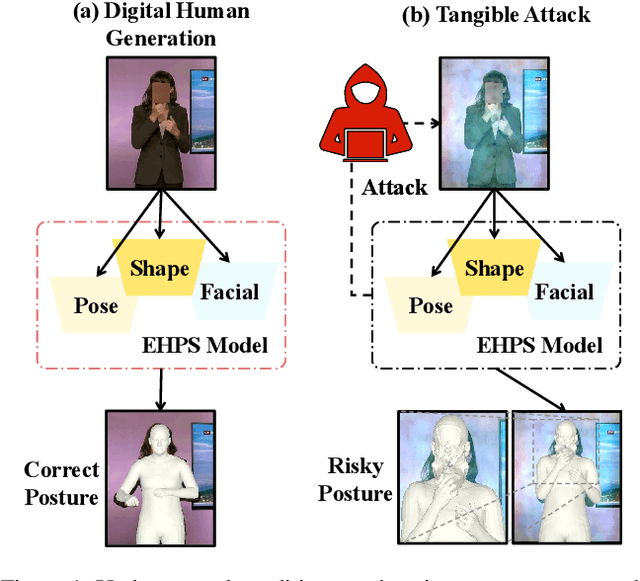
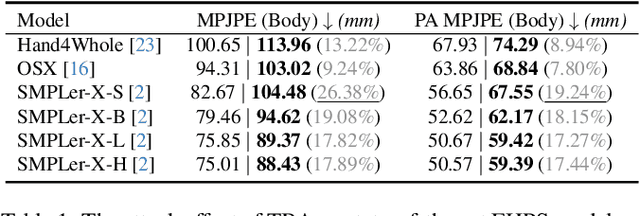
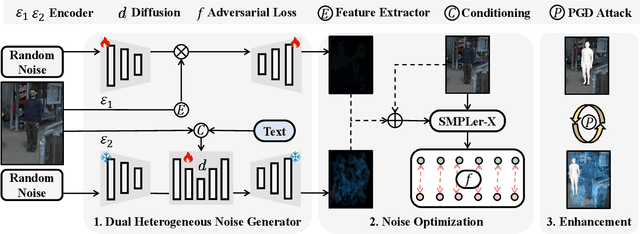

Expressive human pose and shape estimation (EHPS) is crucial for digital human generation, especially in applications like live streaming. While existing research primarily focuses on reducing estimation errors, it largely neglects robustness and security aspects, leaving these systems vulnerable to adversarial attacks. To address this significant challenge, we propose the \textbf{Tangible Attack (TBA)}, a novel framework designed to generate adversarial examples capable of effectively compromising any digital human generation model. Our approach introduces a \textbf{Dual Heterogeneous Noise Generator (DHNG)}, which leverages Variational Autoencoders (VAE) and ControlNet to produce diverse, targeted noise tailored to the original image features. Additionally, we design a custom \textbf{adversarial loss function} to optimize the noise, ensuring both high controllability and potent disruption. By iteratively refining the adversarial sample through multi-gradient signals from both the noise and the state-of-the-art EHPS model, TBA substantially improves the effectiveness of adversarial attacks. Extensive experiments demonstrate TBA's superiority, achieving a remarkable 41.0\% increase in estimation error, with an average improvement of approximately 17.0\%. These findings expose significant security vulnerabilities in current EHPS models and highlight the need for stronger defenses in digital human generation systems.