 Add to Chrome
 Add to Firefox
 Add to Edge
Sharpness-Aware Minimization and Muon: Robustness under the Spectral Norm
Jul 28, 2026
Sharpness-Aware Minimization (SAM) aims to improve generalization by encouraging insensitivity to small, worst-case parameter perturbations. However, the notion of a "small" perturbation is inherently geometry-dependent: while existing SAM variants have explored a wide range of choices, a clear perspective on which geometries are most effective in practice remains elusive. Recent work on matrix-aware optimization, particularly the Muon optimizer, suggests that respecting the matrix structure of hidden-layer weights can lead to strong empirical performance. Motivated by this, we study matrix-aware geometry in both stages of SAM: we introduce a layerwise spectral inner perturbation for matrix-valued hidden-layer parameters and combine it with either AdamW/SGDW or Muon in the outer update. Across ImageNet-1K experiments on ViT-Small/16 and ResNet-50, we find that the combination of a spectral inner step with a Muon outer step performs consistently strongly, achieving the best validation accuracy on both models among the evaluated methods.

A Few Words Go a Long Way: Language Guided Robot Policy Synthesis
Jul 26, 2026While vision-language-action models have demonstrated impressive zero-shot manipulation capabilities, they remain fundamentally black box policies that are difficult to interpret, adapt, or correct when they inevitably fail. In this work, we propose ARCHITECT, a framework that treats robot policy acquisition as an interactive program synthesis task. ARCHITECT leverages the reasoning capabilities of LLM coding agents to synthesize modular robot programs that utilize a suite of perception and control tools. Unlike end-to-end models where distribution shift leads to unpredictable, cascading failures, our modular architecture allows users to isolate failures and localize feedback at the level of abstraction required. We introduce an iterative process where a human supervisor provides natural language corrections to steer the policy. These corrections are grounded in the policy code by program execution traces and distilled into a persistent skill library, a form of long-term in-context learning which enables the agent to accumulate a repertoire of reusable, interpretable behaviors. In a benchmark evaluation on a Franka Panda robot, ARCHITECT outperforms state-of-the-art VLA models and program synthesis baselines on complex, long-horizon tasks, including articulated object manipulation and cloth folding. Our results demonstrate that the synthesized skill library enables the system to transfer to novel tasks with decreasing human intervention, providing a steerable and data-efficient alternative to black-box robot learning. Website: https://robo-architect.github.io/
FlowDAgger: Human-in-the-Loop Adaptation of Generative Robot Policies in Latent Space
Jul 09, 2026Pretrained generative robot policies based on flow matching and diffusion have achieved impressive results across a wide range of manipulation tasks. Yet real-world deployments routinely expose failure modes outside the pretraining distribution. Closing these gaps typically requires large-scale data collection or online reinforcement learning on physical hardware, which is impractical for rapid and safe adaptation. We present FlowDAgger, a sample- and compute-efficient method for adapting frozen generative robot policies from human interventions in latent space. Our key idea is action inversion: each human expert action is mapped to the noise that would have produced it under the frozen base policy, using reverse-time integration followed by local refinement. The resulting inverted noise provides supervision for a lightweight latent policy that steers the base model at deployment time, enabling rapid skill acquisition while preserving its behavioral priors. We evaluate FlowDAgger in simulation and on real-world bimanual and single-arm manipulation, adapting both action-head VLAs and world-action models from a handful of interventions. FlowDAgger outperforms supervised fine-tuning and latent-space RL baselines and preserves pretrained skills on held-out tasks, offering a practical path for adapting robot foundation models in the real world. Website: https://microsoft.github.io/FlowDAgger
Benchmarking Affordance Generalization with BusyBox
Feb 05, 2026Vision-Language-Action (VLA) models have been attracting the attention of researchers and practitioners thanks to their promise of generalization. Although single-task policies still offer competitive performance, VLAs are increasingly able to handle commands and environments unseen in their training set. While generalization in vision and language space is undoubtedly important for robust versatile behaviors, a key meta-skill VLAs need to possess is affordance generalization -- the ability to manipulate new objects with familiar physical features. In this work, we present BusyBox, a physical benchmark for systematic semi-automatic evaluation of VLAs' affordance generalization. BusyBox consists of 6 modules with switches, sliders, wires, buttons, a display, and a dial. The modules can be swapped and rotated to create a multitude of BusyBox variations with different visual appearances but the same set of affordances. We empirically demonstrate that generalization across BusyBox variants is highly challenging even for strong open-weights VLAs such as $π_{0.5}$ and GR00T-N1.6. To encourage the research community to evaluate their own VLAs on BusyBox and to propose new affordance generalization experiments, we have designed BusyBox to be easy to build in most robotics labs. We release the full set of CAD files for 3D-printing its parts as well as a bill of materials for (optionally) assembling its electronics. We also publish a dataset of language-annotated demonstrations that we collected using the common bimanual Mobile Aloha robot on the canonical BusyBox configuration. All of the released materials are available at https://microsoft.github.io/BusyBox.
Implicit Bias and Invariance: How Hopfield Networks Efficiently Learn Graph Orbits
Dec 16, 2025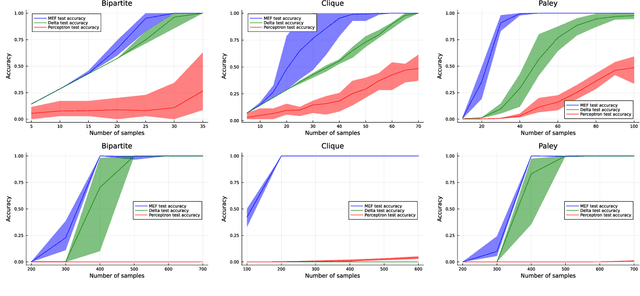
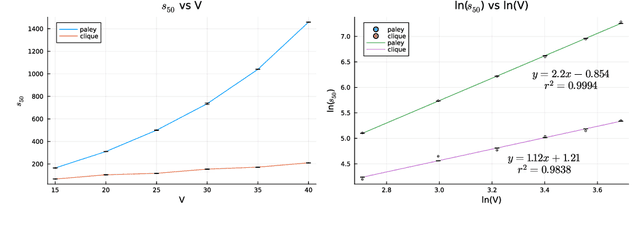
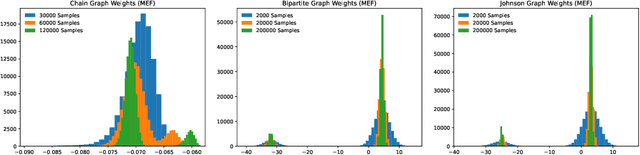
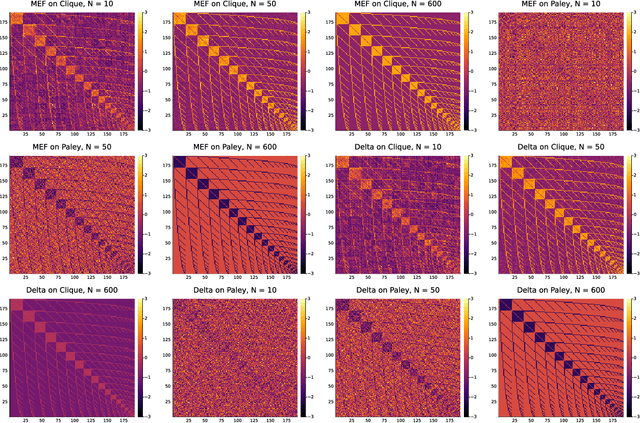
Many learning problems involve symmetries, and while invariance can be built into neural architectures, it can also emerge implicitly when training on group-structured data. We study this phenomenon in classical Hopfield networks and show they can infer the full isomorphism class of a graph from a small random sample. Our results reveal that: (i) graph isomorphism classes can be represented within a three-dimensional invariant subspace, (ii) using gradient descent to minimize energy flow (MEF) has an implicit bias toward norm-efficient solutions, which underpins a polynomial sample complexity bound for learning isomorphism classes, and (iii) across multiple learning rules, parameters converge toward the invariant subspace as sample sizes grow. Together, these findings highlight a unifying mechanism for generalization in Hopfield networks: a bias toward norm efficiency in learning drives the emergence of approximate invariance under group-structured data.
Bounds for the smallest eigenvalue of the NTK for arbitrary spherical data of arbitrary dimension
May 23, 2024Bounds on the smallest eigenvalue of the neural tangent kernel (NTK) are a key ingredient in the analysis of neural network optimization and memorization. However, existing results require distributional assumptions on the data and are limited to a high-dimensional setting, where the input dimension $d_0$ scales at least logarithmically in the number of samples $n$. In this work we remove both of these requirements and instead provide bounds in terms of a measure of the collinearity of the data: notably these bounds hold with high probability even when $d_0$ is held constant versus $n$. We prove our results through a novel application of the hemisphere transform.
Benign overfitting in leaky ReLU networks with moderate input dimension
Mar 11, 2024The problem of benign overfitting asks whether it is possible for a model to perfectly fit noisy training data and still generalize well. We study benign overfitting in two-layer leaky ReLU networks trained with the hinge loss on a binary classification task. We consider input data which can be decomposed into the sum of a common signal and a random noise component, which lie on subspaces orthogonal to one another. We characterize conditions on the signal to noise ratio (SNR) of the model parameters giving rise to benign versus non-benign, or harmful, overfitting: in particular, if the SNR is high then benign overfitting occurs, conversely if the SNR is low then harmful overfitting occurs. We attribute both benign and non-benign overfitting to an approximate margin maximization property and show that leaky ReLU networks trained on hinge loss with Gradient Descent (GD) satisfy this property. In contrast to prior work we do not require near orthogonality conditions on the training data: notably, for input dimension $d$ and training sample size $n$, while prior work shows asymptotically optimal error when $d = \Omega(n^2 \log n)$, here we require only $d = \Omega\left(n \log \frac{1}{\epsilon}\right)$ to obtain error within $\epsilon$ of optimal.
Training shallow ReLU networks on noisy data using hinge loss: when do we overfit and is it benign?
Jun 16, 2023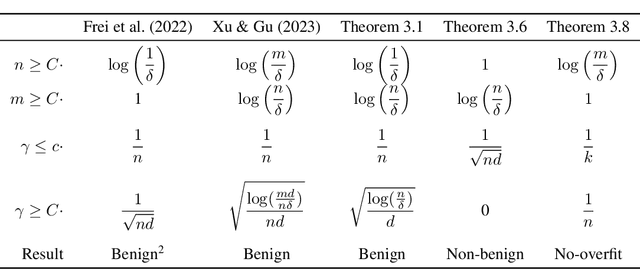
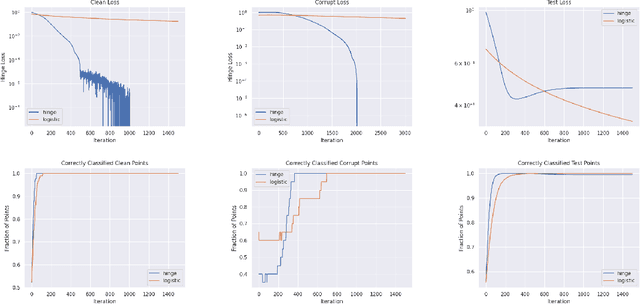
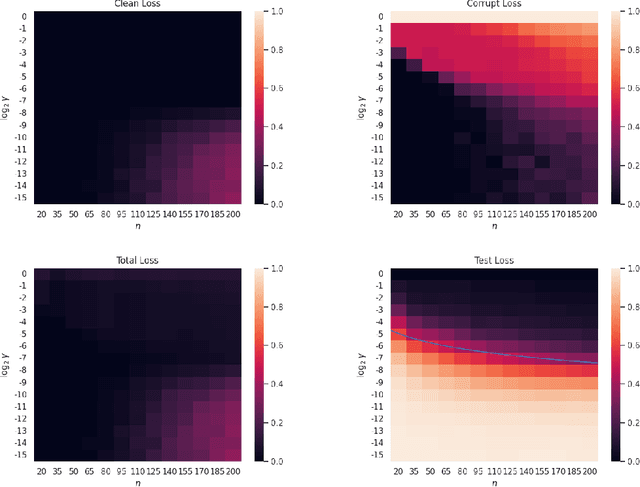
We study benign overfitting in two-layer ReLU networks trained using gradient descent and hinge loss on noisy data for binary classification. In particular, we consider linearly separable data for which a relatively small proportion of labels are corrupted or flipped. We identify conditions on the margin of the clean data that give rise to three distinct training outcomes: benign overfitting, in which zero loss is achieved and with high probability test data is classified correctly; overfitting, in which zero loss is achieved but test data is misclassified with probability lower bounded by a constant; and non-overfitting, in which clean points, but not corrupt points, achieve zero loss and again with high probability test data is classified correctly. Our analysis provides a fine-grained description of the dynamics of neurons throughout training and reveals two distinct phases: in the first phase clean points achieve close to zero loss, in the second phase clean points oscillate on the boundary of zero loss while corrupt points either converge towards zero loss or are eventually zeroed by the network. We prove these results using a combinatorial approach that involves bounding the number of clean versus corrupt updates across these phases of training.
Mildly Overparameterized ReLU Networks Have a Favorable Loss Landscape
May 31, 2023We study the loss landscape of two-layer mildly overparameterized ReLU neural networks on a generic finite input dataset for the squared error loss. Our approach involves bounding the dimension of the sets of local and global minima using the rank of the Jacobian of the parameterization map. Using results on random binary matrices, we show most activation patterns correspond to parameter regions with no bad differentiable local minima. Furthermore, for one-dimensional input data, we show most activation regions realizable by the network contain a high dimensional set of global minima and no bad local minima. We experimentally confirm these results by finding a phase transition from most regions having full rank to many regions having deficient rank depending on the amount of overparameterization.
Characterizing the Spectrum of the NTK via a Power Series Expansion
Nov 15, 2022Under mild conditions on the network initialization we derive a power series expansion for the Neural Tangent Kernel (NTK) of arbitrarily deep feedforward networks in the infinite width limit. We provide expressions for the coefficients of this power series which depend on both the Hermite coefficients of the activation function as well as the depth of the network. We observe faster decay of the Hermite coefficients leads to faster decay in the NTK coefficients. Using this series, first we relate the effective rank of the NTK to the effective rank of the input-data Gram. Second, for data drawn uniformly on the sphere we derive an explicit formula for the eigenvalues of the NTK, which shows faster decay in the NTK coefficients implies a faster decay in its spectrum. From this we recover existing results on eigenvalue asymptotics for ReLU networks and comment on how the activation function influences the RKHS. Finally, for generic data and activation functions with sufficiently fast Hermite coefficient decay, we derive an asymptotic upper bound on the spectrum of the NTK.