 Add to Chrome
 Add to Firefox
 Add to Edge
FlowDAgger: Human-in-the-Loop Adaptation of Generative Robot Policies in Latent Space
Jul 09, 2026
Pretrained generative robot policies based on flow matching and diffusion have achieved impressive results across a wide range of manipulation tasks. Yet real-world deployments routinely expose failure modes outside the pretraining distribution. Closing these gaps typically requires large-scale data collection or online reinforcement learning on physical hardware, which is impractical for rapid and safe adaptation. We present FlowDAgger, a sample- and compute-efficient method for adapting frozen generative robot policies from human interventions in latent space. Our key idea is action inversion: each human expert action is mapped to the noise that would have produced it under the frozen base policy, using reverse-time integration followed by local refinement. The resulting inverted noise provides supervision for a lightweight latent policy that steers the base model at deployment time, enabling rapid skill acquisition while preserving its behavioral priors. We evaluate FlowDAgger in simulation and on real-world bimanual and single-arm manipulation, adapting both action-head VLAs and world-action models from a handful of interventions. FlowDAgger outperforms supervised fine-tuning and latent-space RL baselines and preserves pretrained skills on held-out tasks, offering a practical path for adapting robot foundation models in the real world. Website: https://microsoft.github.io/FlowDAgger

Emergent Dexterity via Diverse Resets and Large-Scale Reinforcement Learning
Mar 16, 2026Reinforcement learning in massively parallel physics simulations has driven major progress in sim-to-real robot learning. However, current approaches remain brittle and task-specific, relying on extensive per-task engineering to design rewards, curricula, and demonstrations. Even with this engineering, they often fail on long-horizon, contact-rich manipulation tasks and do not meaningfully scale with compute, as performance quickly saturates when training revisits the same narrow regions of state space. We introduce \Method, a simple and scalable framework that enables on-policy reinforcement learning to robustly solve a broad class of dexterous manipulation tasks using a single reward function, fixed algorithm hyperparameters, no curricula, and no human demonstrations. Our key insight is that long-horizon exploration can be dramatically simplified by using simulator resets to systematically expose the RL algorithm to the diverse set of robot-object interactions which underlie dexterous manipulation. \Method\ programmatically generates such resets with minimal human input, converting additional compute directly into broader behavioral coverage and continued performance gains. We show that \Method\ gracefully scales to long-horizon dexterous manipulation tasks beyond the capabilities of existing approaches and is able to learn robust policies over significantly wider ranges of initial conditions than baselines. Finally, we distill \Method \ into visuomotor policies which display robust retrying behavior and substantially higher success rates than baselines when transferred to the real world zero-shot. Project webpage: https://omnireset.github.io
Rapidly Adapting Policies to the Real World via Simulation-Guided Fine-Tuning
Feb 04, 2025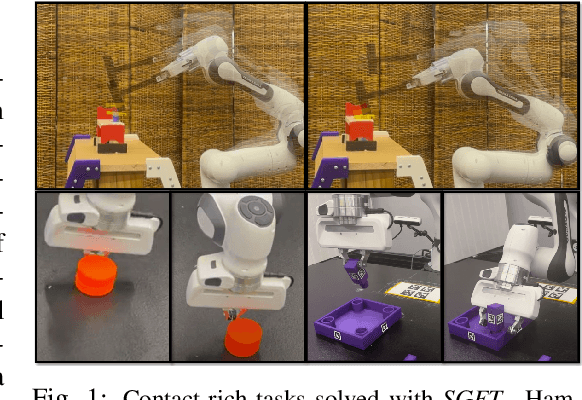
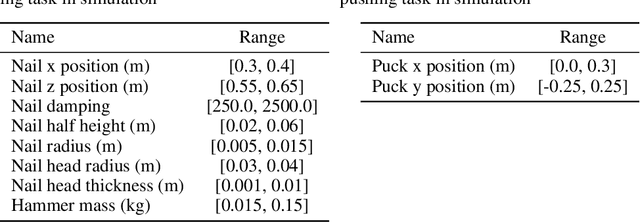
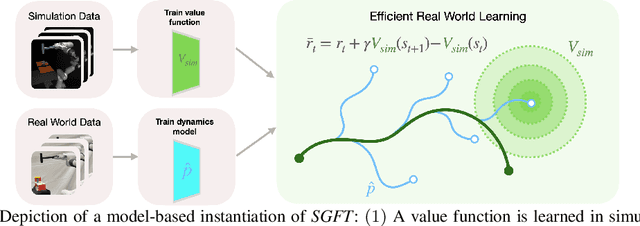
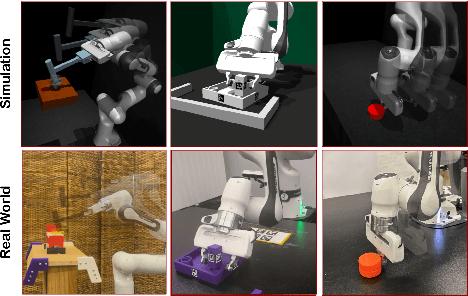
Robot learning requires a considerable amount of high-quality data to realize the promise of generalization. However, large data sets are costly to collect in the real world. Physics simulators can cheaply generate vast data sets with broad coverage over states, actions, and environments. However, physics engines are fundamentally misspecified approximations to reality. This makes direct zero-shot transfer from simulation to reality challenging, especially in tasks where precise and force-sensitive manipulation is necessary. Thus, fine-tuning these policies with small real-world data sets is an appealing pathway for scaling robot learning. However, current reinforcement learning fine-tuning frameworks leverage general, unstructured exploration strategies which are too inefficient to make real-world adaptation practical. This paper introduces the Simulation-Guided Fine-tuning (SGFT) framework, which demonstrates how to extract structural priors from physics simulators to substantially accelerate real-world adaptation. Specifically, our approach uses a value function learned in simulation to guide real-world exploration. We demonstrate this approach across five real-world dexterous manipulation tasks where zero-shot sim-to-real transfer fails. We further demonstrate our framework substantially outperforms baseline fine-tuning methods, requiring up to an order of magnitude fewer real-world samples and succeeding at difficult tasks where prior approaches fail entirely. Last but not least, we provide theoretical justification for this new paradigm which underpins how SGFT can rapidly learn high-performance policies in the face of large sim-to-real dynamics gaps. Project webpage: https://weirdlabuw.github.io/sgft/{weirdlabuw.github.io/sgft}