 Add to Chrome
 Add to Firefox
 Add to Edge
Implicit Bias of SGD in Multivariate ReLU Networks: Effective Width Collapse
Jul 03, 2026
We study the implicit bias of noisy stochastic gradient descent in training wide two-layer ReLU networks for multivariate regression. In a mean-field regime, the training dynamics are approximated by a Wasserstein gradient flow that converges to a unique stationary measure. We characterize the structure of this stationary measure and the predictor it represents. We show that, despite the network being infinitely overparameterized, the learned predictor admits an effectively finite representation: the input weights and biases align along finitely many directions, leading to an effective width collapse. In particular, the solution function is continuous piecewise affine, with affine regions determined by the cells of a finite hyperplane arrangement. The number of learned directions, and hence hyperplanes, is bounded above by $2\mathcal{P}-1$, where $\mathcal{P}$ denotes the number of linear dichotomies realizable on the training inputs. We further establish a non-redundancy property of the learned representation by proving that each learned direction induces a unique ternary activation pattern on the training data. Consequently, the complexity of the learned predictor is governed by the combinatorial geometry of the training data.

TriSearch: Learning to Optimize Triangulations via Bistellar Flips
May 28, 2026We introduce TriSearch, a reinforcement learning framework for optimizing objectives over triangulations of a polytope via bistellar flips. The key idea is a circuit-supported subtriangulation action representation: feasible flips are encoded by their supporting circuit and realized local subtriangulation, enabling a learned policy to rank them using local geometric and combinatorial features. This yields a dimension-agnostic interface and enables efficient traversal of the flip graph without explicit enumeration of the full triangulation space. Instantiated in 3D and 4D, TriSearch generalizes zero-shot from small training instances to larger polytopes with exponentially larger search spaces. It achieves top performance on metric objectives in 3D and, in 4D, discovers more distinct Fine, Regular, Star triangulations of reflexive polytopes, corresponding to Calabi-Yau threefolds, than existing samplers under a fixed budget.
The Symmetries of Three-Layer ReLU Networks
May 18, 2026We develop a framework for analyzing parameter symmetries in deep ReLU networks and obtain a complete characterization of the generic parameter fibers for three-layer bottleneck architectures. Our approach provides explicit semi-algebraic descriptions of these fibers and yields a polynomial time algorithm for deciding functional equivalence of two parameters. The symmetries include discrete and continuous transformations arising from layer composition, and depend on whether deeper layers hide or preserve geometric structure from preceding layers. Finally, we show that some of these symmetries induce local conservation laws along gradient flow, while others do not.
Most ReLU Networks Admit Identifiable Parameters
May 05, 2026We study the realization map of deep ReLU networks, focusing on when a function determines its parameters up to scaling and permutation. To analyze hidden redundancies beyond these standard symmetries, we introduce a framework based on weighted polyhedral complexes. Our main result shows that for every architecture whose input and hidden layers have width at least two, there exists an open set of identifiable parameters. This implies that the functional dimension of every such architecture is exactly the number of parameters minus the number of hidden neurons. We further show that minimal functional representations can still have non-trivial parameter redundancies. Finally, we establish a generic depth hierarchy, whereby for an open set of parameters the realized function cannot be represented generically by any shallower network.
Algebraic Robustness Verification of Neural Networks
Feb 05, 2026We formulate formal robustness verification of neural networks as an algebraic optimization problem. We leverage the Euclidean Distance (ED) degree, which is the generic number of complex critical points of the distance minimization problem to a classifier's decision boundary, as an architecture-dependent measure of the intrinsic complexity of robustness verification. To make this notion operational, we define the associated ED discriminant, which characterizes input points at which the number of real critical points changes, distinguishing test instances that are easier or harder to verify. We provide an explicit algorithm for computing this discriminant. We further introduce the parameter discriminant of a neural network, identifying parameters where the ED degree drops and the decision boundary exhibits reduced algebraic complexity. We derive closed-form expressions for the ED degree for several classes of neural architectures, as well as formulas for the expected number of real critical points in the infinite-width limit. Finally, we present an exact robustness certification algorithm based on numerical homotopy continuation, establishing a concrete link between metric algebraic geometry and neural network verification.
Constraining the outputs of ReLU neural networks
Aug 05, 2025We introduce a class of algebraic varieties naturally associated with ReLU neural networks, arising from the piecewise linear structure of their outputs across activation regions in input space, and the piecewise multilinear structure in parameter space. By analyzing the rank constraints on the network outputs within each activation region, we derive polynomial equations that characterize the functions representable by the network. We further investigate conditions under which these varieties attain their expected dimension, providing insight into the expressive and structural properties of ReLU networks.
Understanding Learning Invariance in Deep Linear Networks
Jun 16, 2025Equivariant and invariant machine learning models exploit symmetries and structural patterns in data to improve sample efficiency. While empirical studies suggest that data-driven methods such as regularization and data augmentation can perform comparably to explicitly invariant models, theoretical insights remain scarce. In this paper, we provide a theoretical comparison of three approaches for achieving invariance: data augmentation, regularization, and hard-wiring. We focus on mean squared error regression with deep linear networks, which parametrize rank-bounded linear maps and can be hard-wired to be invariant to specific group actions. We show that the critical points of the optimization problems for hard-wiring and data augmentation are identical, consisting solely of saddles and the global optimum. By contrast, regularization introduces additional critical points, though they remain saddles except for the global optimum. Moreover, we demonstrate that the regularization path is continuous and converges to the hard-wired solution.
Demystifying Topological Message-Passing with Relational Structures: A Case Study on Oversquashing in Simplicial Message-Passing
Jun 06, 2025Topological deep learning (TDL) has emerged as a powerful tool for modeling higher-order interactions in relational data. However, phenomena such as oversquashing in topological message-passing remain understudied and lack theoretical analysis. We propose a unifying axiomatic framework that bridges graph and topological message-passing by viewing simplicial and cellular complexes and their message-passing schemes through the lens of relational structures. This approach extends graph-theoretic results and algorithms to higher-order structures, facilitating the analysis and mitigation of oversquashing in topological message-passing networks. Through theoretical analysis and empirical studies on simplicial networks, we demonstrate the potential of this framework to advance TDL.
Implicit Bias of Mirror Descent for Shallow Neural Networks in Univariate Regression
Oct 05, 2024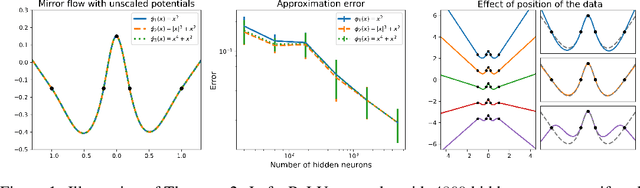
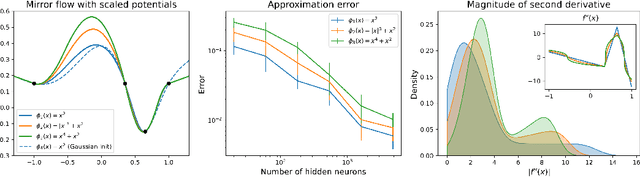
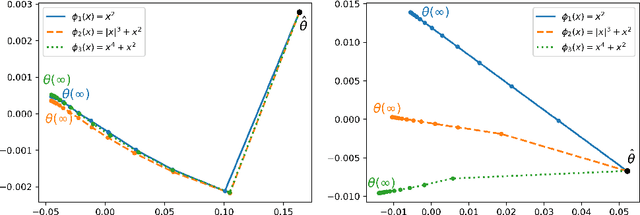
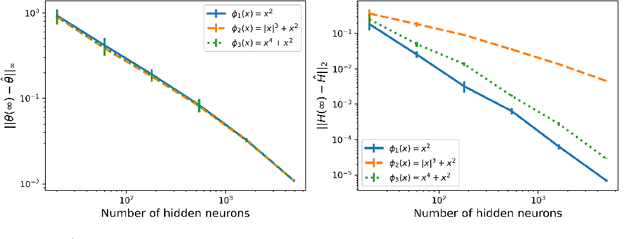
We examine the implicit bias of mirror flow in univariate least squares error regression with wide and shallow neural networks. For a broad class of potential functions, we show that mirror flow exhibits lazy training and has the same implicit bias as ordinary gradient flow when the network width tends to infinity. For ReLU networks, we characterize this bias through a variational problem in function space. Our analysis includes prior results for ordinary gradient flow as a special case and lifts limitations which required either an intractable adjustment of the training data or networks with skip connections. We further introduce scaled potentials and show that for these, mirror flow still exhibits lazy training but is not in the kernel regime. For networks with absolute value activations, we show that mirror flow with scaled potentials induces a rich class of biases, which generally cannot be captured by an RKHS norm. A takeaway is that whereas the parameter initialization determines how strongly the curvature of the learned function is penalized at different locations of the input space, the scaled potential determines how the different magnitudes of the curvature are penalized.
Bounds for the smallest eigenvalue of the NTK for arbitrary spherical data of arbitrary dimension
May 23, 2024Bounds on the smallest eigenvalue of the neural tangent kernel (NTK) are a key ingredient in the analysis of neural network optimization and memorization. However, existing results require distributional assumptions on the data and are limited to a high-dimensional setting, where the input dimension $d_0$ scales at least logarithmically in the number of samples $n$. In this work we remove both of these requirements and instead provide bounds in terms of a measure of the collinearity of the data: notably these bounds hold with high probability even when $d_0$ is held constant versus $n$. We prove our results through a novel application of the hemisphere transform.