 Add to Chrome
 Add to Firefox
 Add to Edge
A Few Words Go a Long Way: Language Guided Robot Policy Synthesis
Jul 26, 2026
While vision-language-action models have demonstrated impressive zero-shot manipulation capabilities, they remain fundamentally black box policies that are difficult to interpret, adapt, or correct when they inevitably fail. In this work, we propose ARCHITECT, a framework that treats robot policy acquisition as an interactive program synthesis task. ARCHITECT leverages the reasoning capabilities of LLM coding agents to synthesize modular robot programs that utilize a suite of perception and control tools. Unlike end-to-end models where distribution shift leads to unpredictable, cascading failures, our modular architecture allows users to isolate failures and localize feedback at the level of abstraction required. We introduce an iterative process where a human supervisor provides natural language corrections to steer the policy. These corrections are grounded in the policy code by program execution traces and distilled into a persistent skill library, a form of long-term in-context learning which enables the agent to accumulate a repertoire of reusable, interpretable behaviors. In a benchmark evaluation on a Franka Panda robot, ARCHITECT outperforms state-of-the-art VLA models and program synthesis baselines on complex, long-horizon tasks, including articulated object manipulation and cloth folding. Our results demonstrate that the synthesized skill library enables the system to transfer to novel tasks with decreasing human intervention, providing a steerable and data-efficient alternative to black-box robot learning. Website: https://robo-architect.github.io/

VAMOS: A Hierarchical Vision-Language-Action Model for Capability-Modulated and Steerable Navigation
Oct 23, 2025A fundamental challenge in robot navigation lies in learning policies that generalize across diverse environments while conforming to the unique physical constraints and capabilities of a specific embodiment (e.g., quadrupeds can walk up stairs, but rovers cannot). We propose VAMOS, a hierarchical VLA that decouples semantic planning from embodiment grounding: a generalist planner learns from diverse, open-world data, while a specialist affordance model learns the robot's physical constraints and capabilities in safe, low-cost simulation. We enabled this separation by carefully designing an interface that lets a high-level planner propose candidate paths directly in image space that the affordance model then evaluates and re-ranks. Our real-world experiments show that VAMOS achieves higher success rates in both indoor and complex outdoor navigation than state-of-the-art model-based and end-to-end learning methods. We also show that our hierarchical design enables cross-embodied navigation across legged and wheeled robots and is easily steerable using natural language. Real-world ablations confirm that the specialist model is key to embodiment grounding, enabling a single high-level planner to be deployed across physically distinct wheeled and legged robots. Finally, this model significantly enhances single-robot reliability, achieving 3X higher success rates by rejecting physically infeasible plans. Website: https://vamos-vla.github.io/
Demonstrating Wheeled Lab: Modern Sim2Real for Low-cost, Open-source Wheeled Robotics
Feb 11, 2025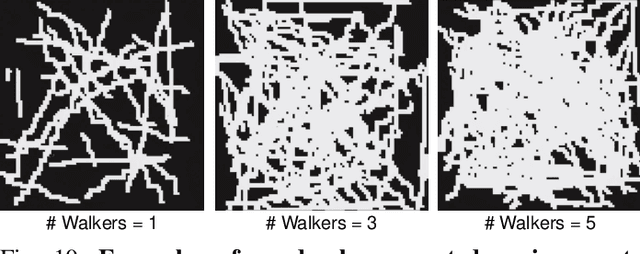
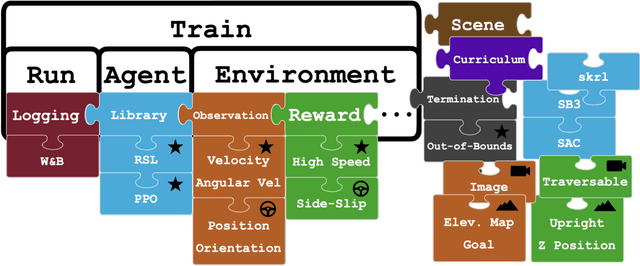
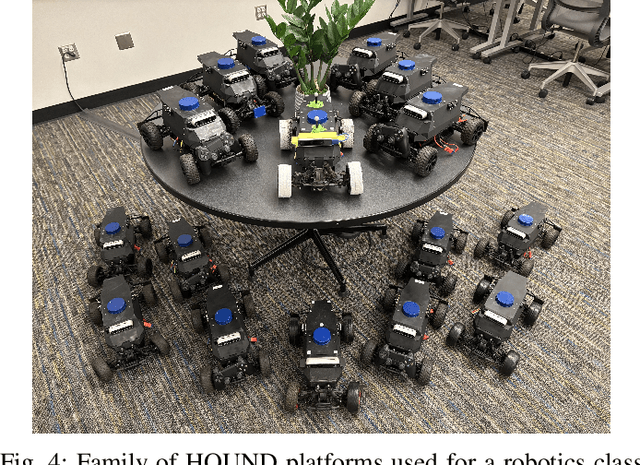
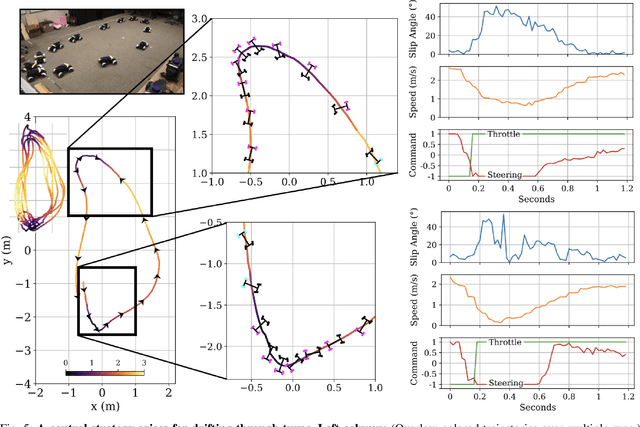
Simulation has been pivotal in recent robotics milestones and is poised to play a prominent role in the field's future. However, recent robotic advances often rely on expensive and high-maintenance platforms, limiting access to broader robotics audiences. This work introduces Wheeled Lab, a framework for the low-cost, open-source wheeled platforms that are already widely established in education and research. Through integration with Isaac Lab, Wheeled Lab introduces modern techniques in Sim2Real, such as domain randomization, sensor simulation, and end-to-end learning, to new user communities. To kickstart education and demonstrate the framework's capabilities, we develop three state-of-the-art policies for small-scale RC cars: controlled drifting, elevation traversal, and visual navigation, each trained in simulation and deployed in the real world. By bridging the gap between advanced Sim2Real methods and affordable, available robotics, Wheeled Lab aims to democratize access to cutting-edge tools, fostering innovation and education in a broader robotics context. The full stack, from hardware to software, is low cost and open-source.