 Add to Chrome
 Add to Firefox
 Add to Edge
Phi-4-reasoning-vision-15B Technical Report
Mar 04, 2026
We present Phi-4-reasoning-vision-15B, a compact open-weight multimodal reasoning model, and share the motivations, design choices, experiments, and learnings that informed its development. Our goal is to contribute practical insight to the research community on building smaller, efficient multimodal reasoning models and to share the result of these learnings as an open-weight model that is good at common vision and language tasks and excels at scientific and mathematical reasoning and understanding user interfaces. Our contributions include demonstrating that careful architecture choices and rigorous data curation enable smaller, open-weight multimodal models to achieve competitive performance with significantly less training and inference-time compute and tokens. The most substantial improvements come from systematic filtering, error correction, and synthetic augmentation -- reinforcing that data quality remains the primary lever for model performance. Systematic ablations show that high-resolution, dynamic-resolution encoders yield consistent improvements, as accurate perception is a prerequisite for high-quality reasoning. Finally, a hybrid mix of reasoning and non-reasoning data with explicit mode tokens allows a single model to deliver fast direct answers for simpler tasks and chain-of-thought reasoning for complex problems.

Phi-4 Technical Report
Dec 12, 2024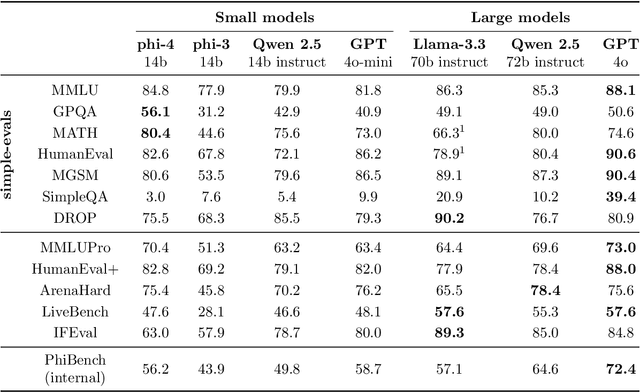
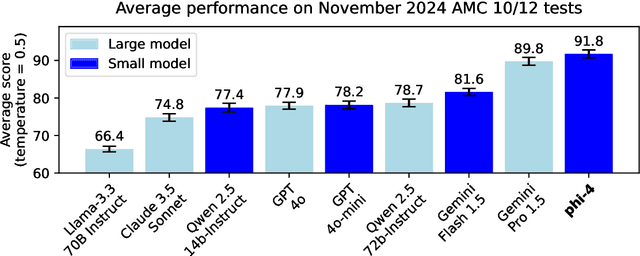

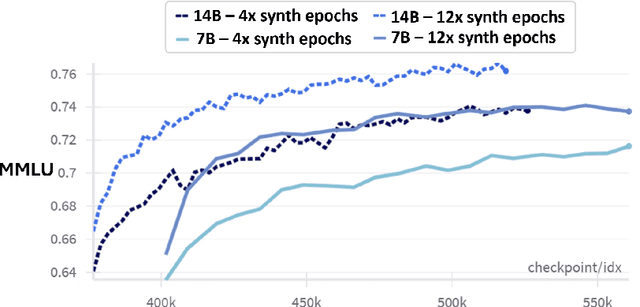
We present phi-4, a 14-billion parameter language model developed with a training recipe that is centrally focused on data quality. Unlike most language models, where pre-training is based primarily on organic data sources such as web content or code, phi-4 strategically incorporates synthetic data throughout the training process. While previous models in the Phi family largely distill the capabilities of a teacher model (specifically GPT-4), phi-4 substantially surpasses its teacher model on STEM-focused QA capabilities, giving evidence that our data-generation and post-training techniques go beyond distillation. Despite minimal changes to the phi-3 architecture, phi-4 achieves strong performance relative to its size -- especially on reasoning-focused benchmarks -- due to improved data, training curriculum, and innovations in the post-training scheme.