 Add to Chrome
 Add to Firefox
 Add to Edge
Barriers to Universal Reasoning With Transformers (And How to Overcome Them)
Apr 28, 2026
Chain-of-Thought (CoT) has been shown to empirically improve Transformers' performance, and theoretically increase their expressivity to Turing completeness. However, whether Transformers can learn to generalize to CoT traces longer than those seen during training is understudied. We use recent theoretical frameworks for Transformer length generalization and find that -- under standard positional encodings and a finite alphabet -- Transformers with CoT cannot solve problems beyond $TC^0$, i.e. the expressivity benefits do not hold under the stricter requirement of length-generalizable learnability. However, if we allow the vocabulary to grow with problem size, we attain a length-generalizable simulation of Turing machines where the CoT trace length is linear in the simulated runtime up to a constant. Our construction overcomes two core obstacles to reliable length generalization: repeated copying and last-occurrence retrieval. We assign each tape position a unique signpost token, and log only value changes to enable recovery of the current tape symbol through counts circumventing both barriers. Further, we empirically show that the use of such signpost tokens and value change encodings provide actionable guidance to improve length generalization on hard problems.

On the Ability of Transformers to Verify Plans
Mar 20, 2026Transformers have shown inconsistent success in AI planning tasks, and theoretical understanding of when generalization should be expected has been limited. We take important steps towards addressing this gap by analyzing the ability of decoder-only models to verify whether a given plan correctly solves a given planning instance. To analyse the general setting where the number of objects -- and thus the effective input alphabet -- grows at test time, we introduce C*-RASP, an extension of C-RASP designed to establish length generalization guarantees for transformers under the simultaneous growth in sequence length and vocabulary size. Our results identify a large class of classical planning domains for which transformers can provably learn to verify long plans, and structural properties that significantly affects the learnability of length generalizable solutions. Empirical experiments corroborate our theory.
Understanding the Emergence of Seemingly Useless Features in Next-Token Predictors
Mar 14, 2026Trained Transformers have been shown to compute abstract features that appear redundant for predicting the immediate next token. We identify which components of the gradient signal from the next-token prediction objective give rise to this phenomenon, and we propose a method to estimate the influence of those components on the emergence of specific features. After validating our approach on toy tasks, we use it to interpret the origins of the world model in OthelloGPT and syntactic features in a small language model. Finally, we apply our framework to a pretrained LLM, showing that features with extremely high or low influence on future tokens tend to be related to formal reasoning domains such as code. Overall, our work takes a step toward understanding hidden features of Transformers through the lens of their development during training.
Discovering Interpretable Algorithms by Decompiling Transformers to RASP
Feb 09, 2026Recent work has shown that the computations of Transformers can be simulated in the RASP family of programming languages. These findings have enabled improved understanding of the expressive capacity and generalization abilities of Transformers. In particular, Transformers have been suggested to length-generalize exactly on problems that have simple RASP programs. However, it remains open whether trained models actually implement simple interpretable programs. In this paper, we present a general method to extract such programs from trained Transformers. The idea is to faithfully re-parameterize a Transformer as a RASP program and then apply causal interventions to discover a small sufficient sub-program. In experiments on small Transformers trained on algorithmic and formal language tasks, we show that our method often recovers simple and interpretable RASP programs from length-generalizing transformers. Our results provide the most direct evidence so far that Transformers internally implement simple RASP programs.
Provably Learning Attention with Queries
Jan 23, 2026We study the problem of learning Transformer-based sequence models with black-box access to their outputs. In this setting, a learner may adaptively query the oracle with any sequence of vectors and observe the corresponding real-valued output. We begin with the simplest case, a single-head softmax-attention regressor. We show that for a model with width $d$, there is an elementary algorithm to learn the parameters of single-head attention exactly with $O(d^2)$ queries. Further, we show that if there exists an algorithm to learn ReLU feedforward networks (FFNs), then the single-head algorithm can be easily adapted to learn one-layer Transformers with single-head attention. Next, motivated by the regime where the head dimension $r \ll d$, we provide a randomised algorithm that learns single-head attention-based models with $O(rd)$ queries via compressed sensing arguments. We also study robustness to noisy oracle access, proving that under mild norm and margin conditions, the parameters can be estimated to $\varepsilon$ accuracy with a polynomial number of queries even when outputs are only provided up to additive tolerance. Finally, we show that multi-head attention parameters are not identifiable from value queries in general -- distinct parameterisations can induce the same input-output map. Hence, guarantees analogous to the single-head setting are impossible without additional structural assumptions.
Systematicity between Forms and Meanings across Languages Supports Efficient Communication
Jan 23, 2026Languages vary widely in how meanings map to word forms. These mappings have been found to support efficient communication; however, this theory does not account for systematic relations within word forms. We examine how a restricted set of grammatical meanings (e.g. person, number) are expressed on verbs and pronouns across typologically diverse languages. Consistent with prior work, we find that verb and pronoun forms are shaped by competing communicative pressures for simplicity (minimizing the inventory of grammatical distinctions) and accuracy (enabling recovery of intended meanings). Crucially, our proposed model uses a novel measure of complexity (inverse of simplicity) based on the learnability of meaning-to-form mappings. This innovation captures fine-grained regularities in linguistic form, allowing better discrimination between attested and unattested systems, and establishes a new connection from efficient communication theory to systematicity in natural language.
System-Mediated Attention Imbalances Make Vision-Language Models Say Yes
Jan 18, 2026Vision-language model (VLM) hallucination is commonly linked to imbalanced allocation of attention across input modalities: system, image and text. However, existing mitigation strategies tend towards an image-centric interpretation of these imbalances, often prioritising increased image attention while giving less consideration to the roles of the other modalities. In this study, we evaluate a more holistic, system-mediated account, which attributes these imbalances to functionally redundant system weights that reduce attention to image and textual inputs. We show that this framework offers a useful empirical perspective on the yes-bias, a common form of hallucination in which VLMs indiscriminately respond 'yes'. Causally redistributing attention from the system modality to image and textual inputs substantially suppresses this bias, often outperforming existing approaches. We further present evidence suggesting that system-mediated attention imbalances contribute to the yes-bias by encouraging a default reliance on coarse input representations, which are effective for some tasks but ill-suited to others. Taken together, these findings firmly establish system attention as a key factor in VLM hallucination and highlight its potential as a lever for mitigation.
The Bayesian Origin of the Probability Weighting Function in Human Representation of Probabilities
Oct 06, 2025Understanding the representation of probability in the human mind has been of great interest to understanding human decision making. Classical paradoxes in decision making suggest that human perception distorts probability magnitudes. Previous accounts postulate a Probability Weighting Function that transforms perceived probabilities; however, its motivation has been debated. Recent work has sought to motivate this function in terms of noisy representations of probabilities in the human mind. Here, we present an account of the Probability Weighting Function grounded in rational inference over optimal decoding from noisy neural encoding of quantities. We show that our model accurately accounts for behavior in a lottery task and a dot counting task. It further accounts for adaptation to a bimodal short-term prior. Taken together, our results provide a unifying account grounding the human representation of probability in rational inference.
One Size Fits None: Rethinking Fairness in Medical AI
Jun 17, 2025Machine learning (ML) models are increasingly used to support clinical decision-making. However, real-world medical datasets are often noisy, incomplete, and imbalanced, leading to performance disparities across patient subgroups. These differences raise fairness concerns, particularly when they reinforce existing disadvantages for marginalized groups. In this work, we analyze several medical prediction tasks and demonstrate how model performance varies with patient characteristics. While ML models may demonstrate good overall performance, we argue that subgroup-level evaluation is essential before integrating them into clinical workflows. By conducting a performance analysis at the subgroup level, differences can be clearly identified-allowing, on the one hand, for performance disparities to be considered in clinical practice, and on the other hand, for these insights to inform the responsible development of more effective models. Thereby, our work contributes to a practical discussion around the subgroup-sensitive development and deployment of medical ML models and the interconnectedness of fairness and transparency.
Position: Pause Recycling LoRAs and Prioritize Mechanisms to Uncover Limits and Effectiveness
Jun 16, 2025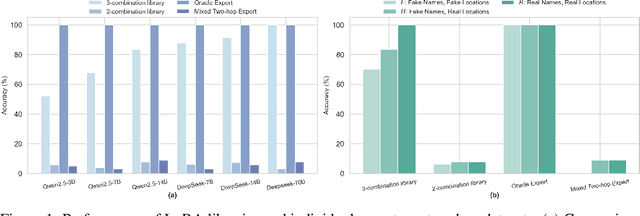
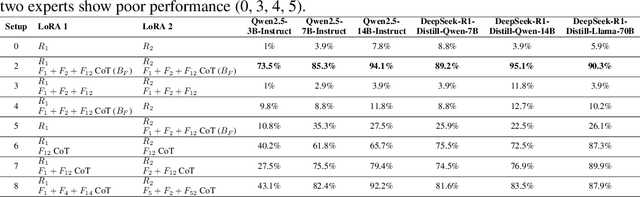
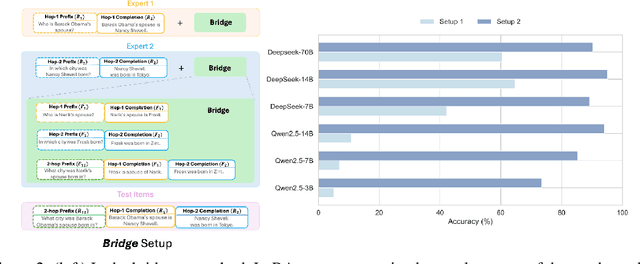

Merging or routing low-rank adapters (LoRAs) has emerged as a popular solution for enhancing large language models, particularly when data access is restricted by regulatory or domain-specific constraints. This position paper argues that the research community should shift its focus from developing new merging or routing algorithms to understanding the conditions under which reusing LoRAs is truly effective. Through theoretical analysis and synthetic two-hop reasoning and math word-problem tasks, we examine whether reusing LoRAs enables genuine compositional generalization or merely reflects shallow pattern matching. Evaluating two data-agnostic methods--parameter averaging and dynamic adapter selection--we found that reusing LoRAs often fails to logically integrate knowledge across disjoint fine-tuning datasets, especially when such knowledge is underrepresented during pretraining. Our empirical results, supported by theoretical insights into LoRA's limited expressiveness, highlight the preconditions and constraints of reusing them for unseen tasks and cast doubt on its feasibility as a truly data-free approach. We advocate for pausing the pursuit of novel methods for recycling LoRAs and emphasize the need for rigorous mechanisms to guide future academic research in adapter-based model merging and practical system designs for practitioners.