 Add to Chrome
 Add to Firefox
 Add to Edge
Algebraic Decomposition Theory for Transformer Length Generalization
Aug 13, 2026
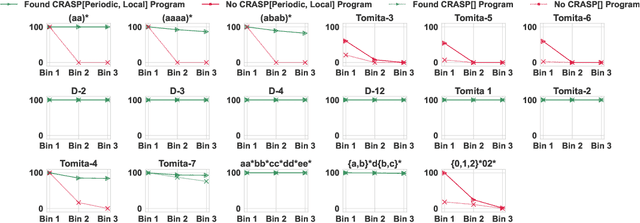
Transformer-based language models are known to sometimes generalize to sequences longer than seen during training, but we lack a precise characterization of which tasks admit length generalization. It is not even known which regular languages transformers length-generalize on -- and this is a foundational class of languages. Our contributions are to establish the first complete characterization of which regular languages transformers length-generalize on and provide a decision algorithm running in polynomial time in the size of the language's syntactic monoid. These results rely on an effective characterization of the regular languages in C-RASP, a recently-established formalism that expresses which languages transformers length-generalize on. This characterization is challenging because classical tools like Krohn-Rhodes decomposition theory for finite semigroups are insufficient for C-RASP. Firstly, the basic building blocks of Krohn-Rhodes theory -- flip-flop and simple groups -- are not expressible in C-RASP. Secondly, the basic building block of C-RASP (unbounded counting) is not expressible by the finite semigroups of Krohn-Rhodes theory. Thus, length generalization on regular languages is controlled by an algebraic property that is invisible to classical finite decomposition theory. We generalize classical decomposition theory from finite semigroups to the infinite additive group on the integers, allowing us to characterize C-RASP in terms of iterated wreath products of the integers and derive a provable polynomial-time decision algorithm for regular language membership. Experiments across a broad test suite of regular languages confirm that our theory captures transformers' length-generalization behavior more accurately than existing classifications.

A Formal Framework for Understanding Length Generalization in Transformers
Oct 03, 2024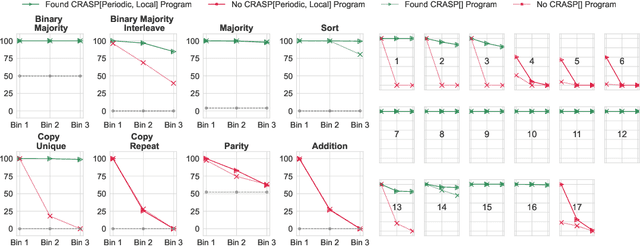


A major challenge for transformers is generalizing to sequences longer than those observed during training. While previous works have empirically shown that transformers can either succeed or fail at length generalization depending on the task, theoretical understanding of this phenomenon remains limited. In this work, we introduce a rigorous theoretical framework to analyze length generalization in causal transformers with learnable absolute positional encodings. In particular, we characterize those functions that are identifiable in the limit from sufficiently long inputs with absolute positional encodings under an idealized inference scheme using a norm-based regularizer. This enables us to prove the possibility of length generalization for a rich family of problems. We experimentally validate the theory as a predictor of success and failure of length generalization across a range of algorithmic and formal language tasks. Our theory not only explains a broad set of empirical observations but also opens the way to provably predicting length generalization capabilities in transformers.