 Add to Chrome
 Add to Firefox
 Add to Edge
GeoDiff3D: Self-Supervised 3D Scene Generation with Geometry-Constrained 2D Diffusion Guidance
Jan 28, 2026
3D scene generation is a core technology for gaming, film/VFX, and VR/AR. Growing demand for rapid iteration, high-fidelity detail, and accessible content creation has further increased interest in this area. Existing methods broadly follow two paradigms - indirect 2D-to-3D reconstruction and direct 3D generation - but both are limited by weak structural modeling and heavy reliance on large-scale ground-truth supervision, often producing structural artifacts, geometric inconsistencies, and degraded high-frequency details in complex scenes. We propose GeoDiff3D, an efficient self-supervised framework that uses coarse geometry as a structural anchor and a geometry-constrained 2D diffusion model to provide texture-rich reference images. Importantly, GeoDiff3D does not require strict multi-view consistency of the diffusion-generated references and remains robust to the resulting noisy, inconsistent guidance. We further introduce voxel-aligned 3D feature aggregation and dual self-supervision to maintain scene coherence and fine details while substantially reducing dependence on labeled data. GeoDiff3D also trains with low computational cost and enables fast, high-quality 3D scene generation. Extensive experiments on challenging scenes show improved generalization and generation quality over existing baselines, offering a practical solution for accessible and efficient 3D scene construction.

An Experimental Evaluation of Imputation Models for Spatial-Temporal Traffic Data
Dec 06, 2024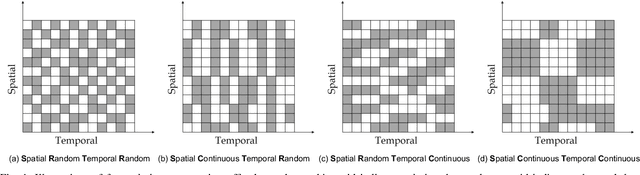
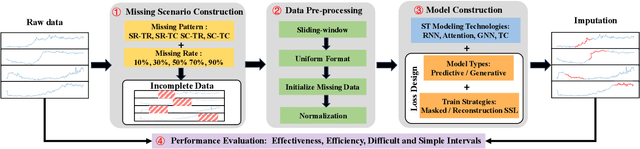
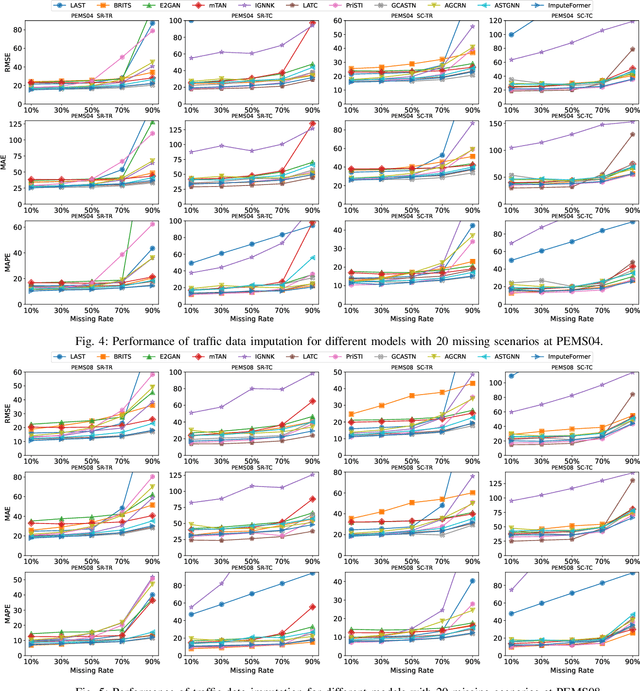
Traffic data imputation is a critical preprocessing step in intelligent transportation systems, enabling advanced transportation services. Despite significant advancements in this field, selecting the most suitable model for practical applications remains challenging due to three key issues: 1) incomprehensive consideration of missing patterns that describe how data loss along spatial and temporal dimensions, 2) the lack of test on standardized datasets, and 3) insufficient evaluations. To this end, we first propose practice-oriented taxonomies for missing patterns and imputation models, systematically identifying all possible forms of real-world traffic data loss and analyzing the characteristics of existing models. Furthermore, we introduce a unified benchmarking pipeline to comprehensively evaluate 10 representative models across various missing patterns and rates. This work aims to provide a holistic understanding of traffic data imputation research and serve as a practical guideline.