 Add to Chrome
 Add to Firefox
 Add to Edge
EgoWAM: World Action Models Beyond Pixels with In-the-Wild Egocentric Human Data
Jul 08, 2026
Egocentric human data offers scalable supervision for robot manipulation. However, behavior cloning entangles transferable content like objects, scenes, and task semantics, with non-transferable factors like human morphology, head motion, and behavioral style. We study whether World Action Models (WAMs) provide a better training signal by requiring policies to predict not only actions, but also how the scene evolves. The central question is what world representation best enables human-to-robot transfer. We hypothesize that an effective world target should abstract appearance, capture agent-invariant physical effects, and separate camera motion from environment change. We introduce EgoWAM, a controlled human-robot co-training framework that fixes the policy backbone, action head, and data mixture while varying only the world prediction target, comparing Pixel, DINO, and 3D motion flow. Across three real-world bimanual tasks, WAM co-training scales more effectively with in-the-wild egocentric human data than behavior cloning. Pixel-based prediction transfers weakly, while DINO and 3D flow yield substantial gains: DINO improves out-of-distribution object and scene generalization by up to 4x, and 3D flow improves in-domain performance by 20-30%. More details: https://gatech-rl2.github.io/egowam.github.io

GRAFT: Graph-Based Affordance Transfer via Part Correspondence
Jun 23, 2026Generalizing robotic manipulation to unseen objects remains challenging, as learning-based approaches require many demonstrations and fail in few-shot settings. Prior work transfers affordances through semantic retrieval, but semantics alone neglect geometric similarity, which is critical for manipulation. We propose GRAFT, a geometry-aware correspondence framework for zero-shot manipulation transfer using only one demonstration per object. Objects are represented as part-based graphs, where part-level descriptors support global instance retrieval and part correspondence, and vertex-level descriptors enable fine-grained contact point matching. For an unseen object, our method first retrieves the most functionally and geometrically similar instance from the demonstration buffer with aligned functional parts, and finally propagates the contact points through point-wise correspondence.
Advancing Object Goal Navigation Through LLM-enhanced Object Affinities Transfer
Mar 15, 2024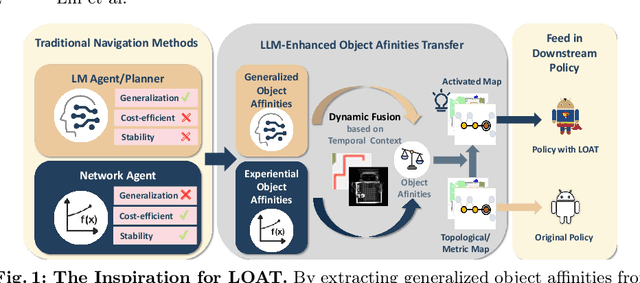
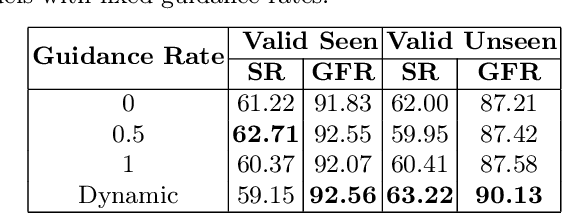
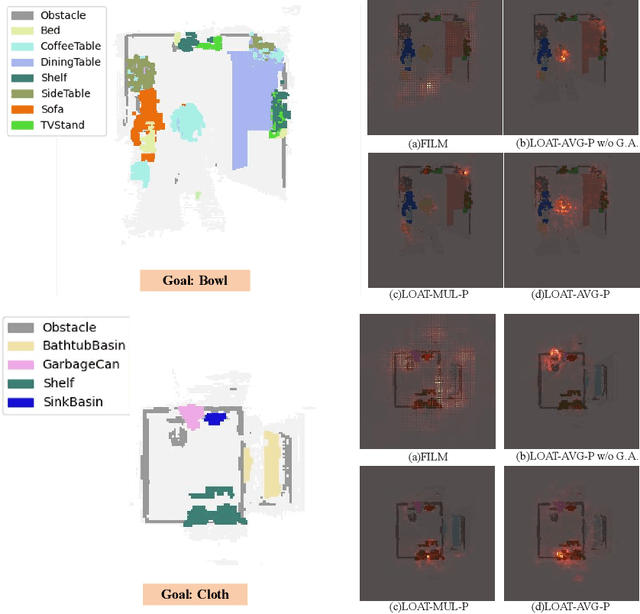
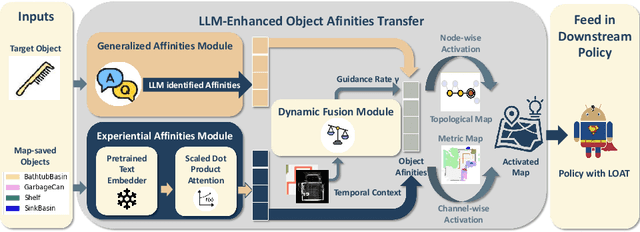
In object goal navigation, agents navigate towards objects identified by category labels using visual and spatial information. Previously, solely network-based methods typically rely on historical data for object affinities estimation, lacking adaptability to new environments and unseen targets. Simultaneously, employing Large Language Models (LLMs) for navigation as either planners or agents, though offering a broad knowledge base, is cost-inefficient and lacks targeted historical experience. Addressing these challenges, we present the LLM-enhanced Object Affinities Transfer (LOAT) framework, integrating LLM-derived object semantics with network-based approaches to leverage experiential object affinities, thus improving adaptability in unfamiliar settings. LOAT employs a dual-module strategy: a generalized affinities module for accessing LLMs' vast knowledge and an experiential affinities module for applying learned object semantic relationships, complemented by a dynamic fusion module harmonizing these information sources based on temporal context. The resulting scores activate semantic maps before feeding into downstream policies, enhancing navigation systems with context-aware inputs. Our evaluations in AI2-THOR and Habitat simulators demonstrate improvements in both navigation success rates and efficiency, validating the LOAT's efficacy in integrating LLM insights for improved object goal navigation.