 Add to Chrome
 Add to Firefox
 Add to Edge
HEad and neCK TumOR (HECKTOR) 2025: Benchmark of Segmentation, Diagnosis, and Prognosis in Multimodal PET/CT
Jun 18, 2026
Head and neck cancers (HNC) represent a significant global health burden, with accurate tumor delineation being essential for effective radiotherapy planning. The complexity of the oropharyngeal anatomy, combined with the heterogeneous appearance of tumors on imaging, makes manual segmentation time-intensive and subject to inter-observer variability. Beyond segmentation, predicting long-term clinical outcomes, such as recurrence-free survival (RFS), and determining human papillomavirus (HPV) status from noninvasive imaging, remain challenging yet clinically valuable goals. The HECKTOR 2025 challenge addresses these needs by establishing a comprehensive benchmark for automated HNC analysis using multimodal PET/CT imaging and electronic health records. Building on previous editions (2020-2022), this challenge features an expanded multi-institutional dataset comprising over 1,100 patients from 10 centers worldwide. Participants were tasked with three complementary objectives: (1) segmenting primary gross tumor volumes (GTVp) and metastatic lymph nodes (GTVn), (2) predicting recurrence-free survival, and (3) classifying HPV status. The challenge attracted 35 registered teams, with 15 final submissions evaluated on a held-out test set. Top-performing algorithms achieved a mean Dice similarity coefficient of 0.75 for segmentation, a concordance index of 0.66 for survival prediction, and a balanced accuracy of 0.56 for HPV classification. This paper presents a comprehensive analysis of the submitted methodologies, evaluates their performance across different lesion characteristics, and discusses their implications for clinical translation in automated oncology workflows and decision support systems.

Towards Brain MRI Foundation Models for the Clinic: Findings from the FOMO25 Challenge
Apr 13, 2026Clinical deployment of automated brain MRI analysis faces a fundamental challenge: clinical data is heterogeneous and noisy, and high-quality labels are prohibitively costly to obtain. Self-supervised learning (SSL) can address this by leveraging the vast amounts of unlabeled data produced in clinical workflows to train robust \textit{foundation models} that adapt out-of-domain with minimal supervision. However, the development of foundation models for brain MRI has been limited by small pretraining datasets and in-domain benchmarking focused on high-quality, research-grade data. To address this gap, we organized the FOMO25 challenge as a satellite event at MICCAI 2025. FOMO25 provided participants with a large pretraining dataset, FOMO60K, and evaluated models on data sourced directly from clinical workflows in few-shot and out-of-domain settings. Tasks covered infarct classification, meningioma segmentation, and brain age regression, and considered both models trained on FOMO60K (method track) and any data (open track). Nineteen foundation models from sixteen teams were evaluated using a standardized containerized pipeline. Results show that (a) self-supervised pretraining improves generalization on clinical data under domain shift, with the strongest models trained \textit{out-of-domain} surpassing supervised baselines trained \textit{in-domain}. (b) No single pretraining objective benefits all tasks: MAE favors segmentation, hybrid reconstruction-contrastive objectives favor classification, and (c) strong performance was achieved by small pretrained models, and improvements from scaling model size and training duration did not yield reliable benefits.
LDPM: Towards undersampled MRI reconstruction with MR-VAE and Latent Diffusion Prior
Nov 05, 2024


Diffusion model, as a powerful generative model, has found a wide range of applications including MRI reconstruction. However, most existing diffusion model-based MRI reconstruction methods operate directly in pixel space, which makes their optimization and inference computationally expensive. Latent diffusion models were introduced to address this problem in natural image processing, but directly applying them to MRI reconstruction still faces many challenges, including the lack of control over the generated results, the adaptability of Variational AutoEncoder (VAE) to MRI, and the exploration of applicable data consistency in latent space. To address these challenges, a Latent Diffusion Prior based undersampled MRI reconstruction (LDPM) method is proposed. A sketcher module is utilized to provide appropriate control and balance the quality and fidelity of the reconstructed MR images. A VAE adapted for MRI tasks (MR-VAE) is explored, which can serve as the backbone for future MR-related tasks. Furthermore, a variation of the DDIM sampler, called the Dual-Stage Sampler, is proposed to achieve high-fidelity reconstruction in the latent space. The proposed method achieves competitive results on fastMRI datasets, and the effectiveness of each module is demonstrated in ablation experiments.
Robust Simultaneous Multislice MRI Reconstruction Using Deep Generative Priors
Jul 31, 2024

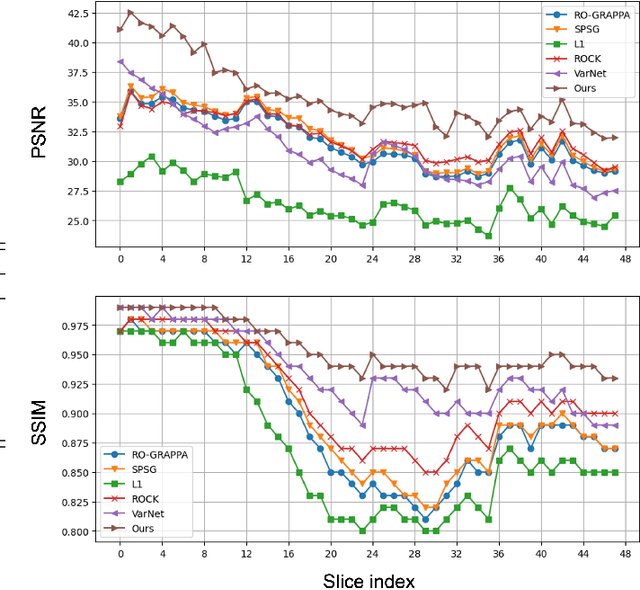
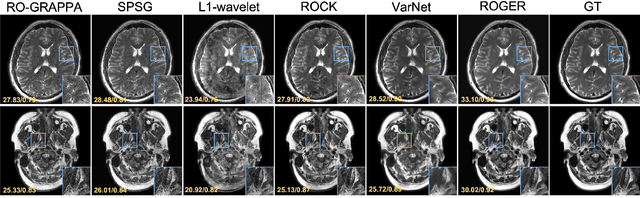
Simultaneous multislice (SMS) imaging is a powerful technique for accelerating magnetic resonance imaging (MRI) acquisitions. However, SMS reconstruction remains challenging due to the complex signal interactions between and within the excited slices. This study presents a robust SMS MRI reconstruction method using deep generative priors. Starting from Gaussian noise, we leverage denoising diffusion probabilistic models (DDPM) to gradually recover the individual slices through reverse diffusion iterations while imposing data consistency from the measured k-space under readout concatenation framework. The posterior sampling procedure is designed such that the DDPM training can be performed on single-slice images without special adjustments for SMS tasks. Additionally, our method integrates a low-frequency enhancement (LFE) module to address a practical issue that SMS-accelerated fast spin echo (FSE) and echo-planar imaging (EPI) sequences cannot easily embed autocalibration signals. Extensive experiments demonstrate that our approach consistently outperforms existing methods and generalizes well to unseen datasets. The code is available at https://github.com/Solor-pikachu/ROGER after the review process.
Noise Level Adaptive Diffusion Model for Robust Reconstruction of Accelerated MRI
Mar 08, 2024In general, diffusion model-based MRI reconstruction methods incrementally remove artificially added noise while imposing data consistency to reconstruct the underlying images. However, real-world MRI acquisitions already contain inherent noise due to thermal fluctuations. This phenomenon is particularly notable when using ultra-fast, high-resolution imaging sequences for advanced research, or using low-field systems favored by low- and middle-income countries. These common scenarios can lead to sub-optimal performance or complete failure of existing diffusion model-based reconstruction techniques. Specifically, as the artificially added noise is gradually removed, the inherent MRI noise becomes increasingly pronounced, making the actual noise level inconsistent with the predefined denoising schedule and consequently inaccurate image reconstruction. To tackle this problem, we propose a posterior sampling strategy with a novel NoIse Level Adaptive Data Consistency (Nila-DC) operation. Extensive experiments are conducted on two public datasets and an in-house clinical dataset with field strength ranging from 0.3T to 3T, showing that our method surpasses the state-of-the-art MRI reconstruction methods, and is highly robust against various noise levels. The code will be released after review.