 Add to Chrome
 Add to Firefox
 Add to Edge
Position Bias in Ordinal Classification: A Systematic Evaluation
Aug 09, 2026
Large language models are increasingly used for ordinal classification, yet semantically equivalent changes to prompt organization can alter their predictions. We conduct systematic experiments to characterize positional bias from label order, demonstration order, and demonstration placement. First, we apply the three probes to ten frontier LLMs on a common ordinal-classification task; every model is sensitive to all three positional sources, showing that the problem is pervasive. Second, we vary eight prompt-, task-, and model-level factors across five datasets; accuracy and stability are often misaligned, and only lower scale cardinality consistently improves both. Third, we compare pointwise, pairwise, and listwise inference, alternative aggregation and debiasing methods, and joint configurations; the tested corrections do not provide a reliable remedy, while a comparison-based listwise formulation offers the best balance but transfers unevenly across models and bias sources. These findings show that positional robustness depends on the full system configuration rather than the model alone. Ordinal-classification systems should therefore be selected jointly for predictive performance and stability.

JailbreakOPT: Tool-Assisted Iterative Jailbreak Prompt Optimization
Jun 09, 2026Jailbreak attacks expose persistent safety weaknesses in large language models (LLMs), but existing stateless single-turn methods face a trade-off: hand-crafted prompts are expressive but static, while iterative prompt optimization can adapt but often relies on low-level mutations that require many target queries. We propose JailbreakOPT, a tool-assisted framework for improving iterative single-turn jailbreak prompt optimization. JailbreakOPT organizes diverse atomic jailbreak prompts into an attack tool library and composes them through a unified intra-episode optimization abstraction to generate stronger standalone attack prompts. To reuse experience across attack episodes, JailbreakOPT further frames tool selection as a contextual bandit problem and applies contextual Thompson sampling to guide exploration and exploitation based on past outcomes. Experiments across multiple target LLMs and attack goals show that JailbreakOPT improves attack success rate (ASR) while reducing the number of attacks until success (No.A) compared with atomic single-turn attacks and existing iterative optimization baselines. This paper may contain offensive or harmful content.
Decoupled Doubly Contrastive Learning for Cross Domain Facial Action Unit Detection
Mar 12, 2025Despite the impressive performance of current vision-based facial action unit (AU) detection approaches, they are heavily susceptible to the variations across different domains and the cross-domain AU detection methods are under-explored. In response to this challenge, we propose a decoupled doubly contrastive adaptation (D$^2$CA) approach to learn a purified AU representation that is semantically aligned for the source and target domains. Specifically, we decompose latent representations into AU-relevant and AU-irrelevant components, with the objective of exclusively facilitating adaptation within the AU-relevant subspace. To achieve the feature decoupling, D$^2$CA is trained to disentangle AU and domain factors by assessing the quality of synthesized faces in cross-domain scenarios when either AU or domain attributes are modified. To further strengthen feature decoupling, particularly in scenarios with limited AU data diversity, D$^2$CA employs a doubly contrastive learning mechanism comprising image and feature-level contrastive learning to ensure the quality of synthesized faces and mitigate feature ambiguities. This new framework leads to an automatically learned, dedicated separation of AU-relevant and domain-relevant factors, and it enables intuitive, scale-specific control of the cross-domain facial image synthesis. Extensive experiments demonstrate the efficacy of D$^2$CA in successfully decoupling AU and domain factors, yielding visually pleasing cross-domain synthesized facial images. Meanwhile, D$^2$CA consistently outperforms state-of-the-art cross-domain AU detection approaches, achieving an average F1 score improvement of 6\%-14\% across various cross-domain scenarios.
* Accepted by IEEE Transactions on Image Processing 2025. A novel and elegant feature decoupling method for cross-domain facial action unit detection
PoliPrompt: A High-Performance Cost-Effective LLM-Based Text Classification Framework for Political Science
Sep 02, 2024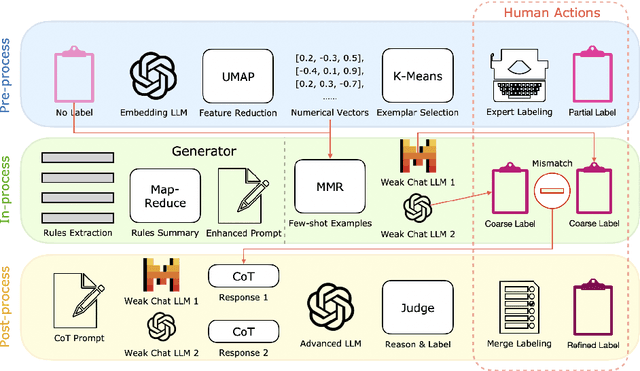
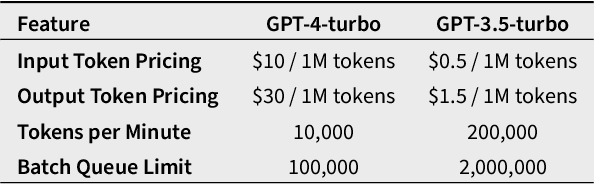
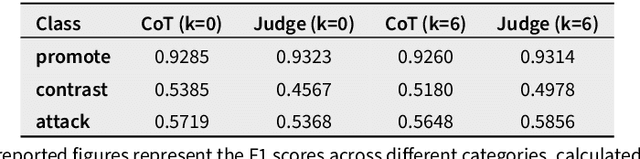
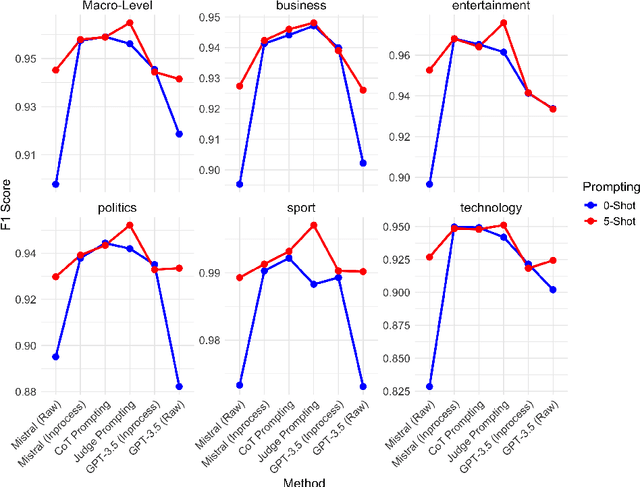
Recent advancements in large language models (LLMs) have opened new avenues for enhancing text classification efficiency in political science, surpassing traditional machine learning methods that often require extensive feature engineering, human labeling, and task-specific training. However, their effectiveness in achieving high classification accuracy remains questionable. This paper introduces a three-stage in-context learning approach that leverages LLMs to improve classification accuracy while minimizing experimental costs. Our method incorporates automatic enhanced prompt generation, adaptive exemplar selection, and a consensus mechanism that resolves discrepancies between two weaker LLMs, refined by an advanced LLM. We validate our approach using datasets from the BBC news reports, Kavanaugh Supreme Court confirmation, and 2018 election campaign ads. The results show significant improvements in classification F1 score (+0.36 for zero-shot classification) with manageable economic costs (-78% compared with human labeling), demonstrating that our method effectively addresses the limitations of traditional machine learning while offering a scalable and reliable solution for text analysis in political science.