 Add to Chrome
 Add to Firefox
 Add to Edge
Reliability-Aware 3D Geometric Injection for Universal Person Re-identification
Jul 21, 2026
Universal person re-identification (ReID) aims to retrieve pedestrian identities across diverse real-world scenarios, including severe occlusions, clothing changes, and cross-modality shifts, within a unified model. However, existing 2D representations fundamentally struggle with spatial ambiguities due to a lack of depth and topological awareness, while naively introducing monocular 3D priors often causes severe negative transfer due to geometric estimation noise under extreme visual degradation. To safely harness the clothing-invariant and canonical structural properties of 3D geometry, we propose UniGeo, a Universal Monocular 3D-Enhanced ReID framework driven by a Consistency-Aware Reliability Gate and Dual-Stream Residual Fusion. Specifically, the processing of 3D information is strategically decoupled into geometric extraction and dynamic utilization. To provide pure structural compensation, we project monocular 3D parameters into kinematic joint representations, explicitly capturing instance-level geometric topology to resolve appearance-based ambiguities. To robustly incorporate these cues without perturbing the reliable 2D feature space, we isolate the 3D prior as a late-stage structural residual; modulated by the consistency-aware gate, this mechanism adaptively filters geometric noise and enables controlled fallback to the pure 2D baseline. Extensive experiments show that our method improves challenging, structure-sensitive scenarios while preserving competitive performance on clean domains. Code is available at https://github.com/BohanSu/UniGeo.

An Edge-aware Prompt-enhanced SAM for Ultrasound Image Segmentation
Jul 08, 2026Ultrasound image segmentation is essential for delineating anatomical structures and lesions, providing the foundation for accurate diagnosis. While the Segment Anything Model (SAM) has demonstrated remarkable success on natural images, its performance on ultrasound data is often hindered by poor boundary delineation. To address this limitation, we propose EP-SAM, an edge-aware and prompt-enhanced adaptation of SAM. Specifically, we leverage multi-block feature extraction from the image encoder to enrich coarse-to-fine semantic representations, while edge-aware supervision of the image encoder improves robustness to contour ambiguity and speckle noise. By integrating these complementary cues, EP-SAM generates high-quality prompts that effectively guide the model toward target regions of interest. Experimental results on multiple benchmarks demonstrate that EP-SAM consistently outperforms existing SAM-based methods.
JailbreakOPT: Tool-Assisted Iterative Jailbreak Prompt Optimization
Jun 09, 2026Jailbreak attacks expose persistent safety weaknesses in large language models (LLMs), but existing stateless single-turn methods face a trade-off: hand-crafted prompts are expressive but static, while iterative prompt optimization can adapt but often relies on low-level mutations that require many target queries. We propose JailbreakOPT, a tool-assisted framework for improving iterative single-turn jailbreak prompt optimization. JailbreakOPT organizes diverse atomic jailbreak prompts into an attack tool library and composes them through a unified intra-episode optimization abstraction to generate stronger standalone attack prompts. To reuse experience across attack episodes, JailbreakOPT further frames tool selection as a contextual bandit problem and applies contextual Thompson sampling to guide exploration and exploitation based on past outcomes. Experiments across multiple target LLMs and attack goals show that JailbreakOPT improves attack success rate (ASR) while reducing the number of attacks until success (No.A) compared with atomic single-turn attacks and existing iterative optimization baselines. This paper may contain offensive or harmful content.
View Confusion Feature Learning for Person Re-identification
Oct 09, 2019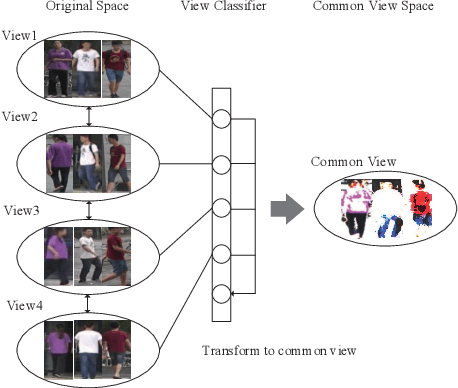
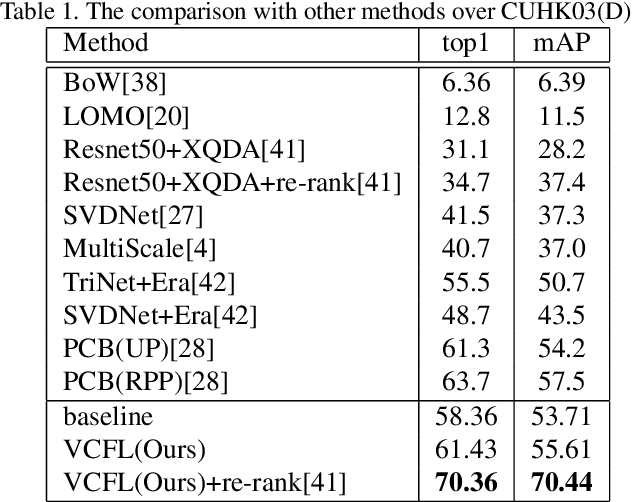
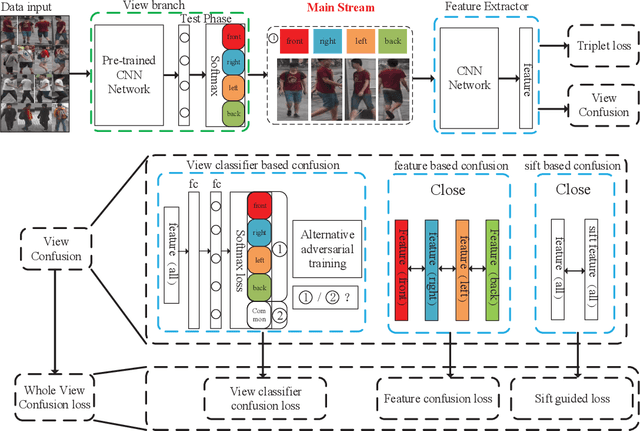
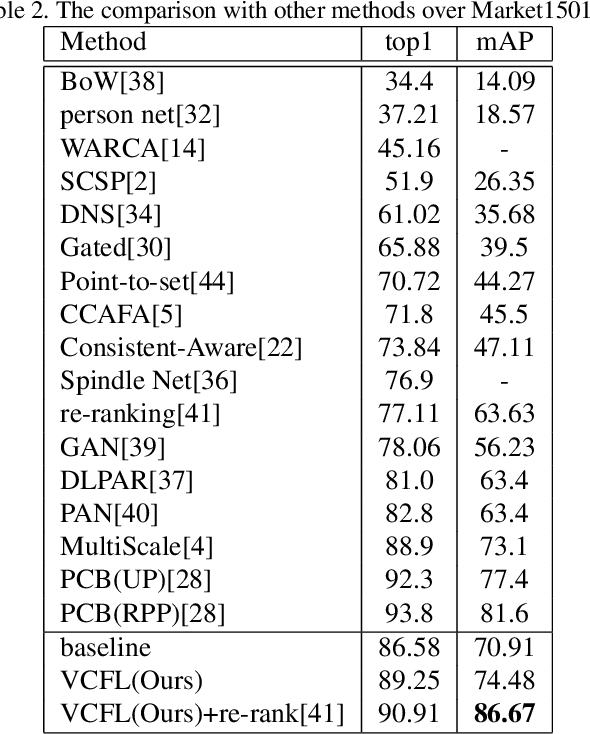
Person re-identification is an important task in video surveillance that aims to associate people across camera views at different locations and time. View variability is always a challenging problem seriously degrading person re-identification performance. Most of the existing methods either focus on how to learn view invariant feature or how to combine view-wise features. In this paper, we mainly focus on how to learn view-invariant features by getting rid of view specific information through a view confusion learning mechanism. Specifically, we propose an end-toend trainable framework, called View Confusion Feature Learning (VCFL), for person Re-ID across cameras. To the best of our knowledge, VCFL is originally proposed to learn view-invariant identity-wise features, and it is a kind of combination of view-generic and view-specific methods. Classifiers and feature centers are utilized to achieve view confusion. Furthermore, we extract sift-guided features by using bag-of-words model to help supervise the training of deep networks and enhance the view invariance of features. In experiments, our approach is validated on three benchmark datasets including CUHK01, CUHK03, and MARKET1501, which show the superiority of the proposed method over several state-of-the-art approaches