 Add to Chrome
 Add to Firefox
 Add to Edge
CUDA MPC: A GPU-Native Solver for Model Predictive Control
Aug 04, 2026
Model Predictive Control (MPC) delivers constraint-aware control, but its reliance on online optimization limits its use on systems with fast dynamics, high-dimensional models, or long horizons. Existing GPU implementations typically treat the device as a linear-algebra accelerator, leaving the optimization loop dependent on repeated kernel launches and high-latency memory transfers. This paper introduces CUDA MPC, a GPU-native MPC framework that co-designs the optimization algorithm, execution model, and memory architecture for CUDA hardware. CUDA MPC pairs a parallel-in-horizon alternating direction method of multipliers (ADMM) splitting with a fused CUDA kernel that runs the entire iterative solve on the device. Intermediate optimization variables stay in low-latency, on-chip shared memory, and a localized atomic-flag protocol synchronizes only adjacent horizon blocks, minimizing host intervention, kernel-dispatch overhead, and global-memory traffic. Across six nonlinear robotics benchmarks spanning increasing state dimension and constraint density, CUDA MPC sustains real-time rates at horizons one to two orders of magnitude longer than CPU solvers: it solves an optimization-based collision-avoidance parking problem with 100 s of lookahead within a 0.1 s sampling interval, and is the only solver evaluated that achieves both real-time execution and collision-free coordination for a centralized 10-agent swarm, where acados and CasADi return no feasible solution and require 3.5 s and 4.5 s per solve. Against tensor-framework implementations of the same ADMM splitting, the fused kernel is up to $965\times$ faster.

Tiny Learning-Based MPC for Multirotors: Solver-Aware Learning for Efficient Embedded Predictive Control
Oct 31, 2024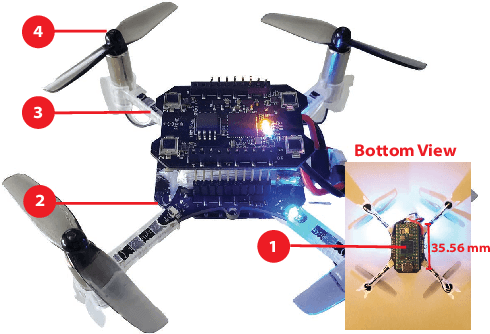
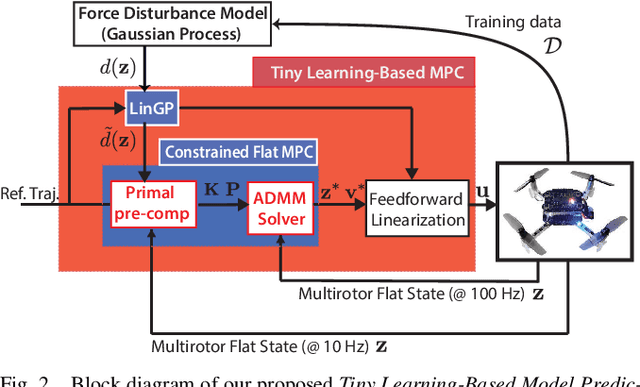
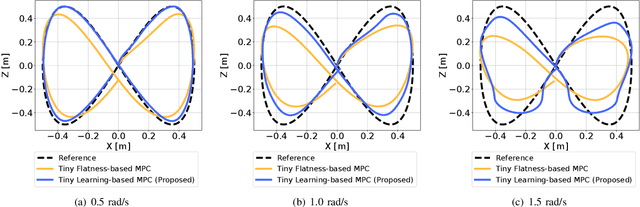
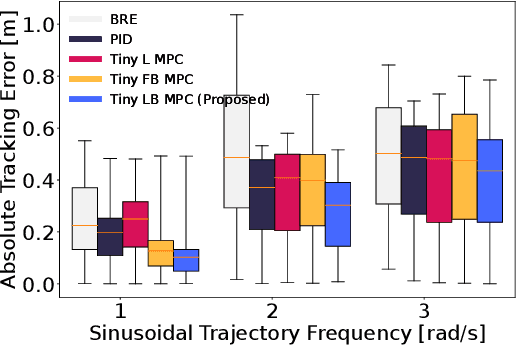
Tiny aerial robots show promise for applications like environmental monitoring and search-and-rescue but face challenges in control due to their limited computing power and complex dynamics. Model Predictive Control (MPC) can achieve agile trajectory tracking and handle constraints. Although current learning-based MPC methods, such as Gaussian Process (GP) MPC, improve control performance by learning residual dynamics, they are computationally demanding, limiting their onboard application on tiny robots. This paper introduces Tiny Learning-Based Model Predictive Control (LB MPC), a novel framework for resource-constrained micro multirotor platforms. By exploiting multirotor dynamics' structure and developing an efficient solver, our approach enables high-rate control at 100 Hz on a Crazyflie 2.1 with a Teensy 4.0 microcontroller. We demonstrate a 23\% average improvement in tracking performance over existing embedded MPC methods, achieving the first onboard implementation of learning-based MPC on a tiny multirotor (53 g).
A Computationally Efficient Learning-Based Model Predictive Control for Multirotors under Aerodynamic Disturbances
Feb 15, 2024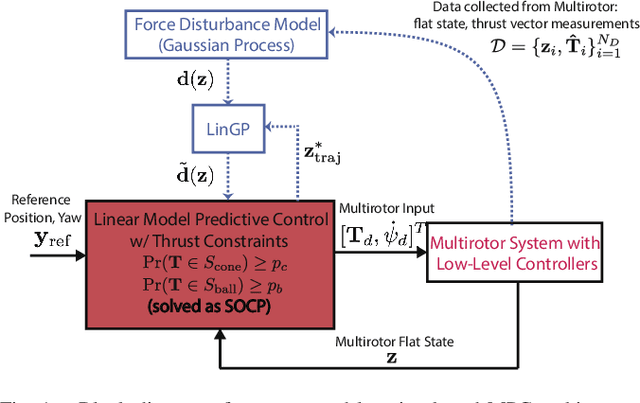
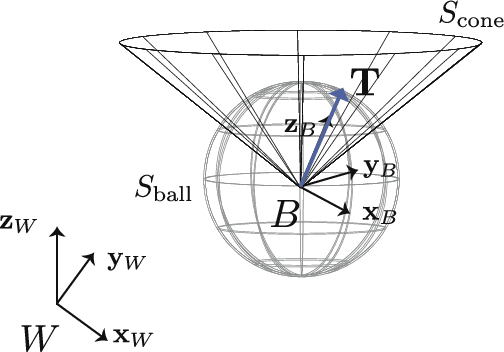
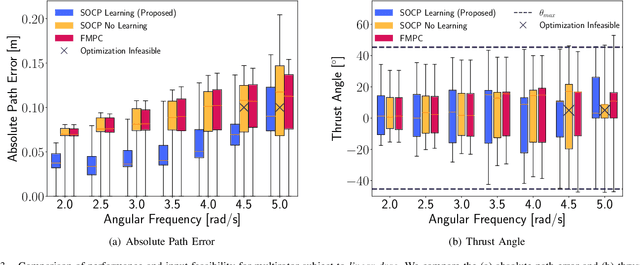
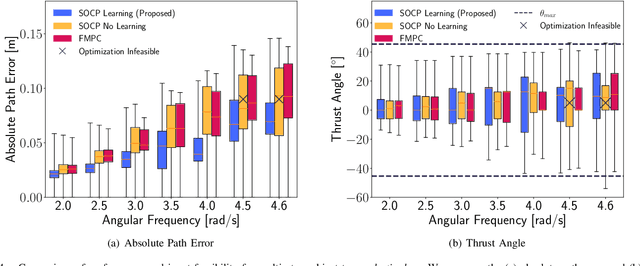
Neglecting complex aerodynamic effects hinders high-speed yet high-precision multirotor autonomy. In this paper, we present a computationally efficient learning-based model predictive controller that simultaneously optimizes a trajectory that can be tracked within the physical limits (on thrust and orientation) of the multirotor system despite unknown aerodynamic forces and adapts the control input. To do this, we leverage the well-known differential flatness property of multirotors, which allows us to transform their nonlinear dynamics into a linear model. The main limitation of current flatness-based planning and control approaches is that they often neglect dynamic feasibility. This is because these constraints are nonlinear as a result of the mapping between the input, i.e., multirotor thrust, and the flat state. In our approach, we learn a novel representation of the drag forces by learning the mapping from the flat state to the multirotor thrust vector (in a world frame) as a Gaussian Process (GP). Our proposed approach leverages the properties of GPs to develop a convex optimal controller that can be iteratively solved as a second-order cone program (SOCP). In simulation experiments, our proposed approach outperforms related model predictive controllers that do not account for aerodynamic effects on trajectory feasibility, leading to a reduction of up to 55% in absolute tracking error.