 Add to Chrome
 Add to Firefox
 Add to Edge
YuFeng-XGuard: A Reasoning-Centric, Interpretable, and Flexible Guardrail Model for Large Language Models
Jan 22, 2026
As large language models (LLMs) are increasingly deployed in real-world applications, safety guardrails are required to go beyond coarse-grained filtering and support fine-grained, interpretable, and adaptable risk assessment. However, existing solutions often rely on rapid classification schemes or post-hoc rules, resulting in limited transparency, inflexible policies, or prohibitive inference costs. To this end, we present YuFeng-XGuard, a reasoning-centric guardrail model family designed to perform multi-dimensional risk perception for LLM interactions. Instead of producing opaque binary judgments, YuFeng-XGuard generates structured risk predictions, including explicit risk categories and configurable confidence scores, accompanied by natural language explanations that expose the underlying reasoning process. This formulation enables safety decisions that are both actionable and interpretable. To balance decision latency and explanatory depth, we adopt a tiered inference paradigm that performs an initial risk decision based on the first decoded token, while preserving ondemand explanatory reasoning when required. In addition, we introduce a dynamic policy mechanism that decouples risk perception from policy enforcement, allowing safety policies to be adjusted without model retraining. Extensive experiments on a diverse set of public safety benchmarks demonstrate that YuFeng-XGuard achieves stateof-the-art performance while maintaining strong efficiency-efficacy trade-offs. We release YuFeng-XGuard as an open model family, including both a full-capacity variant and a lightweight version, to support a wide range of deployment scenarios.

Adapters for Enhanced Modeling of Multilingual Knowledge and Text
Oct 26, 2022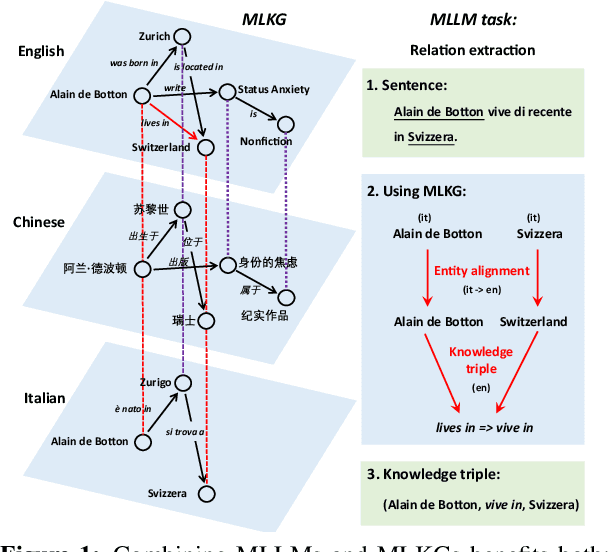
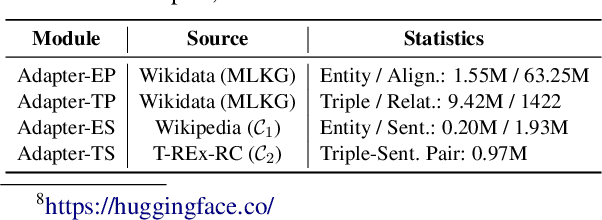
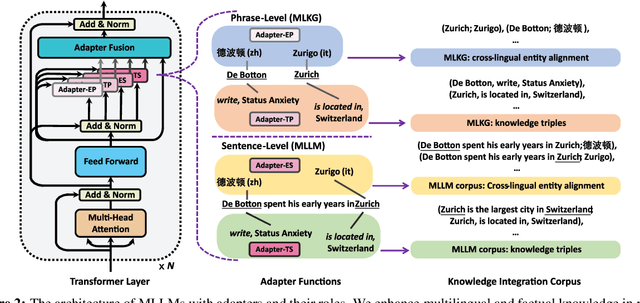
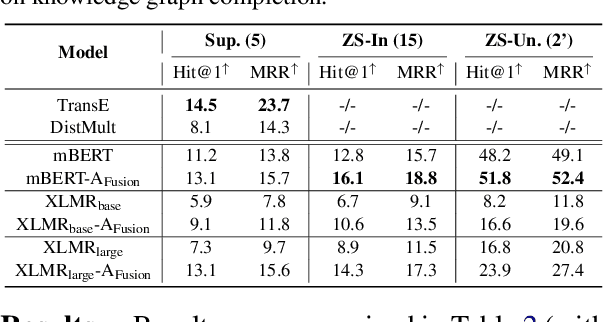
Large language models appear to learn facts from the large text corpora they are trained on. Such facts are encoded implicitly within their many parameters, making it difficult to verify or manipulate what knowledge has been learned. Language models have recently been extended to multilingual language models (MLLMs), enabling knowledge to be learned across hundreds of languages. Meanwhile, knowledge graphs contain facts in an explicit triple format, which require careful and costly curation and are only available in a few high-resource languages, restricting their research and application. To address these issues, we propose to enhance MLLMs with knowledge from multilingual knowledge graphs (MLKGs) so as to tackle language and knowledge graph tasks across many languages, including low-resource ones. Specifically, we introduce a lightweight adapter set to enhance MLLMs with cross-lingual entity alignment and facts from MLKGs for many languages. Experiments on common benchmarks show that such enhancement benefits both MLLMs and MLKGs, achieving: (1) comparable or improved performance for knowledge graph completion and entity alignment relative to baselines, especially for low-resource languages (for which knowledge graphs are unavailable); and (2) improved MLLM performance on language understanding tasks that require multilingual factual knowledge; all while maintaining performance on other general language tasks.