 Add to Chrome
 Add to Firefox
 Add to Edge
DLink: Distilling Layer-wise and Dominant Knowledge from EEG Foundation Models
Apr 16, 2026
EEG foundation models (FMs) achieve strong cross-subject and cross-task generalization but impose substantial computational and memory costs that hinder deployment on embedded BCI systems. Knowledge distillation is a natural solution; however, conventional methods fail for EEG FMs because task-relevant semantics are often distributed across intermediate layers, and aggressive dimensionality reduction can distort oscillatory structure via representational collapse and aliasing. To address these challenges, we propose DLink (Distilling Layer-wise and Dominant Knowledge), a unified framework for transferring knowledge from large EEG FMs to compact students with three key innovations: (1) a dynamic Router that adaptively aggregates teacher layers to capture dominant intermediate representations; (2) an EEG MiC student with a Mimic-then-Compress pipeline, which inherits high-dimensional teacher features and then applies structured spatio-temporal compression to avoid a heavy classification head; and (3) spectral distillation that aligns teacher-student representations in the frequency domain to regularize compression and mitigate aliasing and temporal jitter. Experiments on four EEG benchmarks show that DLink enables compact students to outperform lightweight baselines while approaching fully fine-tuned FM performance at substantially lower model size and inference cost.

Exact Fit Attention in Node-Holistic Graph Convolutional Network for Improved EEG-Based Driver Fatigue Detection
Jan 25, 2025EEG-based fatigue monitoring can effectively reduce the incidence of related traffic accidents. In the past decade, with the advancement of deep learning, convolutional neural networks (CNN) have been increasingly used for EEG signal processing. However, due to the data's non-Euclidean characteristics, existing CNNs may lose important spatial information from EEG, specifically channel correlation. Thus, we propose the node-holistic graph convolutional network (NHGNet), a model that uses graphic convolution to dynamically learn each channel's features. With exact fit attention optimization, the network captures inter-channel correlations through a trainable adjacency matrix. The interpretability is enhanced by revealing critical areas of brain activity and their interrelations in various mental states. In validations on two public datasets, NHGNet outperforms the SOTAs. Specifically, in the intra-subject, NHGNet improved detection accuracy by at least 2.34% and 3.42%, and in the inter-subjects, it improved by at least 2.09% and 15.06%. Visualization research on the model revealed that the central parietal area plays an important role in detecting fatigue levels, whereas the frontal and temporal lobes are essential for maintaining vigilance.
A Dynamic Domain Adaptation Deep Learning Network for EEG-based Motor Imagery Classification
Sep 21, 2023
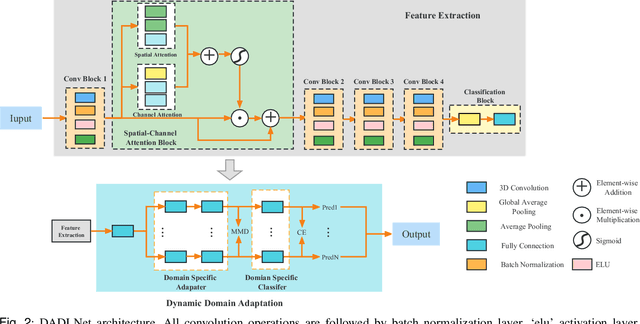
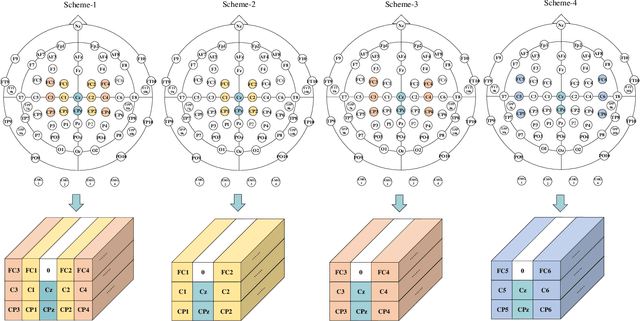
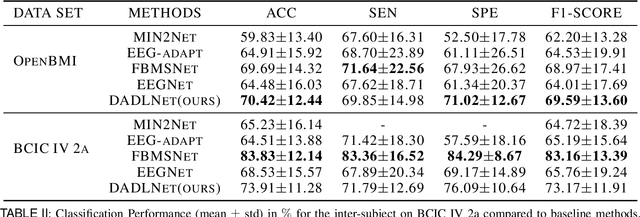
There is a correlation between adjacent channels of electroencephalogram (EEG), and how to represent this correlation is an issue that is currently being explored. In addition, due to inter-individual differences in EEG signals, this discrepancy results in new subjects need spend a amount of calibration time for EEG-based motor imagery brain-computer interface. In order to solve the above problems, we propose a Dynamic Domain Adaptation Based Deep Learning Network (DADL-Net). First, the EEG data is mapped to the three-dimensional geometric space and its temporal-spatial features are learned through the 3D convolution module, and then the spatial-channel attention mechanism is used to strengthen the features, and the final convolution module can further learn the spatial-temporal information of the features. Finally, to account for inter-subject and cross-sessions differences, we employ a dynamic domain-adaptive strategy, the distance between features is reduced by introducing a Maximum Mean Discrepancy loss function, and the classification layer is fine-tuned by using part of the target domain data. We verify the performance of the proposed method on BCI competition IV 2a and OpenBMI datasets. Under the intra-subject experiment, the accuracy rates of 70.42% and 73.91% were achieved on the OpenBMI and BCIC IV 2a datasets.