 Add to Chrome
 Add to Firefox
 Add to Edge
Deep-learning Causal Retrieval Optimization for Efficient e-commerce Distribution in Pinterest
Jul 14, 2026
Pinterest is where people turn inspiration into action as users browse ideas, then take steps toward realization, often by discovering shoppable content. To support this journey, we must distribute commerce content when it helps, not when it distracts. We frame this as a causal decision of triggering shopping candidate generators in early retrieval and deploy a production system at Pinterest that learns personalized and contextualized triggering policies. A deep multi-task model jointly predicts outcomes and uplift of multiple events, trained with a doubly-robust pseudo-outcome alongside calibrated outcome losses for stable, single-robust uplift learning. A randomized data logging supplies counterfactual coverage, and the model is evaluated by both regular and reverse metrics for full assessment. A linear-time offline replay is designed to select thresholds and forecast policy impact with extremely high consistency with online results. For productionization, the model runs in parallel with remote retrieval calls without end-to-end latency regression. At web scale, we cut shopping triggers by up to 85% while holding key shopping sessions neutral, improving important total sessions (+0.26%) and Pin saves (+1.10%), with significant infrastructure savings. By unifying deep causal learning with reliable offline replay and demonstrating production-grade deployment, this work provides a generally practical recipe for early-retrieval optimizations in modern cascading recommenders beyond shopping, aligning exploration and cost with user intent at scale.

Deep Reinforcement Learning for Ranking Utility Tuning in the Ad Recommender System at Pinterest
Sep 05, 2025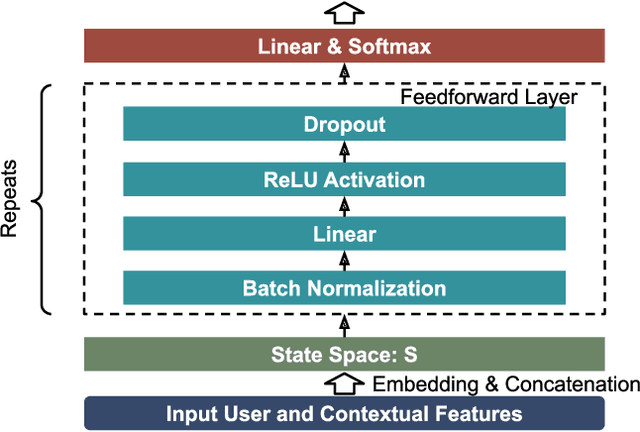
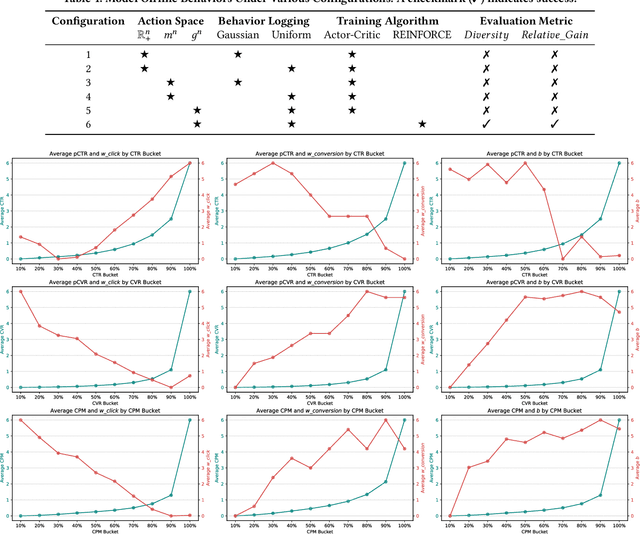
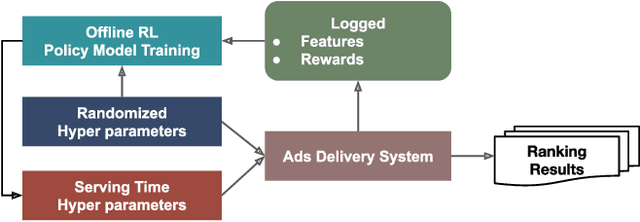
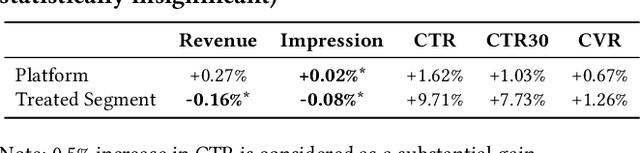
The ranking utility function in an ad recommender system, which linearly combines predictions of various business goals, plays a central role in balancing values across the platform, advertisers, and users. Traditional manual tuning, while offering simplicity and interpretability, often yields suboptimal results due to its unprincipled tuning objectives, the vast amount of parameter combinations, and its lack of personalization and adaptability to seasonality. In this work, we propose a general Deep Reinforcement Learning framework for Personalized Utility Tuning (DRL-PUT) to address the challenges of multi-objective optimization within ad recommender systems. Our key contributions include: 1) Formulating the problem as a reinforcement learning task: given the state of an ad request, we predict the optimal hyperparameters to maximize a pre-defined reward. 2) Developing an approach to directly learn an optimal policy model using online serving logs, avoiding the need to estimate a value function, which is inherently challenging due to the high variance and unbalanced distribution of immediate rewards. We evaluated DRL-PUT through an online A/B experiment in Pinterest's ad recommender system. Compared to the baseline manual utility tuning approach, DRL-PUT improved the click-through rate by 9.7% and the long click-through rate by 7.7% on the treated segment. We conducted a detailed ablation study on the impact of different reward definitions and analyzed the personalization aspect of the learned policy model.
RecoMind: A Reinforcement Learning Framework for Optimizing In-Session User Satisfaction in Recommendation Systems
Jul 31, 2025Existing web-scale recommendation systems commonly use supervised learning methods that prioritize immediate user feedback. Although reinforcement learning (RL) offers a solution to optimize longer-term goals, such as in-session engagement, applying it at web scale is challenging due to the extremely large action space and engineering complexity. In this paper, we introduce RecoMind, a simulator-based RL framework designed for the effective optimization of session-based goals at web-scale. RecoMind leverages existing recommendation models to establish a simulation environment and to bootstrap the RL policy to optimize immediate user interactions from the outset. This method integrates well with existing industry pipelines, simplifying the training and deployment of RL policies. Additionally, RecoMind introduces a custom exploration strategy to efficiently explore web-scale action spaces with hundreds of millions of items. We evaluated RecoMind through extensive offline simulations and online A/B testing on a video streaming platform. Both methods showed that the RL policy trained using RecoMind significantly outperforms traditional supervised learning recommendation approaches in in-session user satisfaction. In online A/B tests, the RL policy increased videos watched for more than 10 seconds by 15.81\% and improved session depth by 4.71\% for sessions with at least 10 interactions. As a result, RecoMind presents a systematic and scalable approach for embedding RL into web-scale recommendation systems, showing great promise for optimizing session-based user satisfaction.