 Add to Chrome
 Add to Firefox
 Add to Edge
FLINT: Fingerprinting Federated Learning Architectures from 5G PHY-Layer Side Channels
Jul 16, 2026
Federated Learning (FL) over 5G cellular networks protects raw data but remains vulnerable to side-channel leakage. Prior fingerprinting attacks assume packet-level network visibility, an assumption that does not hold at the 5G Physical (PHY) layer, where user payloads are encrypted and Radio Network Temporary Identifiers (RNTIs) may change over time. However, we demonstrate that PHY-layer scheduling metadata broadcast over the Physical Downlink Control Channel (PDCCH) preserves architecture-associated temporal patterns. We introduce FLINT, a novel black-box fingerprinting framework that infers FL model architecture families, including CNNs, RNNs, and Transformers, using only coarse PHY-layer observations. FLINT overcomes the lack of network-layer visibility by decoding PDCCH scheduling information, mapping changing RNTIs to physical user devices, and applying multi-view temporal modeling to distinguish architecture-specific training behavior. This leakage is security-critical because knowledge of a client's model architecture can transform passive reconnaissance into targeted downstream exploitation. Extensive experiments on an over-the-air srsRAN-based 5G testbed demonstrate that FLINT achieves a macro F1-score of 0.930 for architecture-family classification. To our knowledge, FLINT is the first work to fingerprint AI/ML model architectures using lower-layer 5G side-channel information obtainable by any protocol-aware adversary.

Towards Intelligent Legal Document Analysis: CNN-Driven Classification of Case Law Texts
Apr 20, 2026Legal practitioners and judicial institutions face an ever-growing volume of case-law documents characterised by formalised language, lengthy sentence structures, and highly specialised terminology, making manual triage both time-consuming and error-prone. This work presents a lightweight yet high-accuracy framework for citation-treatment classification that pairs lemmatisation-based preprocessing with subword-aware FastText embeddings and a multi-kernel one-dimensional Convolutional Neural Network (CNN). Evaluated on a publicly available corpus of 25,000 annotated legal documents with a 75/25 training-test partition, the proposed system achieves 97.26% classification accuracy and a macro F1-score of 96.82%, surpassing established baselines including fine-tuned BERT, Long Short-Term Memory (LSTM) with FastText, CNN with random embeddings, and a Term Frequency-Inverse Document Frequency (TF-IDF) k-Nearest Neighbour (KNN) classifier. The model also attains the highest Area Under the Receiver Operating Characteristic (AUC-ROC) curve of 97.83% among all compared systems while operating with only 5.1 million parameters and an inference latency of 0.31 ms per document - more than 13 times faster than BERT. Ablation experiments confirm the individual contribution of each pipeline component, and the confusion matrix reveals that residual errors are confined to semantically adjacent citation categories. These findings indicate that carefully designed convolutional architectures represent a scalable, resource-efficient alternative to heavyweight transformers for intelligent legal document analysis.
PHANTOM: PHysical ANamorphic Threats Obstructing Connected Vehicle Mobility
Dec 15, 2025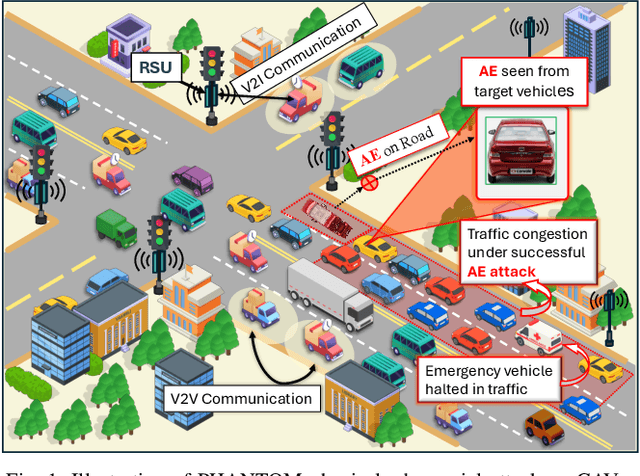
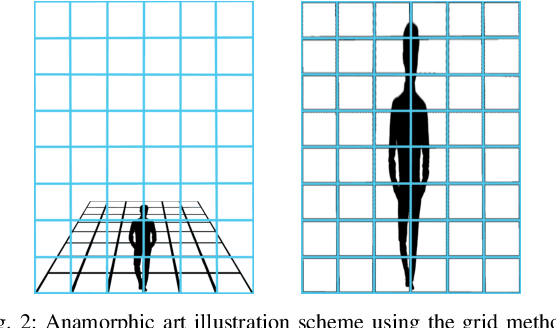
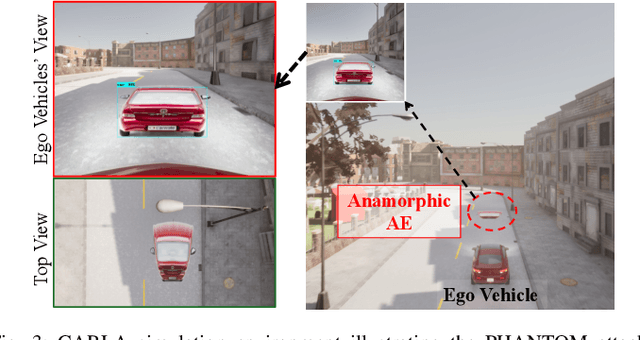
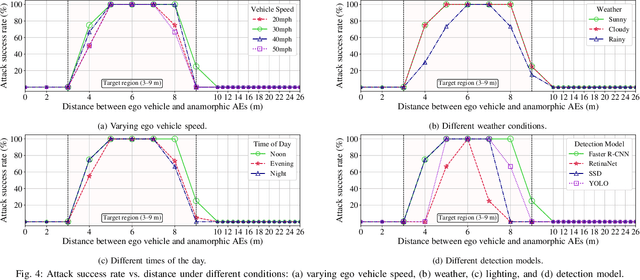
Connected autonomous vehicles (CAVs) rely on vision-based deep neural networks (DNNs) and low-latency (Vehicle-to-Everything) V2X communication to navigate safely and efficiently. Despite their advances, these systems remain vulnerable to physical adversarial attacks. In this paper, we introduce PHANTOM (PHysical ANamorphic Threats Obstructing connected vehicle Mobility), a novel framework for crafting and deploying perspective-dependent adversarial examples using \textit{anamorphic art}. PHANTOM exploits geometric distortions that appear natural to humans but are misclassified with high confidence by state-of-the-art object detectors. Unlike conventional attacks, PHANTOM operates in black-box settings without model access and demonstrates strong transferability across four diverse detector architectures (YOLOv5, SSD, Faster R-CNN, and RetinaNet). Comprehensive evaluation in CARLA across varying speeds, weather conditions, and lighting scenarios shows that PHANTOM achieves over 90\% attack success rate under optimal conditions and maintains 60-80\% effectiveness even in degraded environments. The attack activates within 6-10 meters of the target, providing insufficient time for safe maneuvering. Beyond individual vehicle deception, PHANTOM triggers network-wide disruption in CAV systems: SUMO-OMNeT++ co-simulation demonstrates that false emergency messages propagate through V2X links, increasing Peak Age of Information by 68-89\% and degrading safety-critical communication. These findings expose critical vulnerabilities in both perception and communication layers of CAV ecosystems.
FLARE: A Wireless Side-Channel Fingerprinting Attack on Federated Learning
Dec 11, 2025Federated Learning (FL) enables collaborative model training across distributed devices while safeguarding data and user privacy. However, FL remains susceptible to privacy threats that can compromise data via direct means. That said, indirectly compromising the confidentiality of the FL model architecture (e.g., a convolutional neural network (CNN) or a recurrent neural network (RNN)) on a client device by an outsider remains unexplored. If leaked, this information can enable next-level attacks tailored to the architecture. This paper proposes a novel side-channel fingerprinting attack, leveraging flow-level and packet-level statistics of encrypted wireless traffic from an FL client to infer its deep learning model architecture. We name it FLARE, a fingerprinting framework based on FL Architecture REconnaissance. Evaluation across various CNN and RNN variants-including pre-trained and custom models trained over IEEE 802.11 Wi-Fi-shows that FLARE achieves over 98% F1-score in closed-world and up to 91% in open-world scenarios. These results reveal that CNN and RNN models leak distinguishable traffic patterns, enabling architecture fingerprinting even under realistic FL settings with hardware, software, and data heterogeneity. To our knowledge, this is the first work to fingerprint FL model architectures by sniffing encrypted wireless traffic, exposing a critical side-channel vulnerability in current FL systems.