 Add to Chrome
 Add to Firefox
 Add to Edge
GDPR Auto-Formalization with AI Agents and Human Verification
Apr 16, 2026
We study the overall process of automatic formalization of GDPR provisions using large language models, within a human-in-the-loop verification framework. Rather than aiming for full autonomy, we adopt a role-specialized workflow in which LLM-based AI components, operating in a multi-agent setting with iterative feedback, generate legal scenarios, formal rules, and atomic facts. This is coupled with independent verification modules which include human reviewers' assessment of representational, logical, and legal correctness. Using this approach, we construct a high-quality dataset to be used for GDPR auto-formalization, and analyze both successful and problematic cases. Our results show that structured verification and targeted human oversight are essential for reliable legal formalization, especially in the presence of legal nuance and context-sensitive reasoning.

Legal2LogicICL: Improving Generalization in Transforming Legal Cases to Logical Formulas via Diverse Few-Shot Learning
Apr 13, 2026This work aims to improve the generalization of logic-based legal reasoning systems by integrating recent advances in NLP with legal-domain adaptive few-shot learning techniques using LLMs. Existing logic-based legal reasoning pipelines typically rely on fine-tuned models to map natural-language legal cases into logical formulas before forwarding them to a symbolic reasoner. However, such approaches are heavily constrained by the scarcity of high-quality annotated training data. To address this limitation, we propose a novel LLM-based legal reasoning framework that enables effective in-context learning through retrieval-augmented generation. Specifically, we introduce Legal2LogicICL, a few-shot retrieval framework that balances diversity and similarity of exemplars at both the latent semantic representation level and the legal text structure level. In addition, our method explicitly accounts for legal structure by mitigating entity-induced retrieval bias in legal texts, where lengthy and highly specific entity mentions often dominate semantic representations and obscure legally meaningful reasoning patterns. Our Legal2LogicICL constructs informative and robust few-shot demonstrations, leading to accurate and stable logical rule generation without requiring additional training. In addition, we construct a new dataset, named Legal2Proleg, which is annotated with alignments between legal cases and PROLEG logical formulas to support the evaluation of legal semantic parsing. Experimental results on both open-source and proprietary LLMs demonstrate that our approach significantly improves accuracy, stability, and generalization in transforming natural-language legal case descriptions into logical representations, highlighting its effectiveness for interpretable and reliable legal reasoning. Our code is available at https://github.com/yingjie7/Legal2LogicICL.
Data Augmented Pipeline for Legal Information Extraction and Reasoning
Jan 09, 2026In this paper, we propose a pipeline leveraging Large Language Models (LLMs) for data augmentation in Information Extraction tasks within the legal domain. The proposed method is both simple and effective, significantly reducing the manual effort required for data annotation while enhancing the robustness of Information Extraction systems. Furthermore, the method is generalizable, making it applicable to various Natural Language Processing (NLP) tasks beyond the legal domain.
Layer-of-Thoughts Prompting (LoT): Leveraging LLM-Based Retrieval with Constraint Hierarchies
Oct 16, 2024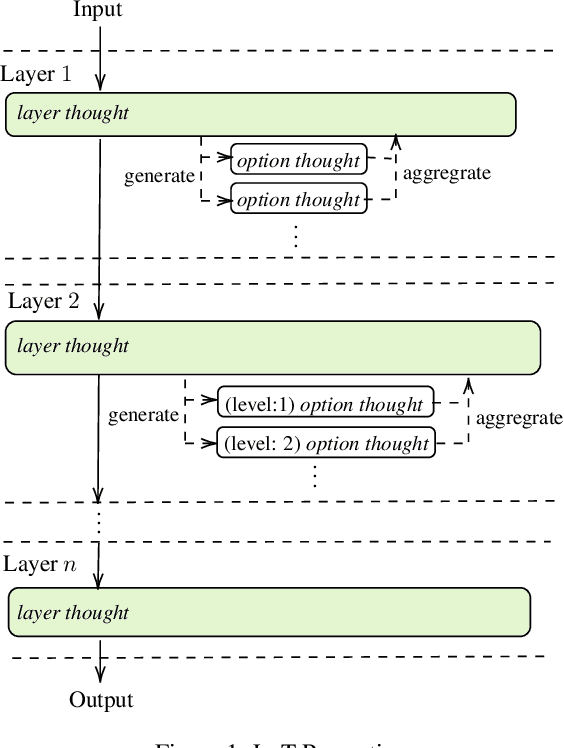
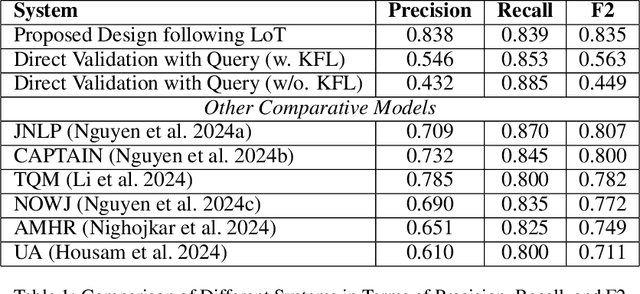
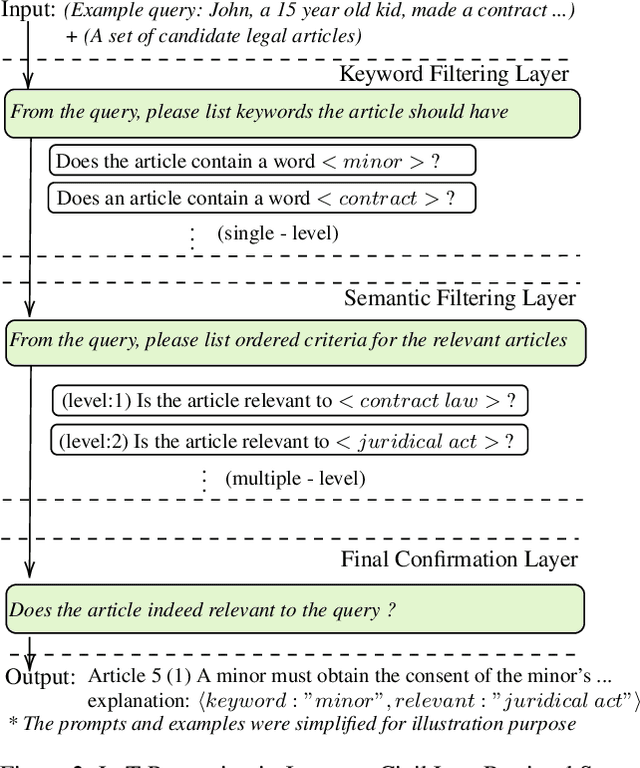
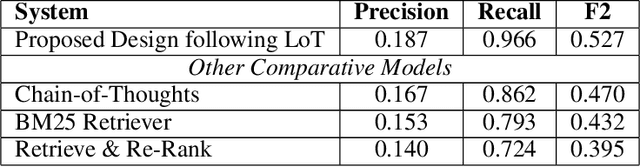
This paper presents a novel approach termed Layer-of-Thoughts Prompting (LoT), which utilizes constraint hierarchies to filter and refine candidate responses to a given query. By integrating these constraints, our method enables a structured retrieval process that enhances explainability and automation. Existing methods have explored various prompting techniques but often present overly generalized frameworks without delving into the nuances of prompts in multi-turn interactions. Our work addresses this gap by focusing on the hierarchical relationships among prompts. We demonstrate that the efficacy of thought hierarchy plays a critical role in developing efficient and interpretable retrieval algorithms. Leveraging Large Language Models (LLMs), LoT significantly improves the accuracy and comprehensibility of information retrieval tasks.