 Add to Chrome
 Add to Firefox
 Add to Edge
From Prompting to Behavioral Alignment: Personalized LLM Judges for Recommendation Evaluation
Aug 11, 2026
Traditional offline recommendation evaluation relies heavily on complex, manually maintained feature pipelines that are difficult to scale. While Large Language Models (LLMs) offer a promising alternative by predicting user engagement directly from raw text logs, empirical analysis in this study identifies a critical failure mode termed bidirectional rationalization. In a zero-shot setting, LLMs are found to convincingly argue for both positive and negative user engagement outcomes on the exact same item with identical evidence, highlighting the unreliability of off-the-shelf LLMs in predicting user engagement. To resolve this, we develop and apply a sequential behavioral alignment framework pairing fine-tuning with preference optimization over paired correct and counterfactual rationales. Evaluated on real-world homepage interaction logs, this aligned reasoning approach achieves a 32.19\% lift in Macro-F1 score over the zero-shot baseline and matches the production feature-engineered baseline. The results demonstrate that behavioral alignment mitigates bidirectional rationalization while delivering human-interpretable reasoning traces without manual pipeline overhead.

Assessing the Usability of GutGPT: A Simulation Study of an AI Clinical Decision Support System for Gastrointestinal Bleeding Risk
Dec 06, 2023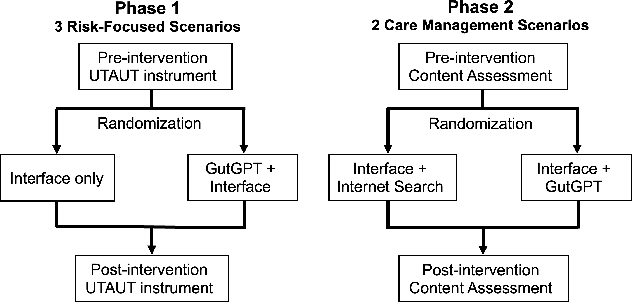
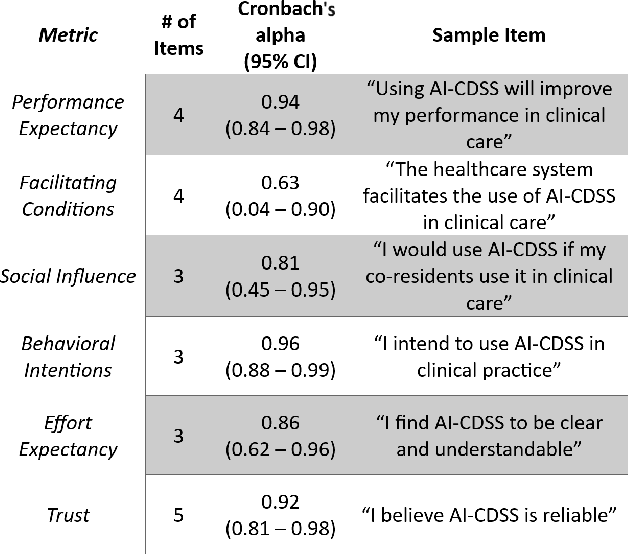
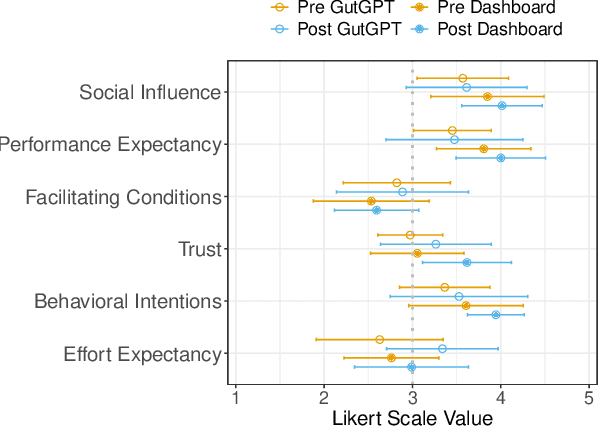
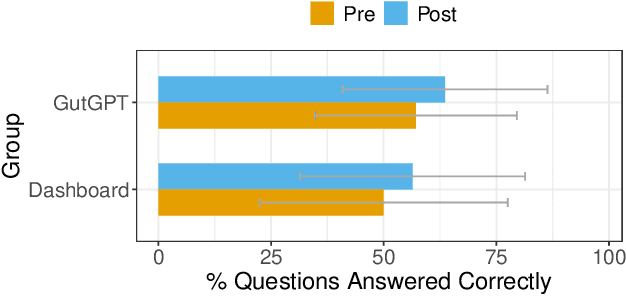
Applications of large language models (LLMs) like ChatGPT have potential to enhance clinical decision support through conversational interfaces. However, challenges of human-algorithmic interaction and clinician trust are poorly understood. GutGPT, a LLM for gastrointestinal (GI) bleeding risk prediction and management guidance, was deployed in clinical simulation scenarios alongside the electronic health record (EHR) with emergency medicine physicians, internal medicine physicians, and medical students to evaluate its effect on physician acceptance and trust in AI clinical decision support systems (AI-CDSS). GutGPT provides risk predictions from a validated machine learning model and evidence-based answers by querying extracted clinical guidelines. Participants were randomized to GutGPT and an interactive dashboard, or the interactive dashboard and a search engine. Surveys and educational assessments taken before and after measured technology acceptance and content mastery. Preliminary results showed mixed effects on acceptance after using GutGPT compared to the dashboard or search engine but appeared to improve content mastery based on simulation performance. Overall, this study demonstrates LLMs like GutGPT could enhance effective AI-CDSS if implemented optimally and paired with interactive interfaces.