 Add to Chrome
 Add to Firefox
 Add to Edge
A PubMed-Scale Dataset of Structured Biomedical Abstracts
Jun 09, 2026
Structured abstracts are important for biomedical literature processing, by facilitating information retrieval, text mining, and knowledge synthesis. However, a vast portion of abstracts indexed in PubMed remain unstructured, presenting a significant bottleneck for downstream text-processing workflows and applications. To resolve this limitation, we introduce Structured PubMed, a comprehensive corpus of section-labeled biomedical abstracts compiled from the complete PubMed database, encompassing over 23.2 million research-article records. The corpus is divided into two distinct subsets: a collection of 5.9 million author-structured abstracts parsed from official XML files, and an automatically labeled collection of 17.2 million originally unstructured abstracts structured via a verbatim-extraction Large Language Model pipeline. Every record is harmonized under a unified five-section schema and mapped to its original PubMed identifier, publication type, and publication date. This dataset can be utilized to train sentence-classification models, benchmark text-segmentation architectures, and perform large-scale, section-specific information extraction at an unprecedented PubMed-wide scale.

IRIS: time-structured manifold projections
May 29, 2026High-dimensional biomedical data, such as cell-by-gene matrices, are increasingly generated temporally. However, Manifold Learning algorithms, like t-SNE and UMAP, cannot incorporate time-ordering in their layouts, obfuscating the dynamics of cell types or other classes. As a solution, we present IRIS, a new Manifold Learning algorithm that structures layouts both chronologically and by manifold topology. IRIS can visualize a wide range of dynamic biomedical data, including scRNA-seq, comparative metagenomics, and literature.
MedViz: An Agent-based, Visual-guided Research Assistant for Navigating Biomedical Literature
Jan 28, 2026Biomedical researchers face increasing challenges in navigating millions of publications in diverse domains. Traditional search engines typically return articles as ranked text lists, offering little support for global exploration or in-depth analysis. Although recent advances in generative AI and large language models have shown promise in tasks such as summarization, extraction, and question answering, their dialog-based implementations are poorly integrated with literature search workflows. To address this gap, we introduce MedViz, a visual analytics system that integrates multiple AI agents with interactive visualization to support the exploration of the large-scale biomedical literature. MedViz combines a semantic map of millions of articles with agent-driven functions for querying, summarizing, and hypothesis generation, allowing researchers to iteratively refine questions, identify trends, and uncover hidden connections. By bridging intelligent agents with interactive visualization, MedViz transforms biomedical literature search into a dynamic, exploratory process that accelerates knowledge discovery.
ctELM: Decoding and Manipulating Embeddings of Clinical Trials with Embedding Language Models
Jan 26, 2026Text embeddings have become an essential part of a variety of language applications. However, methods for interpreting, exploring and reversing embedding spaces are limited, reducing transparency and precluding potentially valuable generative use cases. In this work, we align Large Language Models to embeddings of clinical trials using the recently reported Embedding Language Model (ELM) method. We develop an open-source, domain-agnostic ELM architecture and training framework, design training tasks for clinical trials, and introduce an expert-validated synthetic dataset. We then train a series of ELMs exploring the impact of tasks and training regimes. Our final model, ctELM, can accurately describe and compare unseen clinical trials from embeddings alone and produce plausible clinical trials from novel vectors. We further show that generated trial abstracts are responsive to moving embeddings along concept vectors for age and sex of study subjects. Our public ELM implementation and experimental results will aid the alignment of Large Language Models to embedding spaces in the biomedical domain and beyond.
Collaboration among Multiple Large Language Models for Medical Question Answering
May 22, 2025Empowered by vast internal knowledge reservoir, the new generation of large language models (LLMs) demonstrate untapped potential to tackle medical tasks. However, there is insufficient effort made towards summoning up a synergic effect from multiple LLMs' expertise and background. In this study, we propose a multi-LLM collaboration framework tailored on a medical multiple-choice questions dataset. Through post-hoc analysis on 3 pre-trained LLM participants, our framework is proved to boost all LLMs reasoning ability as well as alleviate their divergence among questions. We also measure an LLM's confidence when it confronts with adversary opinions from other LLMs and observe a concurrence between LLM's confidence and prediction accuracy.
Refining Dimensions for Improving Clustering-based Cross-lingual Topic Models
Dec 17, 2024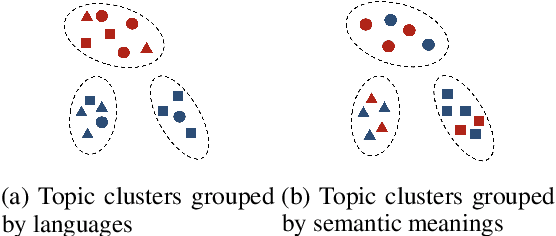
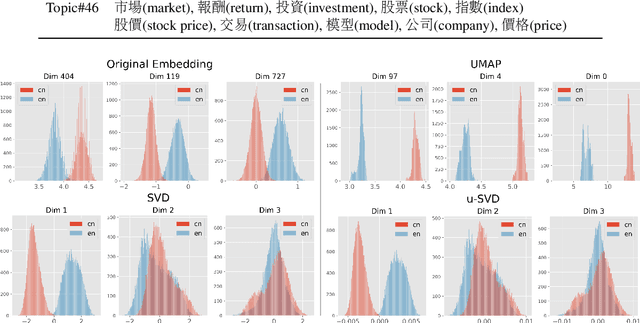
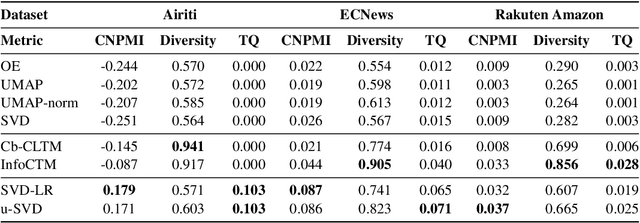
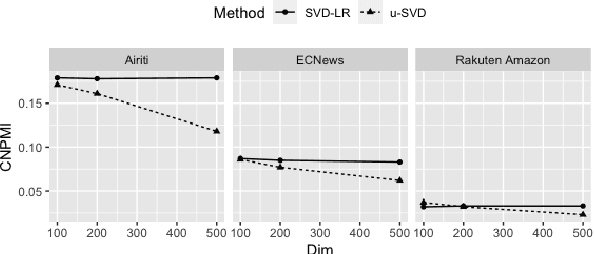
Recent works in clustering-based topic models perform well in monolingual topic identification by introducing a pipeline to cluster the contextualized representations. However, the pipeline is suboptimal in identifying topics across languages due to the presence of language-dependent dimensions (LDDs) generated by multilingual language models. To address this issue, we introduce a novel, SVD-based dimension refinement component into the pipeline of the clustering-based topic model. This component effectively neutralizes the negative impact of LDDs, enabling the model to accurately identify topics across languages. Our experiments on three datasets demonstrate that the updated pipeline with the dimension refinement component generally outperforms other state-of-the-art cross-lingual topic models.
LITA: An Efficient LLM-assisted Iterative Topic Augmentation Framework
Dec 17, 2024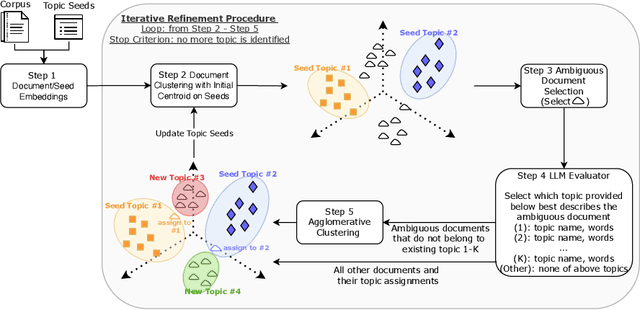
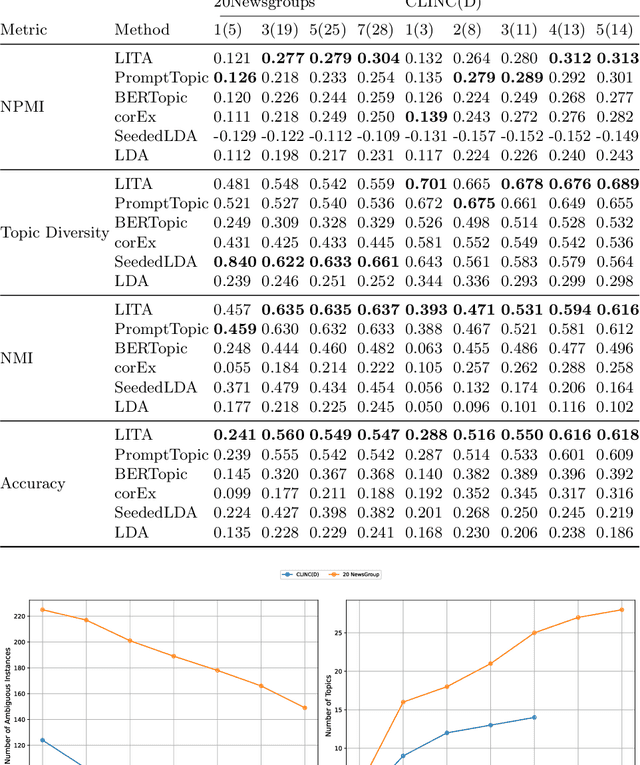
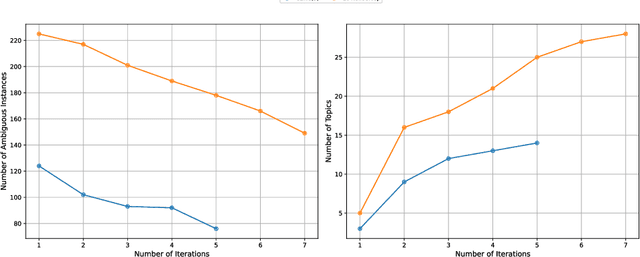
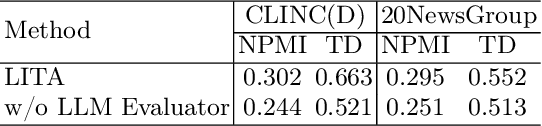
Topic modeling is widely used for uncovering thematic structures within text corpora, yet traditional models often struggle with specificity and coherence in domain-focused applications. Guided approaches, such as SeededLDA and CorEx, incorporate user-provided seed words to improve relevance but remain labor-intensive and static. Large language models (LLMs) offer potential for dynamic topic refinement and discovery, yet their application often incurs high API costs. To address these challenges, we propose the LLM-assisted Iterative Topic Augmentation framework (LITA), an LLM-assisted approach that integrates user-provided seeds with embedding-based clustering and iterative refinement. LITA identifies a small number of ambiguous documents and employs an LLM to reassign them to existing or new topics, minimizing API costs while enhancing topic quality. Experiments on two datasets across topic quality and clustering performance metrics demonstrate that LITA outperforms five baseline models, including LDA, SeededLDA, CorEx, BERTopic, and PromptTopic. Our work offers an efficient and adaptable framework for advancing topic modeling and text clustering.
Beyond Self-Consistency: Ensemble Reasoning Boosts Consistency and Accuracy of LLMs in Cancer Staging
Apr 19, 2024Advances in large language models (LLMs) have encouraged their adoption in the healthcare domain where vital clinical information is often contained in unstructured notes. Cancer staging status is available in clinical reports, but it requires natural language processing to extract the status from the unstructured text. With the advance in clinical-oriented LLMs, it is promising to extract such status without extensive efforts in training the algorithms. Prompting approaches of the pre-trained LLMs that elicit a model's reasoning process, such as chain-of-thought, may help to improve the trustworthiness of the generated responses. Using self-consistency further improves model performance, but often results in inconsistent generations across the multiple reasoning paths. In this study, we propose an ensemble reasoning approach with the aim of improving the consistency of the model generations. Using an open access clinical large language model to determine the pathologic cancer stage from real-world pathology reports, we show that the ensemble reasoning approach is able to improve both the consistency and performance of the LLM in determining cancer stage, thereby demonstrating the potential to use these models in clinical or other domains where reliability and trustworthiness are critical.
Explainable AI for Fair Sepsis Mortality Predictive Model
Apr 19, 2024Artificial intelligence supports healthcare professionals with predictive modeling, greatly transforming clinical decision-making. This study addresses the crucial need for fairness and explainability in AI applications within healthcare to ensure equitable outcomes across diverse patient demographics. By focusing on the predictive modeling of sepsis-related mortality, we propose a method that learns a performance-optimized predictive model and then employs the transfer learning process to produce a model with better fairness. Our method also introduces a novel permutation-based feature importance algorithm aiming at elucidating the contribution of each feature in enhancing fairness on predictions. Unlike existing explainability methods concentrating on explaining feature contribution to predictive performance, our proposed method uniquely bridges the gap in understanding how each feature contributes to fairness. This advancement is pivotal, given sepsis's significant mortality rate and its role in one-third of hospital deaths. Our method not only aids in identifying and mitigating biases within the predictive model but also fosters trust among healthcare stakeholders by improving the transparency and fairness of model predictions, thereby contributing to more equitable and trustworthy healthcare delivery.
An ExplainableFair Framework for Prediction of Substance Use Disorder Treatment Completion
Apr 04, 2024
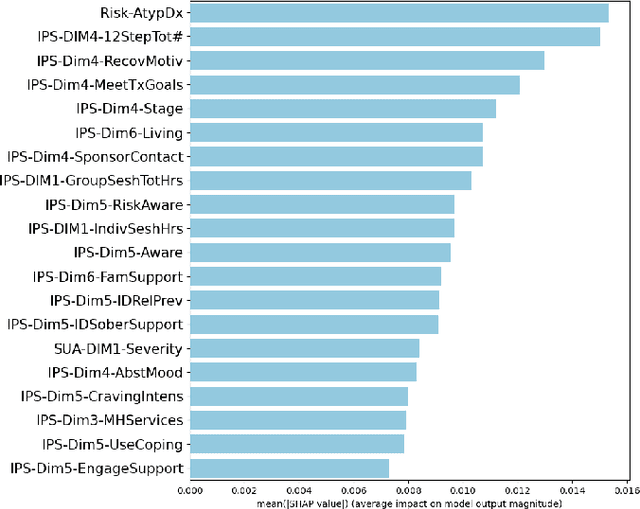

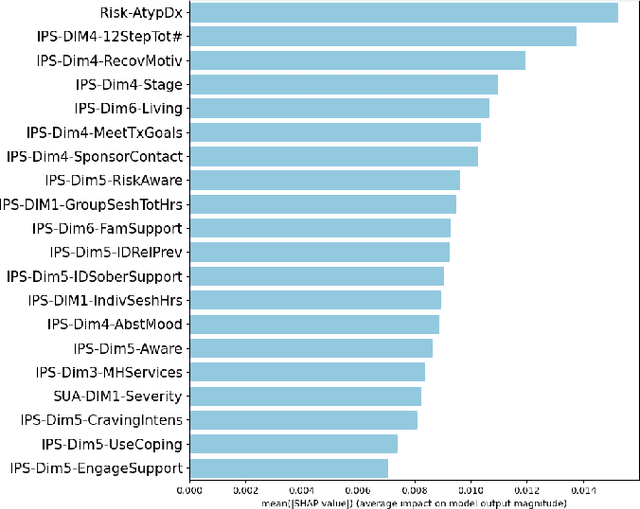
Fairness of machine learning models in healthcare has drawn increasing attention from clinicians, researchers, and even at the highest level of government. On the other hand, the importance of developing and deploying interpretable or explainable models has been demonstrated, and is essential to increasing the trustworthiness and likelihood of adoption of these models. The objective of this study was to develop and implement a framework for addressing both these issues - fairness and explainability. We propose an explainable fairness framework, first developing a model with optimized performance, and then using an in-processing approach to mitigate model biases relative to the sensitive attributes of race and sex. We then explore and visualize explanations of the model changes that lead to the fairness enhancement process through exploring the changes in importance of features. Our resulting-fairness enhanced models retain high sensitivity with improved fairness and explanations of the fairness-enhancement that may provide helpful insights for healthcare providers to guide clinical decision-making and resource allocation.