 Add to Chrome
 Add to Firefox
 Add to Edge
Learning, locomotion, and navigation of soft synthetic snakes in three-dimensional, heterogeneous environments
May 24, 2026
Limbless terrestrial animals exhibit exceptional locomotor versatility and control, currently unmatched by engineered counterparts. Here, we introduce a computational framework that enables soft synthetic snakes to navigate unstructured, heterogeneous 3D terrains. Our approach is grounded in bio-inspired actuation and sensing models that reduce the control complexity inherent to high-degree-of-freedom, continuum bodies. These models are integrated into a reinforcement learning architecture to derive environment-traversing policies. Training first occurs in simplified, homogeneous terrains to learn locomotion primitives. These are then composed into adaptive strategies for complex landscapes. We demonstrate robustness by deploying a snake in high-fidelity 3D environments reconstructed from real-world imaging, achieving reliable navigation. Overall, this work provides a physically-realistic simulation platform and practical insights for the control of continuum systems in natural terrains.

Computing with Living Neurons: Chaos-Controlled Reservoir Computing with Knowledge Transplant
Apr 02, 2026We introduce chaos-controlled Reservoir Computing (cc-RC) for living neural cultures: dynamically rich substrates of unique potential for adaptive computation. To account for intrinsic biological variability, cc-RC combines: (i) pre-training identification of each culture's dynamical signature and phase-portrait attractor; (ii) low-power optical chaos control to stabilize spontaneous and stimulus-evoked activity; (iii) readout training within this controlled regime. Across hundreds of neural samples, cc-RC enables robust learning and pattern classification, improving both accuracy and model longevity by approximately 300% over standard RC. We further propose Knowledge Transplant (KT), for which the reservoir map learned by an expert culture is transplanted to an attractor-equivalent student culture, reducing training time to minutes while improving performance. By enabling cross-substrate, reusable learned models, KT paves the way for knowledge accumulation and sharing across neural populations, transcending biological lifespan limits.
Joint Surrogate Learning of Objectives, Constraints, and Sensitivities for Efficient Multi-objective Optimization of Neural Dynamical Systems
Mar 22, 2026Biophysical neural system simulations are among the most computationally demanding scientific applications, and their optimization requires navigating high-dimensional parameter spaces under numerous constraints that impose a binary feasible/infeasible partition with no gradient signal to guide the search. Here, we introduce DMOSOPT, a scalable optimization framework that leverages a unified, jointly learned surrogate model to capture the interplay between objectives, constraints, and parameter sensitivities. By learning a smooth approximation of both the objective landscape and the feasibility boundary, the joint surrogate provides a unified gradient that simultaneously steers the search toward improved objective values and greater constraint satisfaction, while its partial derivatives yield per-parameter sensitivity estimates that enable more targeted exploration. We validate the framework from single-cell dynamics to population-level network activity, spanning incremental stages of a neural circuit modeling workflow, and demonstrate efficient, effective optimization of highly constrained problems at supercomputing scale with substantially fewer problem evaluations. While motivated by and demonstrated in the context of computational neuroscience, the framework is general and applicable to constrained multi-objective optimization problems across scientific and engineering domains.
S2Act: Simple Spiking Actor
Mar 16, 2026Spiking neural networks (SNNs) and biologically-inspired learning mechanisms are attractive in mobile robotics, where the size and performance of onboard neural network policies are constrained by power and computational budgets. Existing SNN approaches, such as population coding, reward modulation, and hybrid artificial neural network (ANN)-SNN architectures, have shown promising results; however, they face challenges in complex, highly stochastic environments due to SNN sensitivity to hyperparameters and inconsistent gradient signals. To address these challenges, we propose simple spiking actor (S2Act), a computationally lightweight framework that deploys an RL policy using an SNN in three steps: (1) architect an actor-critic model based on an approximated network of rate-based spiking neurons, (2) train the network with gradients using compatible activation functions, and (3) transfer the trained weights into physical parameters of rate-based leaky integrate-and-fire (LIF) neurons for inference and deployment. By globally shaping LIF neuron parameters such that their rate-based responses approximate ReLU activations, S2Act effectively mitigates the vanishing gradient problem, while pre-constraining LIF response curves reduces reliance on complex SNN-specific hyperparameter tuning. We demonstrate our method in two multi-agent stochastic environments (capture-the-flag and parking) that capture the complexity of multi-robot interactions, and deploy our trained policies on physical TurtleBot platforms using Intel's Loihi neuromorphic hardware. Our experimental results show that S2Act outperforms relevant baselines in task performance and real-time inference in nearly all considered scenarios, highlighting its potential for rapid prototyping and efficient real-world deployment of SNN-based RL policies.
Neural reservoir control of a soft bio-hybrid arm
Mar 12, 2025A long-standing engineering problem, the control of soft robots is difficult because of their highly non-linear, heterogeneous, anisotropic, and distributed nature. Here, bridging engineering and biology, a neural reservoir is employed for the dynamic control of a bio-hybrid model arm made of multiple muscle-tendon groups enveloping an elastic spine. We show how the use of reservoirs facilitates simultaneous control and self-modeling across a set of challenging tasks, outperforming classic neural network approaches. Further, by implementing a spiking reservoir on neuromorphic hardware, energy efficiency is achieved, with nearly two-orders of magnitude improvement relative to standard CPUs, with implications for the on-board control of untethered, small-scale soft robots.
Neural Models and Algorithms for Sensorimotor Control of an Octopus Arm
Feb 02, 2024


In this article, a biophysically realistic model of a soft octopus arm with internal musculature is presented. The modeling is motivated by experimental observations of sensorimotor control where an arm localizes and reaches a target. Major contributions of this article are: (i) development of models to capture the mechanical properties of arm musculature, the electrical properties of the arm peripheral nervous system (PNS), and the coupling of PNS with muscular contractions; (ii) modeling the arm sensory system, including chemosensing and proprioception; and (iii) algorithms for sensorimotor control, which include a novel feedback neural motor control law for mimicking target-oriented arm reaching motions, and a novel consensus algorithm for solving sensing problems such as locating a food source from local chemical sensory information (exogenous) and arm deformation information (endogenous). Several analytical results, including rest-state characterization and stability properties of the proposed sensing and motor control algorithms, are provided. Numerical simulations demonstrate the efficacy of our approach. Qualitative comparisons against observed arm rest shapes and target-oriented reaching motions are also reported.
Topology, dynamics, and control of an octopus-analog muscular hydrostat
Apr 17, 2023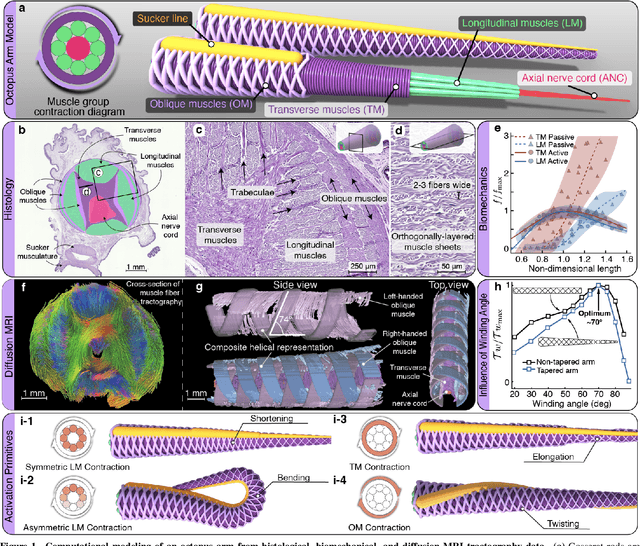


Muscular hydrostats, such as octopus arms or elephant trunks, lack bones entirely, endowing them with exceptional dexterity and reconfigurability. Key to their unmatched ability to control nearly infinite degrees of freedom is the architecture into which muscle fibers are weaved. Their arrangement is, effectively, the instantiation of a sophisticated mechanical program that mediates, and likely facilitates, the control and realization of complex, dynamic morphological reconfigurations. Here, by combining medical imaging, biomechanical data, live behavioral experiments and numerical simulations, we synthesize a model octopus arm entailing ~200 continuous muscles groups, and begin to unravel its complexity. We show how 3D arm motions can be understood in terms of storage, transport, and conversion of topological quantities, effected by simple muscle activation templates. These, in turn, can be composed into higher-level control strategies that, compounded by the arm's compliance, are demonstrated in a range of object manipulation tasks rendered additionally challenging by the need to appropriately align suckers, to sense and grasp. Overall, our work exposes broad design and algorithmic principles pertinent to muscular hydrostats, robotics, and dynamics, while significantly advancing our ability to model muscular structures from medical imaging, with potential implications for human health and care.
Hierarchical control and learning of a foraging CyberOctopus
Feb 11, 2023Inspired by the unique neurophysiology of the octopus, we propose a hierarchical framework that simplifies the coordination of multiple soft arms by decomposing control into high-level decision making, low-level motor activation, and local reflexive behaviors via sensory feedback. When evaluated in the illustrative problem of a model octopus foraging for food, this hierarchical decomposition results in significant improvements relative to end-to-end methods. Performance is achieved through a mixed-modes approach, whereby qualitatively different tasks are addressed via complementary control schemes. Here, model-free reinforcement learning is employed for high-level decision-making, while model-based energy shaping takes care of arm-level motor execution. To render the pairing computationally tenable, a novel neural-network energy shaping (NN-ES) controller is developed, achieving accurate motions with time-to-solutions 200 times faster than previous attempts. Our hierarchical framework is then successfully deployed in increasingly challenging foraging scenarios, including an arena littered with obstacles in 3D space, demonstrating the viability of our approach.
Modeling the Neuromuscular Control System of an Octopus Arm
Nov 12, 2022


The octopus arm is a neuromechanical system that involves a complex interplay between peripheral nervous system (PNS) and arm musculature. This makes the arm capable of carrying out rich maneuvers. In this paper, we build a model for the PNS and integrate it with a muscular soft octopus arm. The proposed neuromuscular architecture is used to qualitatively reproduce several biophysical observations in real octopuses, including curled rest shapes and target-directed arm reaching motions. Two control laws are proposed for target-oriented arm motions, and their performance is compared against a benchmark. Several analytical results, including rest-state characterization and stability properties of the proposed control laws, are provided.
Energy Shaping Control of a Muscular Octopus Arm Moving in Three Dimensions
Sep 09, 2022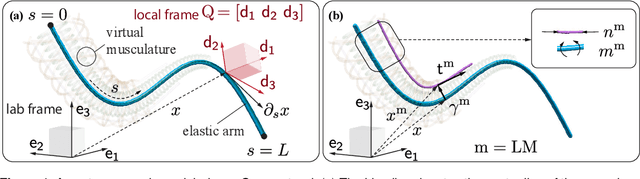
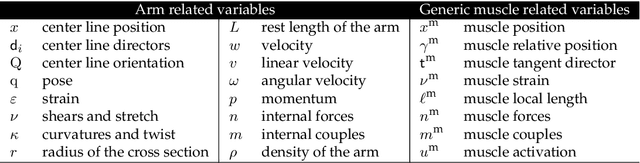
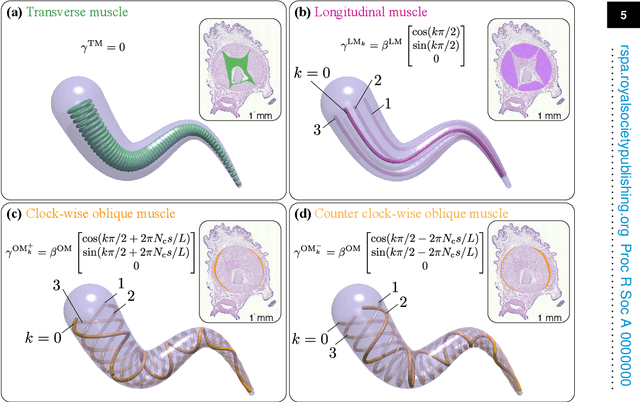
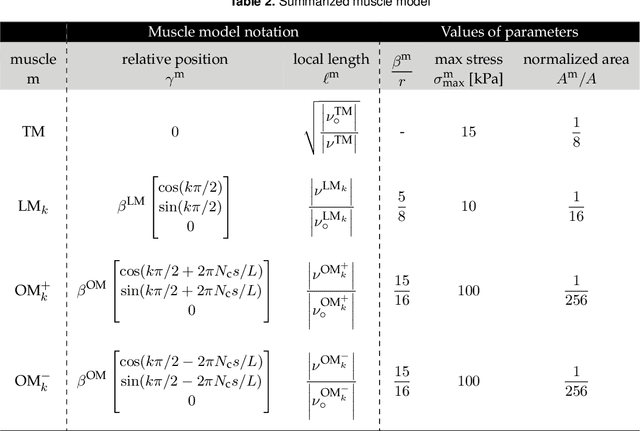
Flexible octopus arms exhibit an exceptional ability to coordinate large numbers of degrees of freedom and perform complex manipulation tasks. As a consequence, these systems continue to attract the attention of biologists and roboticists alike. In this paper, we develop a three-dimensional model of a soft octopus arm, equipped with biomechanically realistic muscle actuation. Internal forces and couples exerted by all major muscle groups are considered. An energy shaping control method is described to coordinate muscle activity so as to grasp and reach in 3D space. Key contributions of this paper are: (i) modeling of major muscle groups to elicit three-dimensional movements; (ii) a mathematical formulation for muscle activations based on a stored energy function; and (iii) a computationally efficient procedure to design task-specific equilibrium configurations, obtained by solving an optimization problem in the Special Euclidean group SE(3). Muscle controls are then iteratively computed based on the co-state variable arising from the solution of the optimization problem. The approach is numerically demonstrated in the physically accurate software environment Elastica. Results of numerical experiments mimicking observed octopus behaviors are reported.