 Add to Chrome
 Add to Firefox
 Add to Edge
Joint Surrogate Learning of Objectives, Constraints, and Sensitivities for Efficient Multi-objective Optimization of Neural Dynamical Systems
Mar 22, 2026
Biophysical neural system simulations are among the most computationally demanding scientific applications, and their optimization requires navigating high-dimensional parameter spaces under numerous constraints that impose a binary feasible/infeasible partition with no gradient signal to guide the search. Here, we introduce DMOSOPT, a scalable optimization framework that leverages a unified, jointly learned surrogate model to capture the interplay between objectives, constraints, and parameter sensitivities. By learning a smooth approximation of both the objective landscape and the feasibility boundary, the joint surrogate provides a unified gradient that simultaneously steers the search toward improved objective values and greater constraint satisfaction, while its partial derivatives yield per-parameter sensitivity estimates that enable more targeted exploration. We validate the framework from single-cell dynamics to population-level network activity, spanning incremental stages of a neural circuit modeling workflow, and demonstrate efficient, effective optimization of highly constrained problems at supercomputing scale with substantially fewer problem evaluations. While motivated by and demonstrated in the context of computational neuroscience, the framework is general and applicable to constrained multi-objective optimization problems across scientific and engineering domains.

Automatic Task Parallelization of Dataflow Graphs in ML/DL models
Aug 22, 2023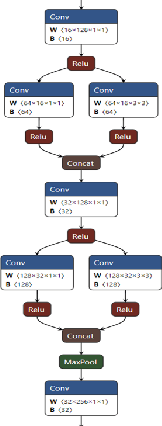
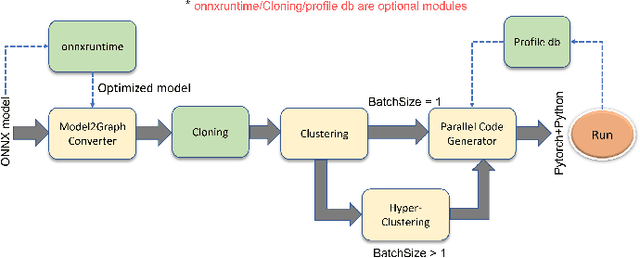
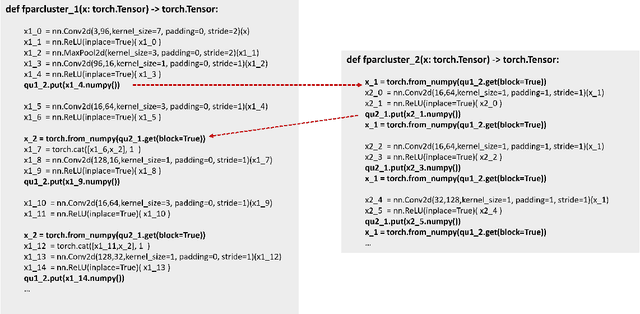
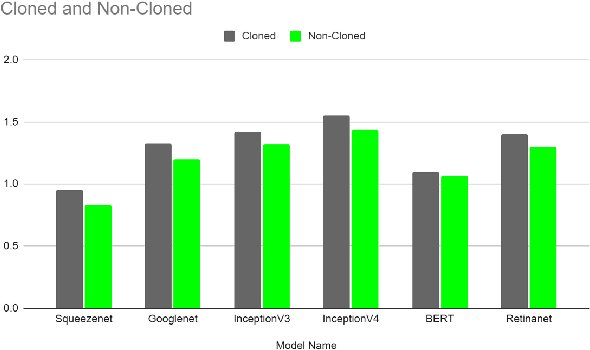
Several methods exist today to accelerate Machine Learning(ML) or Deep-Learning(DL) model performance for training and inference. However, modern techniques that rely on various graph and operator parallelism methodologies rely on search space optimizations which are costly in terms of power and hardware usage. Especially in the case of inference, when the batch size is 1 and execution is on CPUs or for power-constrained edge devices, current techniques can become costly, complicated or inapplicable. To ameliorate this, we present a Critical-Path-based Linear Clustering approach to exploit inherent parallel paths in ML dataflow graphs. Our task parallelization approach further optimizes the structure of graphs via cloning and prunes them via constant propagation and dead-code elimination. Contrary to other work, we generate readable and executable parallel Pytorch+Python code from input ML models in ONNX format via a new tool that we have built called {\bf Ramiel}. This allows us to benefit from other downstream acceleration techniques like intra-op parallelism and potentially pipeline parallelism. Our preliminary results on several ML graphs demonstrate up to 1.9$\times$ speedup over serial execution and outperform some of the current mechanisms in both compile and runtimes. Lastly, our methods are lightweight and fast enough so that they can be used effectively for power and resource-constrained devices, while still enabling downstream optimizations.