 Add to Chrome
 Add to Firefox
 Add to Edge
S2Act: Simple Spiking Actor
Mar 16, 2026
Spiking neural networks (SNNs) and biologically-inspired learning mechanisms are attractive in mobile robotics, where the size and performance of onboard neural network policies are constrained by power and computational budgets. Existing SNN approaches, such as population coding, reward modulation, and hybrid artificial neural network (ANN)-SNN architectures, have shown promising results; however, they face challenges in complex, highly stochastic environments due to SNN sensitivity to hyperparameters and inconsistent gradient signals. To address these challenges, we propose simple spiking actor (S2Act), a computationally lightweight framework that deploys an RL policy using an SNN in three steps: (1) architect an actor-critic model based on an approximated network of rate-based spiking neurons, (2) train the network with gradients using compatible activation functions, and (3) transfer the trained weights into physical parameters of rate-based leaky integrate-and-fire (LIF) neurons for inference and deployment. By globally shaping LIF neuron parameters such that their rate-based responses approximate ReLU activations, S2Act effectively mitigates the vanishing gradient problem, while pre-constraining LIF response curves reduces reliance on complex SNN-specific hyperparameter tuning. We demonstrate our method in two multi-agent stochastic environments (capture-the-flag and parking) that capture the complexity of multi-robot interactions, and deploy our trained policies on physical TurtleBot platforms using Intel's Loihi neuromorphic hardware. Our experimental results show that S2Act outperforms relevant baselines in task performance and real-time inference in nearly all considered scenarios, highlighting its potential for rapid prototyping and efficient real-world deployment of SNN-based RL policies.

Neuro-Symbolic Generation of Explanations for Robot Policies with Weighted Signal Temporal Logic
Apr 30, 2025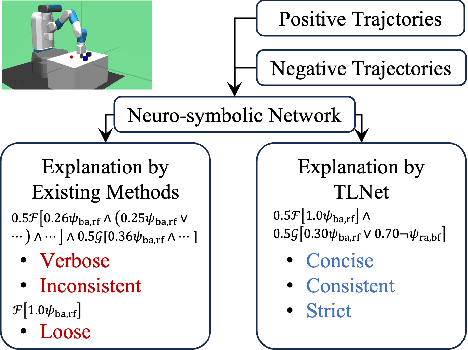
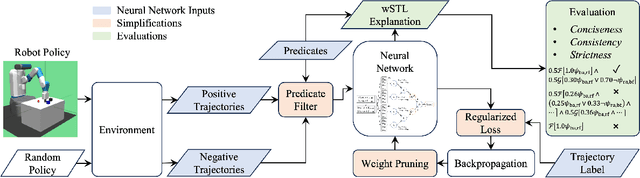
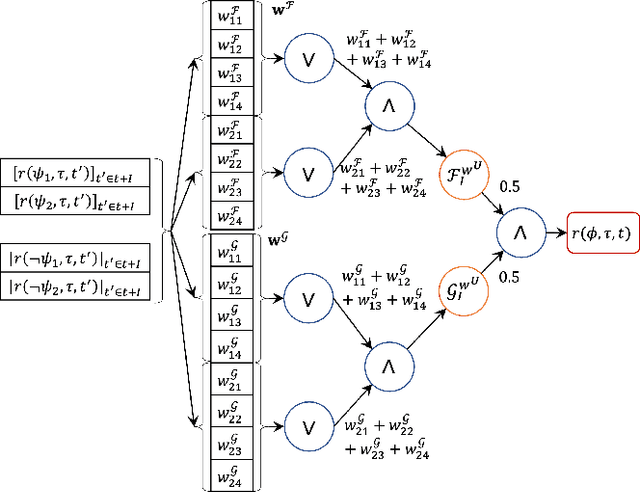
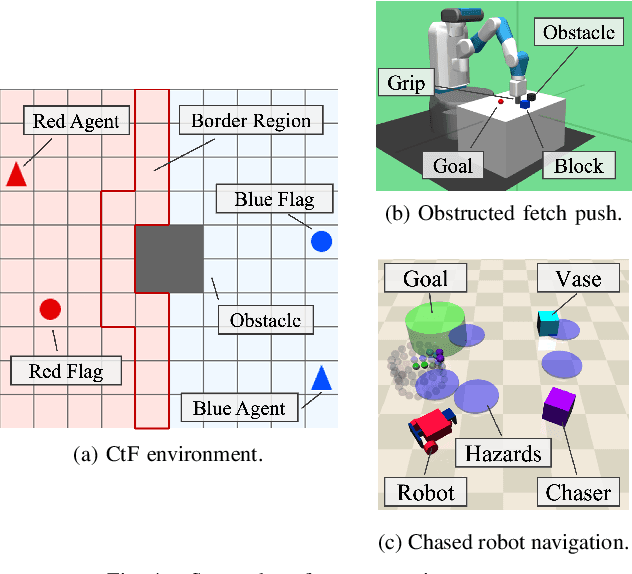
Neural network-based policies have demonstrated success in many robotic applications, but often lack human-explanability, which poses challenges in safety-critical deployments. To address this, we propose a neuro-symbolic explanation framework that generates a weighted signal temporal logic (wSTL) specification to describe a robot policy in a interpretable form. Existing methods typically produce explanations that are verbose and inconsistent, which hinders explainability, and loose, which do not give meaningful insights into the underlying policy. We address these issues by introducing a simplification process consisting of predicate filtering, regularization, and iterative pruning. We also introduce three novel explainability evaluation metrics -- conciseness, consistency, and strictness -- to assess explanation quality beyond conventional classification metrics. Our method is validated in three simulated robotic environments, where it outperforms baselines in generating concise, consistent, and strict wSTL explanations without sacrificing classification accuracy. This work bridges policy learning with formal methods, contributing to safer and more transparent decision-making in robotics.
On Generating Explanations for Reinforcement Learning Policies: An Empirical Study
Sep 29, 2023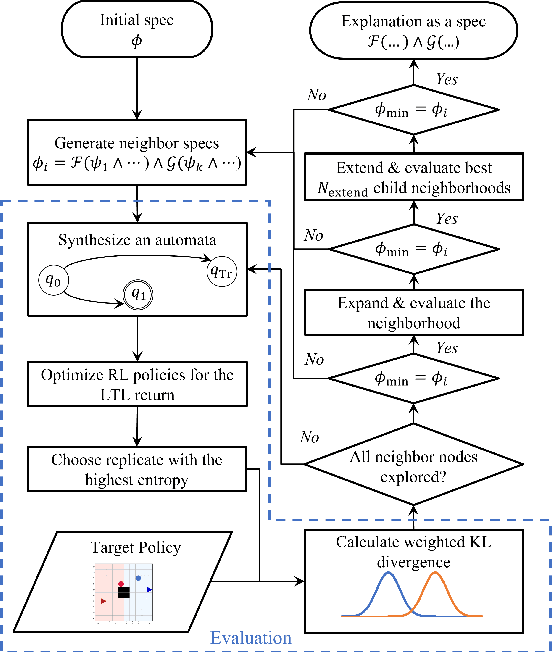
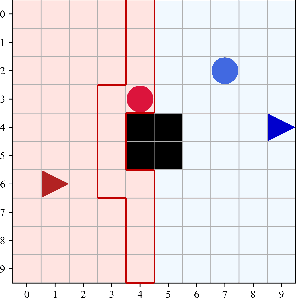
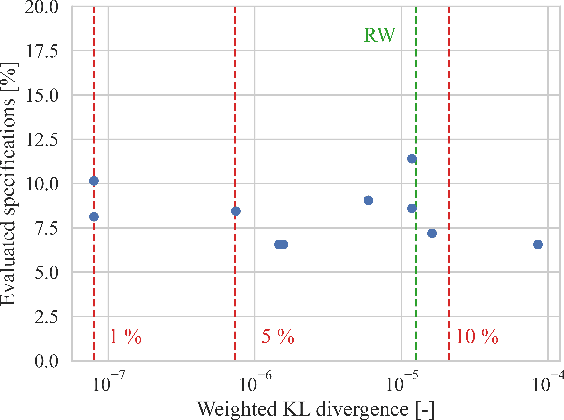
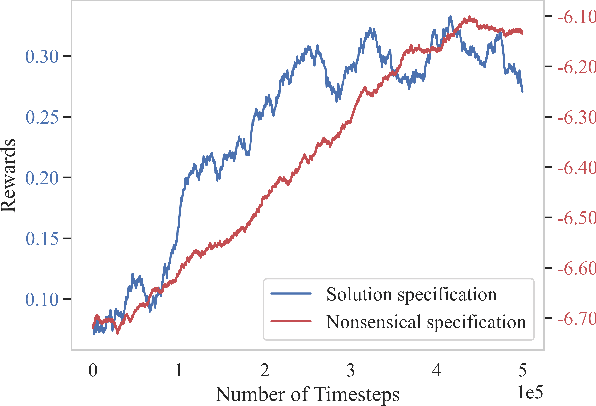
In this paper, we introduce a set of \textit{Linear Temporal Logic} (LTL) formulae designed to provide explanations for policies. Our focus is on crafting explanations that elucidate both the ultimate objectives accomplished by the policy and the prerequisites it upholds throughout its execution. These LTL-based explanations feature a structured representation, which is particularly well-suited for local-search techniques. The effectiveness of our proposed approach is illustrated through a simulated capture the flag environment. The paper concludes with suggested directions for future research.