 Add to Chrome
 Add to Firefox
 Add to Edge
Computing with Living Neurons: Chaos-Controlled Reservoir Computing with Knowledge Transplant
Apr 02, 2026
We introduce chaos-controlled Reservoir Computing (cc-RC) for living neural cultures: dynamically rich substrates of unique potential for adaptive computation. To account for intrinsic biological variability, cc-RC combines: (i) pre-training identification of each culture's dynamical signature and phase-portrait attractor; (ii) low-power optical chaos control to stabilize spontaneous and stimulus-evoked activity; (iii) readout training within this controlled regime. Across hundreds of neural samples, cc-RC enables robust learning and pattern classification, improving both accuracy and model longevity by approximately 300% over standard RC. We further propose Knowledge Transplant (KT), for which the reservoir map learned by an expert culture is transplanted to an attractor-equivalent student culture, reducing training time to minutes while improving performance. By enabling cross-substrate, reusable learned models, KT paves the way for knowledge accumulation and sharing across neural populations, transcending biological lifespan limits.

Toward a Physics of Deep Learning and Brains
Sep 26, 2025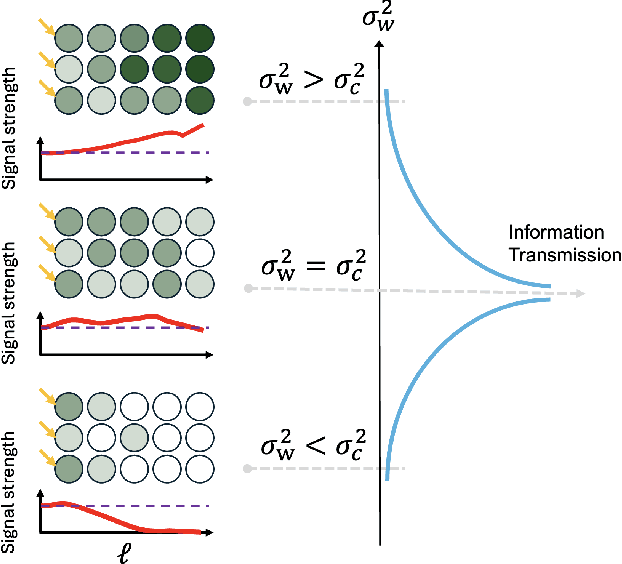
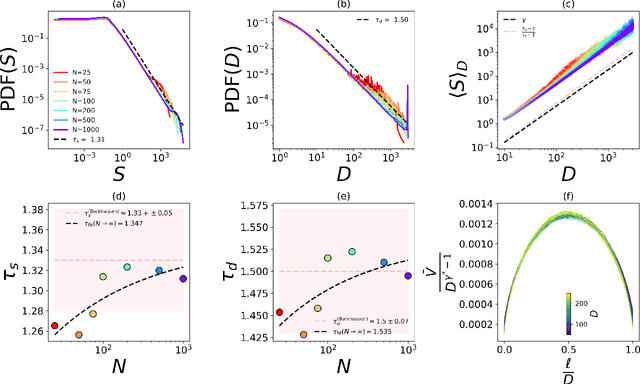
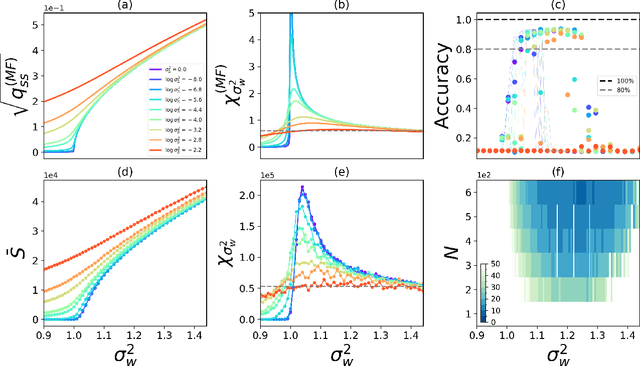
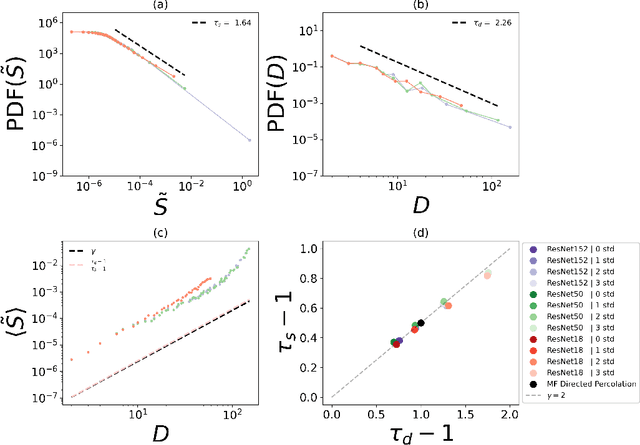
Deep neural networks and brains both learn and share superficial similarities: processing nodes are likened to neurons and adjustable weights are likened to modifiable synapses. But can a unified theoretical framework be found to underlie them both? Here we show that the equations used to describe neuronal avalanches in living brains can also be applied to cascades of activity in deep neural networks. These equations are derived from non-equilibrium statistical physics and show that deep neural networks learn best when poised between absorbing and active phases. Because these networks are strongly driven by inputs, however, they do not operate at a true critical point but within a quasi-critical regime -- one that still approximately satisfies crackling noise scaling relations. By training networks with different initializations, we show that maximal susceptibility is a more reliable predictor of learning than proximity to the critical point itself. This provides a blueprint for engineering improved network performance. Finally, using finite-size scaling we identify distinct universality classes, including Barkhausen noise and directed percolation. This theoretical framework demonstrates that universal features are shared by both biological and artificial neural networks.