 Add to Chrome
 Add to Firefox
 Add to Edge
AI Benchmark Democratization and Carpentry
Dec 12, 2025
Benchmarks are a cornerstone of modern machine learning, enabling reproducibility, comparison, and scientific progress. However, AI benchmarks are increasingly complex, requiring dynamic, AI-focused workflows. Rapid evolution in model architectures, scale, datasets, and deployment contexts makes evaluation a moving target. Large language models often memorize static benchmarks, causing a gap between benchmark results and real-world performance. Beyond traditional static benchmarks, continuous adaptive benchmarking frameworks are needed to align scientific assessment with deployment risks. This calls for skills and education in AI Benchmark Carpentry. From our experience with MLCommons, educational initiatives, and programs like the DOE's Trillion Parameter Consortium, key barriers include high resource demands, limited access to specialized hardware, lack of benchmark design expertise, and uncertainty in relating results to application domains. Current benchmarks often emphasize peak performance on top-tier hardware, offering limited guidance for diverse, real-world scenarios. Benchmarking must become dynamic, incorporating evolving models, updated data, and heterogeneous platforms while maintaining transparency, reproducibility, and interpretability. Democratization requires both technical innovation and systematic education across levels, building sustained expertise in benchmark design and use. Benchmarks should support application-relevant comparisons, enabling informed, context-sensitive decisions. Dynamic, inclusive benchmarking will ensure evaluation keeps pace with AI evolution and supports responsible, reproducible, and accessible AI deployment. Community efforts can provide a foundation for AI Benchmark Carpentry.

An MLCommons Scientific Benchmarks Ontology
Nov 06, 2025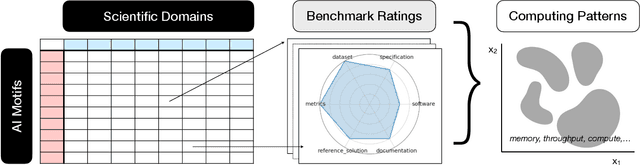
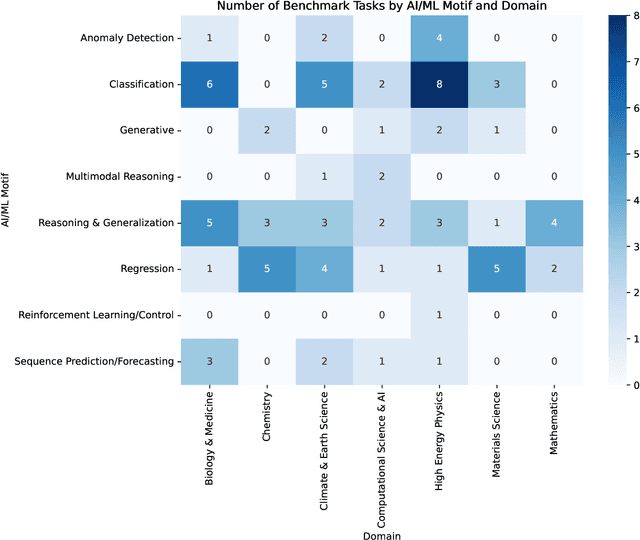
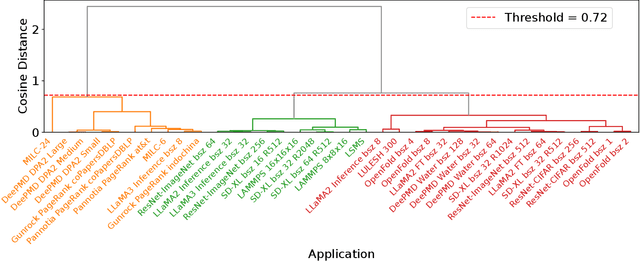
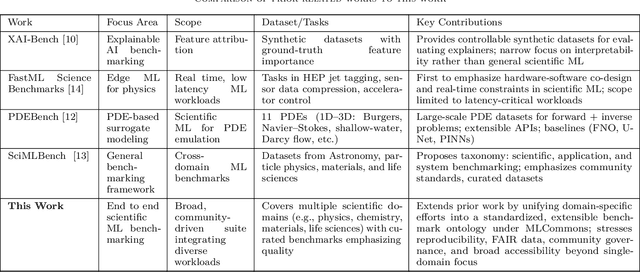
Scientific machine learning research spans diverse domains and data modalities, yet existing benchmark efforts remain siloed and lack standardization. This makes novel and transformative applications of machine learning to critical scientific use-cases more fragmented and less clear in pathways to impact. This paper introduces an ontology for scientific benchmarking developed through a unified, community-driven effort that extends the MLCommons ecosystem to cover physics, chemistry, materials science, biology, climate science, and more. Building on prior initiatives such as XAI-BENCH, FastML Science Benchmarks, PDEBench, and the SciMLBench framework, our effort consolidates a large set of disparate benchmarks and frameworks into a single taxonomy of scientific, application, and system-level benchmarks. New benchmarks can be added through an open submission workflow coordinated by the MLCommons Science Working Group and evaluated against a six-category rating rubric that promotes and identifies high-quality benchmarks, enabling stakeholders to select benchmarks that meet their specific needs. The architecture is extensible, supporting future scientific and AI/ML motifs, and we discuss methods for identifying emerging computing patterns for unique scientific workloads. The MLCommons Science Benchmarks Ontology provides a standardized, scalable foundation for reproducible, cross-domain benchmarking in scientific machine learning. A companion webpage for this work has also been developed as the effort evolves: https://mlcommons-science.github.io/benchmark/
T3: Transparent Tracking & Triggering for Fine-grained Overlap of Compute & Collectives
Jan 30, 2024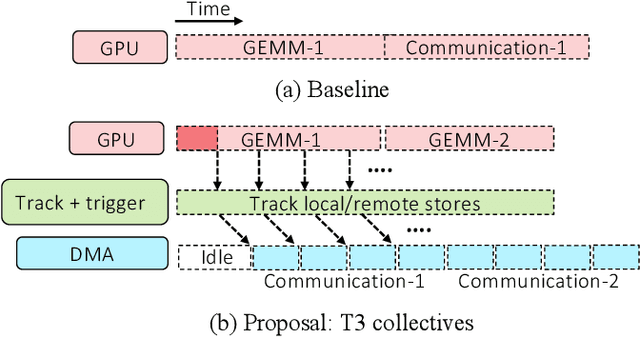
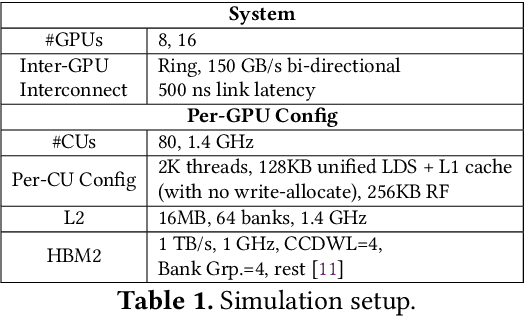
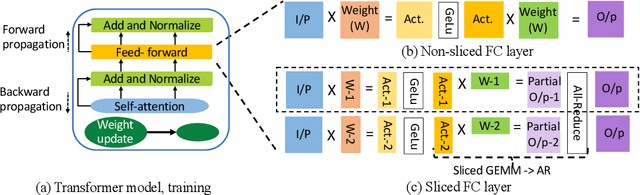
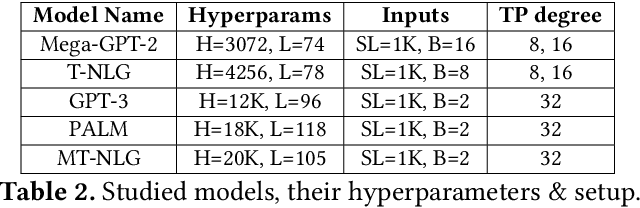
Large Language Models increasingly rely on distributed techniques for their training and inference. These techniques require communication across devices which can reduce scaling efficiency as the number of devices increases. While some distributed techniques can overlap, and thus, hide this communication with independent computations, techniques such as Tensor Parallelism (TP) inherently serialize communication with model execution. One approach to hide this serialized communication is to interleave it with the producer operation (of the communicated data) in a fine-grained manner. However, this fine-grained interleaving of communication and computation in software can be difficult. Furthermore, as with any concurrent execution, it requires compute and memory resources to be shared between computation and communication, causing resource contention that reduces overlapping efficacy. To overcome these challenges, we propose T3 which applies hardware-software co-design to transparently overlap serialized communication while minimizing resource contention with compute. T3 transparently fuses producer operations with the subsequent communication via a simple configuration of the producer's output address space and requires minor software changes. At the hardware level, T3 adds a lightweight track and trigger mechanism to orchestrate the producer's compute, and communication. It further uses compute-enhanced memories for communication's attendant compute. As a result, T3 reduces resource contention, and efficiently overlaps serialized communication with computation. For important Transformer models like T-NLG, T3 speeds up communication-heavy sublayers by 30% geomean (max 47%) and reduces data movement by 22% geomean (max 36%). Furthermore, T3's benefits persist as models scale: geomean 29% for sublayers in $\sim$500-billion parameter models, PALM and MT-NLG.
Demystifying BERT: Implications for Accelerator Design
Apr 14, 2021


Transfer learning in natural language processing (NLP), as realized using models like BERT (Bi-directional Encoder Representation from Transformer), has significantly improved language representation with models that can tackle challenging language problems. Consequently, these applications are driving the requirements of future systems. Thus, we focus on BERT, one of the most popular NLP transfer learning algorithms, to identify how its algorithmic behavior can guide future accelerator design. To this end, we carefully profile BERT training and identify key algorithmic behaviors which are worthy of attention in accelerator design. We observe that while computations which manifest as matrix multiplication dominate BERT's overall runtime, as in many convolutional neural networks, memory-intensive computations also feature prominently. We characterize these computations, which have received little attention so far. Further, we also identify heterogeneity in compute-intensive BERT computations and discuss software and possible hardware mechanisms to further optimize these computations. Finally, we discuss implications of these behaviors as networks get larger and use distributed training environments, and how techniques such as micro-batching and mixed-precision training scale. Overall, our analysis identifies holistic solutions to optimize systems for BERT-like models.