 Add to Chrome
 Add to Firefox
 Add to Edge
Design Space Exploration of DMA based Finer-Grain Compute Communication Overlap
Dec 11, 2025
As both ML training and inference are increasingly distributed, parallelization techniques that shard (divide) ML model across GPUs of a distributed system, are often deployed. With such techniques, there is a high prevalence of data-dependent communication and computation operations where communication is exposed, leaving as high as 1.7x ideal performance on the table. Prior works harness the fact that ML model state and inputs are already sharded, and employ careful overlap of individual computation/communication shards. While such coarse-grain overlap is promising, in this work, we instead make a case for finer-grain compute-communication overlap which we term FiCCO, where we argue for finer-granularity, one-level deeper overlap than at shard-level, to unlock compute/communication overlap for a wider set of network topologies, finer-grain dataflow and more. We show that FiCCO opens up a wider design space of execution schedules than possible at shard-level alone. At the same time, decomposition of ML operations into smaller operations (done in both shard-based and finer-grain techniques) causes operation-level inefficiency losses. To balance the two, we first present a detailed characterization of these inefficiency losses, then present a design space of FiCCO schedules, and finally overlay the schedules with concomitant inefficiency signatures. Doing so helps us design heuristics that frameworks and runtimes can harness to select bespoke FiCCO schedules based on the nature of underlying ML operations. Finally, to further minimize contention inefficiencies inherent with operation overlap, we offload communication to GPU DMA engines. We evaluate several scenarios from realistic ML deployments and demonstrate that our proposed bespoke schedules deliver up to 1.6x speedup and our heuristics provide accurate guidance in 81% of unseen scenarios.

T3: Transparent Tracking & Triggering for Fine-grained Overlap of Compute & Collectives
Jan 30, 2024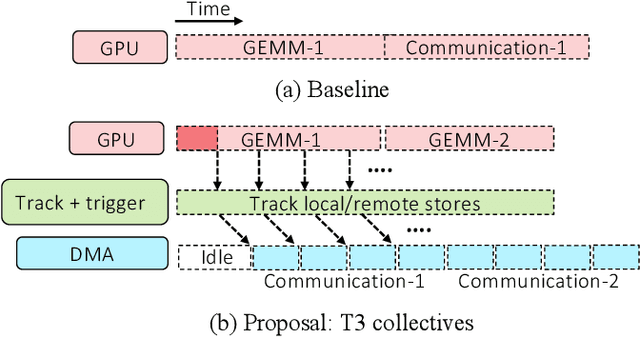
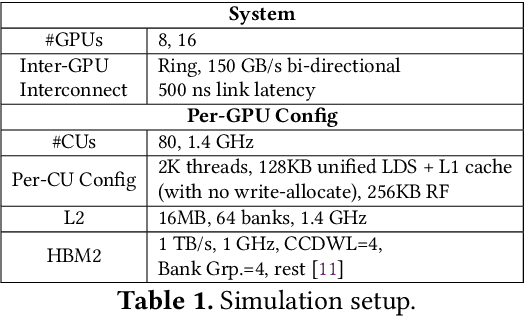
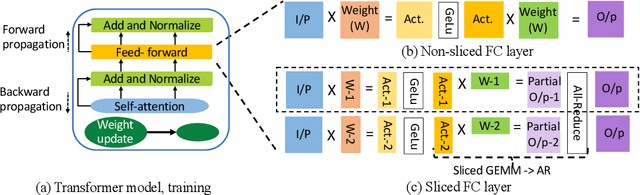
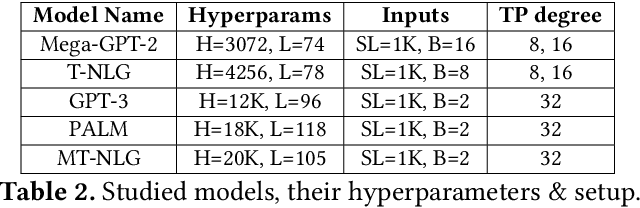
Large Language Models increasingly rely on distributed techniques for their training and inference. These techniques require communication across devices which can reduce scaling efficiency as the number of devices increases. While some distributed techniques can overlap, and thus, hide this communication with independent computations, techniques such as Tensor Parallelism (TP) inherently serialize communication with model execution. One approach to hide this serialized communication is to interleave it with the producer operation (of the communicated data) in a fine-grained manner. However, this fine-grained interleaving of communication and computation in software can be difficult. Furthermore, as with any concurrent execution, it requires compute and memory resources to be shared between computation and communication, causing resource contention that reduces overlapping efficacy. To overcome these challenges, we propose T3 which applies hardware-software co-design to transparently overlap serialized communication while minimizing resource contention with compute. T3 transparently fuses producer operations with the subsequent communication via a simple configuration of the producer's output address space and requires minor software changes. At the hardware level, T3 adds a lightweight track and trigger mechanism to orchestrate the producer's compute, and communication. It further uses compute-enhanced memories for communication's attendant compute. As a result, T3 reduces resource contention, and efficiently overlaps serialized communication with computation. For important Transformer models like T-NLG, T3 speeds up communication-heavy sublayers by 30% geomean (max 47%) and reduces data movement by 22% geomean (max 36%). Furthermore, T3's benefits persist as models scale: geomean 29% for sublayers in $\sim$500-billion parameter models, PALM and MT-NLG.