 Add to Chrome
 Add to Firefox
 Add to Edge
AI Benchmark Democratization and Carpentry
Dec 12, 2025
Benchmarks are a cornerstone of modern machine learning, enabling reproducibility, comparison, and scientific progress. However, AI benchmarks are increasingly complex, requiring dynamic, AI-focused workflows. Rapid evolution in model architectures, scale, datasets, and deployment contexts makes evaluation a moving target. Large language models often memorize static benchmarks, causing a gap between benchmark results and real-world performance. Beyond traditional static benchmarks, continuous adaptive benchmarking frameworks are needed to align scientific assessment with deployment risks. This calls for skills and education in AI Benchmark Carpentry. From our experience with MLCommons, educational initiatives, and programs like the DOE's Trillion Parameter Consortium, key barriers include high resource demands, limited access to specialized hardware, lack of benchmark design expertise, and uncertainty in relating results to application domains. Current benchmarks often emphasize peak performance on top-tier hardware, offering limited guidance for diverse, real-world scenarios. Benchmarking must become dynamic, incorporating evolving models, updated data, and heterogeneous platforms while maintaining transparency, reproducibility, and interpretability. Democratization requires both technical innovation and systematic education across levels, building sustained expertise in benchmark design and use. Benchmarks should support application-relevant comparisons, enabling informed, context-sensitive decisions. Dynamic, inclusive benchmarking will ensure evaluation keeps pace with AI evolution and supports responsible, reproducible, and accessible AI deployment. Community efforts can provide a foundation for AI Benchmark Carpentry.

An MLCommons Scientific Benchmarks Ontology
Nov 06, 2025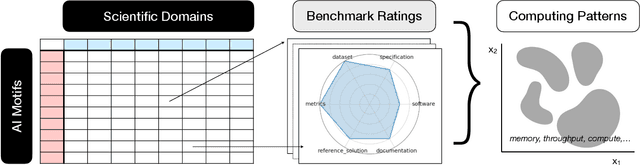
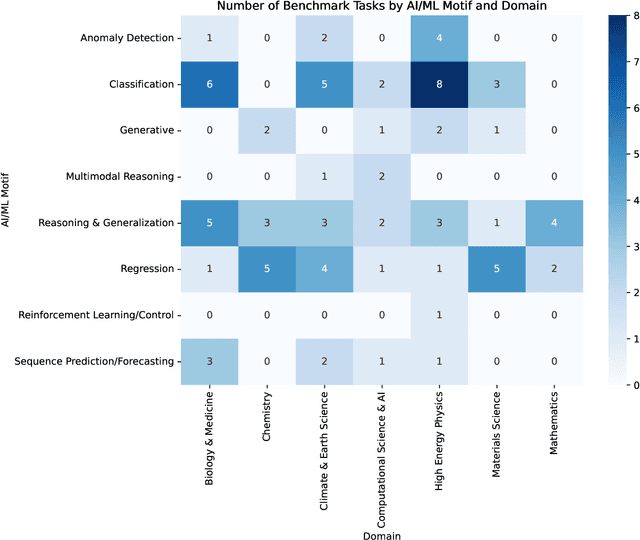
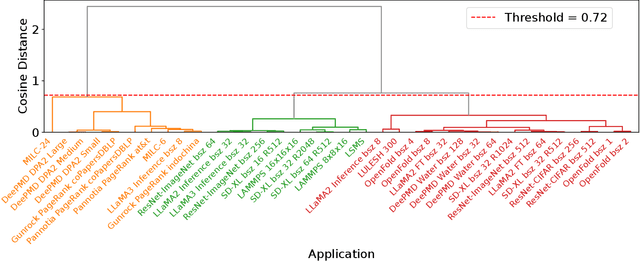
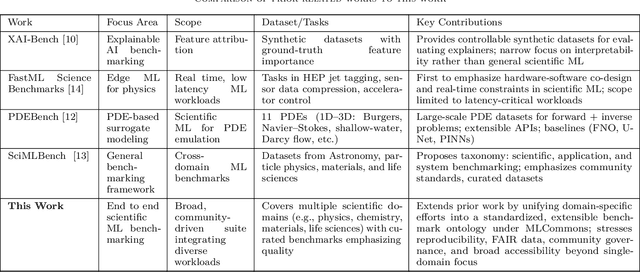
Scientific machine learning research spans diverse domains and data modalities, yet existing benchmark efforts remain siloed and lack standardization. This makes novel and transformative applications of machine learning to critical scientific use-cases more fragmented and less clear in pathways to impact. This paper introduces an ontology for scientific benchmarking developed through a unified, community-driven effort that extends the MLCommons ecosystem to cover physics, chemistry, materials science, biology, climate science, and more. Building on prior initiatives such as XAI-BENCH, FastML Science Benchmarks, PDEBench, and the SciMLBench framework, our effort consolidates a large set of disparate benchmarks and frameworks into a single taxonomy of scientific, application, and system-level benchmarks. New benchmarks can be added through an open submission workflow coordinated by the MLCommons Science Working Group and evaluated against a six-category rating rubric that promotes and identifies high-quality benchmarks, enabling stakeholders to select benchmarks that meet their specific needs. The architecture is extensible, supporting future scientific and AI/ML motifs, and we discuss methods for identifying emerging computing patterns for unique scientific workloads. The MLCommons Science Benchmarks Ontology provides a standardized, scalable foundation for reproducible, cross-domain benchmarking in scientific machine learning. A companion webpage for this work has also been developed as the effort evolves: https://mlcommons-science.github.io/benchmark/