 Add to Chrome
 Add to Firefox
 Add to Edge
The $qs$ Inequality: Quantifying the Double Penalty of Mixture-of-Experts at Inference
Mar 09, 2026
Mixture-of-Experts (MoE) models deliver high quality at low training FLOPs, but this efficiency often vanishes at inference. We identify a double penalty that structurally disadvantages MoE architectures during decoding: first, expert routing fragments microbatches and reduces weight reuse; second, massive resident expert pools reduce high-bandwidth memory (HBM) headroom for the KV cache. This phenomenon, formalized as reuse fragmentation, pushes feed-forward networks (FFNs) into a bandwidth-bound regime, especially at long context lengths. We introduce the $qs$ inequality, a predictive criterion that identifies when MoE is structurally disadvantaged relative to a quality-matched dense model. This criterion unifies sparsity ($s$), the fraction of parameters activated per token, and the quality-equivalence factor ($q$), the size multiplier required for a dense model to match MoE performance. Our evaluation across frontier models including DeepSeek-V3, Qwen3-235B, Grok-1, and Switch-C demonstrates that this fragmentation is a general architectural phenomenon. For DeepSeek-V3 at 128k context, this results in a 4.5x throughput advantage for a quality-matched dense baseline. Crucially, massive architectures like Switch-C can become infeasible on cluster sizes where a quality-matched dense model remains viable. Our results suggest that training-time FLOP efficiency is an incomplete proxy for inference-time performance in long-context serving. They also indicate that MoE may be best viewed as a training-time optimization, with distillation into dense models as a possible path toward inference-efficient deployment.

RAPID-Serve: Resource-efficient and Accelerated P/D Intra-GPU Disaggregation
Jan 16, 2026Two widely adopted techniques for LLM inference serving systems today are hybrid batching and disaggregated serving. A hybrid batch combines prefill and decode tokens of different requests in the same batch to improve resource utilization and throughput at the cost of increased latency per token. In contrast, disaggregated serving decouples compute-bound prefill and bandwidth-bound decode phases to optimize for service level objectives (SLOs) at the cost of resource under-utilization and KV-cache transfer overheads. To address the limitations of these techniques, we propose RAPID-Serve: a technique to concurrently execute prefill and decode on the same GPU(s) to meet latency SLOs while maintaining high throughput and efficient resource utilization. Furthermore, we propose Adaptive Resource Management for runtime compute resource allocation, optionally leveraging CU masking (a fine-grained Compute Unit partitioning feature on AMD Instinct\textsuperscript{TM} GPUs). RAPID-Serve provides up to 4.1x (average 1.7x) unconstrained throughput improvement and 32x and higher (average 4.9x) throughput improvement under SLO constraints, showing it as an effective strategy compared to the state-of-the-art approaches, particularly in resource-constrained environments.
T3: Transparent Tracking & Triggering for Fine-grained Overlap of Compute & Collectives
Jan 30, 2024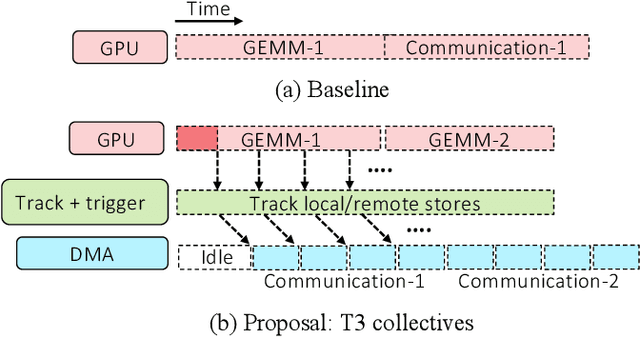
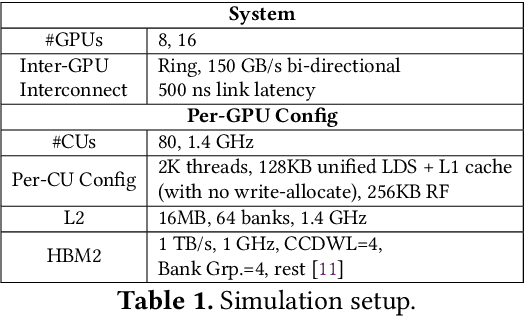
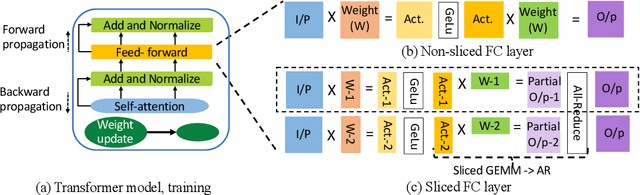
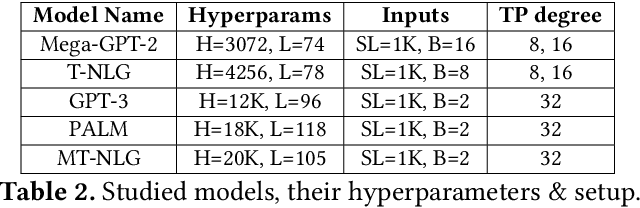
Large Language Models increasingly rely on distributed techniques for their training and inference. These techniques require communication across devices which can reduce scaling efficiency as the number of devices increases. While some distributed techniques can overlap, and thus, hide this communication with independent computations, techniques such as Tensor Parallelism (TP) inherently serialize communication with model execution. One approach to hide this serialized communication is to interleave it with the producer operation (of the communicated data) in a fine-grained manner. However, this fine-grained interleaving of communication and computation in software can be difficult. Furthermore, as with any concurrent execution, it requires compute and memory resources to be shared between computation and communication, causing resource contention that reduces overlapping efficacy. To overcome these challenges, we propose T3 which applies hardware-software co-design to transparently overlap serialized communication while minimizing resource contention with compute. T3 transparently fuses producer operations with the subsequent communication via a simple configuration of the producer's output address space and requires minor software changes. At the hardware level, T3 adds a lightweight track and trigger mechanism to orchestrate the producer's compute, and communication. It further uses compute-enhanced memories for communication's attendant compute. As a result, T3 reduces resource contention, and efficiently overlaps serialized communication with computation. For important Transformer models like T-NLG, T3 speeds up communication-heavy sublayers by 30% geomean (max 47%) and reduces data movement by 22% geomean (max 36%). Furthermore, T3's benefits persist as models scale: geomean 29% for sublayers in $\sim$500-billion parameter models, PALM and MT-NLG.
Demystifying BERT: Implications for Accelerator Design
Apr 14, 2021


Transfer learning in natural language processing (NLP), as realized using models like BERT (Bi-directional Encoder Representation from Transformer), has significantly improved language representation with models that can tackle challenging language problems. Consequently, these applications are driving the requirements of future systems. Thus, we focus on BERT, one of the most popular NLP transfer learning algorithms, to identify how its algorithmic behavior can guide future accelerator design. To this end, we carefully profile BERT training and identify key algorithmic behaviors which are worthy of attention in accelerator design. We observe that while computations which manifest as matrix multiplication dominate BERT's overall runtime, as in many convolutional neural networks, memory-intensive computations also feature prominently. We characterize these computations, which have received little attention so far. Further, we also identify heterogeneity in compute-intensive BERT computations and discuss software and possible hardware mechanisms to further optimize these computations. Finally, we discuss implications of these behaviors as networks get larger and use distributed training environments, and how techniques such as micro-batching and mixed-precision training scale. Overall, our analysis identifies holistic solutions to optimize systems for BERT-like models.