 Add to Chrome
 Add to Firefox
 Add to Edge
HortiMulti: A Multi-Sensor Dataset for Localisation and Mapping in Horticultural Polytunnels
Mar 23, 2026
Agricultural robotics is gaining increasing relevance in both research and real-world deployment. As these systems are expected to operate autonomously in more complex tasks, the availability of representative real-world datasets becomes essential. While domains such as urban and forestry robotics benefit from large and established benchmarks, horticultural environments remain comparatively under-explored despite the economic significance of this sector. To address this gap, we present HortiMulti, a multimodal, cross-season dataset collected in commercial strawberry and raspberry polytunnels across an entire growing season, capturing substantial appearance variation, dynamic foliage, specular reflections from plastic covers, severe perceptual aliasing, and GNSS-unreliable conditions, all of which directly degrade existing localisation and perception algorithms. The sensor suite includes two 3D LiDARs, four RGB cameras, an IMU, GNSS, and wheel odometry. Ground truth trajectories are derived from a combination of Total Station surveying, AprilTag fiducial markers, and LiDAR-inertial odometry, spanning dense, sparse, and marker-free coverage to support evaluation under both controlled and realistic conditions. We release time-synchronised raw measurements, calibration files, reference trajectories, and baseline benchmarks for visual, LiDAR, and multi-sensor SLAM, with results confirming that current state-of-the-art methods remain inadequate for reliable polytunnel deployment, establishing HortiMulti as a one-stop resource for developing and testing robotic perception systems in horticulture environments.

XIT: Exploration and Exploitation Informed Trees for Active Gas Distribution Mapping in Unknown Environments
Feb 14, 2026Mobile robotic gas distribution mapping (GDM) provides critical situational awareness during emergency responses to hazardous gas releases. However, most systems still rely on teleoperation, limiting scalability and response speed. Autonomous active GDM is challenging in unknown and cluttered environments, because the robot must simultaneously explore traversable space, map the environment, and infer the gas distribution belief from sparse chemical measurements. We address this by formulating active GDM as a next-best-trajectory informative path planning (IPP) problem and propose XIT (Exploration-Exploitation Informed Trees), a sampling-based planner that balances exploration and exploitation by generating concurrent trajectories toward exploration-rich goals while collecting informative gas measurements en route. XIT draws batches of samples from an Upper Confidence Bound (UCB) information field derived from the current gas posterior and expands trees using a cost that trades off travel effort against gas concentration and uncertainty. To enable plume-aware exploration, we introduce the gas frontier concept, defined as unobserved regions adjacent to high gas concentrations, and propose the Wavefront Gas Frontier Detection (WGFD) algorithm for their identification. High-fidelity simulations and real-world experiments demonstrate the benefits of XIT in terms of GDM quality and efficiency. Although developed for active GDM, XIT is readily applicable to other robotic information-gathering tasks in unknown environments that face the exploration and exploitation trade-off.
Multi-UAV Search and Rescue in Wilderness Using Smart Agent-Based Probability Models
Nov 15, 2024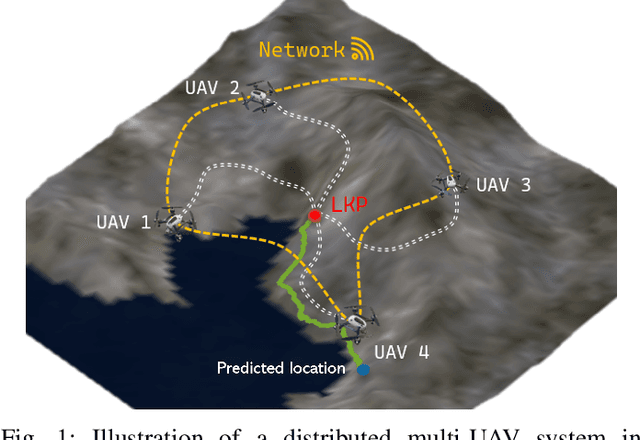
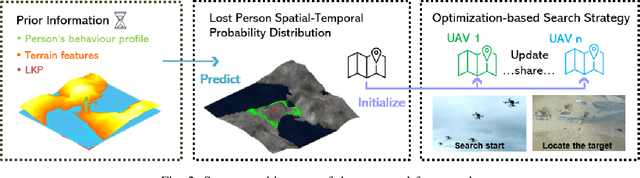
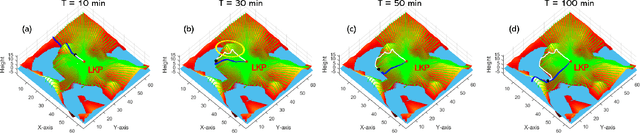
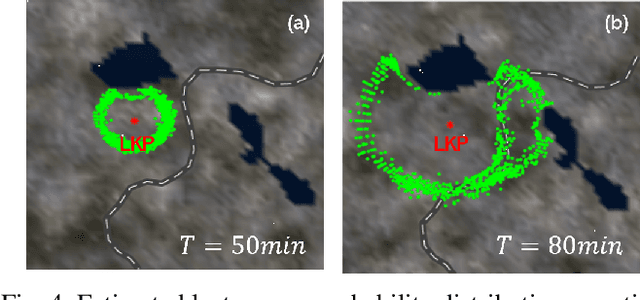
The application of Multiple Unmanned Aerial Vehicles (Multi-UAV) in Wilderness Search and Rescue (WiSAR) significantly enhances mission success due to their rapid coverage of search areas from high altitudes and their adaptability to complex terrains. This capability is particularly crucial because time is a critical factor in searching for a lost person in the wilderness; as time passes, survival rates decrease and the search area expands. The probability of success in such searches can be further improved if UAVs leverage terrain features to predict the lost person's position. In this paper, we aim to enhance search missions by proposing a smart agent-based probability model that combines Monte Carlo simulations with an agent strategy list, mimicking the behavior of a lost person in the wildness areas. Furthermore, we develop a distributed Multi-UAV receding horizon search strategy with dynamic partitioning, utilizing the generated probability density model as prior information to prioritize locations where the lost person is most likely to be found. Simulated search experiments across different terrains have been conducted to validate the search efficiency of the proposed methods compared to other benchmark methods.
Receding Horizon Optimization with PPUM: An Approach for Autonomous Robot Path Planning in Uncertain Environments
Nov 24, 2023The ability to understand spatial-temporal patterns for crowds of people is crucial for achieving long-term autonomy of mobile robots deployed in human environments. However, traditional historical data-driven memory models are inadequate for handling anomalies, resulting in poor reasoning by robot in estimating the crowd spatial distribution. In this article, a Receding Horizon Optimization (RHO) formulation is proposed that incorporates a Probability-related Partially Updated Memory (PPUM) for robot path planning in crowded environments with uncertainties. The PPUM acts as a memory layer that combines real-time sensor observations with historical knowledge using a weighted evidence fusion theory to improve robot's adaptivity to the dynamic environments. RHO then utilizes the PPUM as a informed knowledge to generate a path that minimizes the likelihood of encountering dense crowds while reducing the cost of local motion planning. The proposed approach provides an innovative solution to the problem of robot's long-term safe interaction with human in uncertain crowded environments. In simulation, the results demonstrate the superior performance of our approach compared to benchmark methods in terms of crowd distribution estimation accuracy, adaptability to anomalies and path planning efficiency.