 Add to Chrome
 Add to Firefox
 Add to Edge
HortiMulti: A Multi-Sensor Dataset for Localisation and Mapping in Horticultural Polytunnels
Mar 23, 2026
Agricultural robotics is gaining increasing relevance in both research and real-world deployment. As these systems are expected to operate autonomously in more complex tasks, the availability of representative real-world datasets becomes essential. While domains such as urban and forestry robotics benefit from large and established benchmarks, horticultural environments remain comparatively under-explored despite the economic significance of this sector. To address this gap, we present HortiMulti, a multimodal, cross-season dataset collected in commercial strawberry and raspberry polytunnels across an entire growing season, capturing substantial appearance variation, dynamic foliage, specular reflections from plastic covers, severe perceptual aliasing, and GNSS-unreliable conditions, all of which directly degrade existing localisation and perception algorithms. The sensor suite includes two 3D LiDARs, four RGB cameras, an IMU, GNSS, and wheel odometry. Ground truth trajectories are derived from a combination of Total Station surveying, AprilTag fiducial markers, and LiDAR-inertial odometry, spanning dense, sparse, and marker-free coverage to support evaluation under both controlled and realistic conditions. We release time-synchronised raw measurements, calibration files, reference trajectories, and baseline benchmarks for visual, LiDAR, and multi-sensor SLAM, with results confirming that current state-of-the-art methods remain inadequate for reliable polytunnel deployment, establishing HortiMulti as a one-stop resource for developing and testing robotic perception systems in horticulture environments.

Towards Smart Point-and-Shoot Photography
May 06, 2025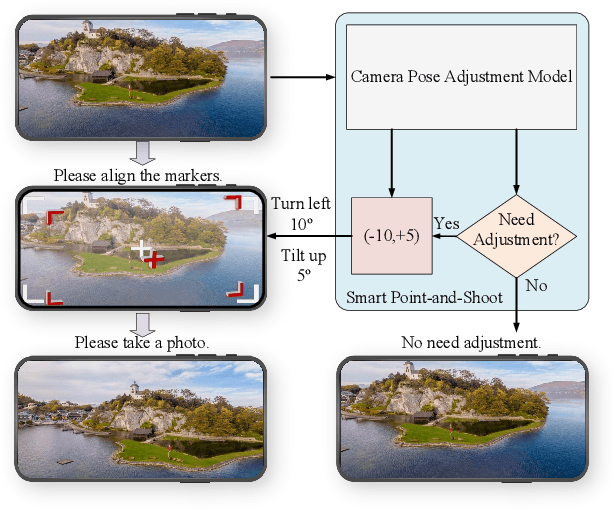
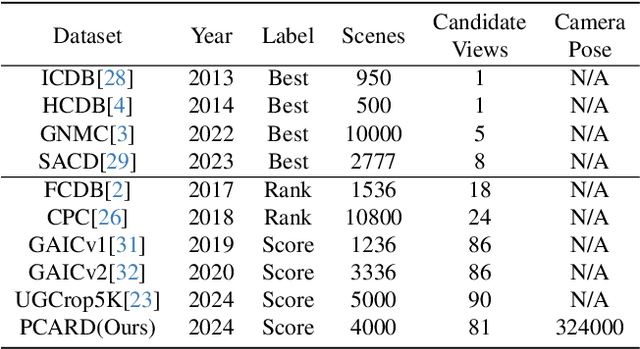

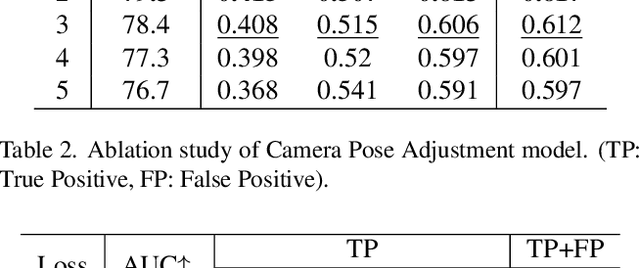
Hundreds of millions of people routinely take photos using their smartphones as point and shoot (PAS) cameras, yet very few would have the photography skills to compose a good shot of a scene. While traditional PAS cameras have built-in functions to ensure a photo is well focused and has the right brightness, they cannot tell the users how to compose the best shot of a scene. In this paper, we present a first of its kind smart point and shoot (SPAS) system to help users to take good photos. Our SPAS proposes to help users to compose a good shot of a scene by automatically guiding the users to adjust the camera pose live on the scene. We first constructed a large dataset containing 320K images with camera pose information from 4000 scenes. We then developed an innovative CLIP-based Composition Quality Assessment (CCQA) model to assign pseudo labels to these images. The CCQA introduces a unique learnable text embedding technique to learn continuous word embeddings capable of discerning subtle visual quality differences in the range covered by five levels of quality description words {bad, poor, fair, good, perfect}. And finally we have developed a camera pose adjustment model (CPAM) which first determines if the current view can be further improved and if so it outputs the adjust suggestion in the form of two camera pose adjustment angles. The two tasks of CPAM make decisions in a sequential manner and each involves different sets of training samples, we have developed a mixture-of-experts model with a gated loss function to train the CPAM in an end-to-end manner. We will present extensive results to demonstrate the performances of our SPAS system using publicly available image composition datasets.
Aesthetically Relevant Image Captioning
Nov 25, 2022Image aesthetic quality assessment (AQA) aims to assign numerical aesthetic ratings to images whilst image aesthetic captioning (IAC) aims to generate textual descriptions of the aesthetic aspects of images. In this paper, we study image AQA and IAC together and present a new IAC method termed Aesthetically Relevant Image Captioning (ARIC). Based on the observation that most textual comments of an image are about objects and their interactions rather than aspects of aesthetics, we first introduce the concept of Aesthetic Relevance Score (ARS) of a sentence and have developed a model to automatically label a sentence with its ARS. We then use the ARS to design the ARIC model which includes an ARS weighted IAC loss function and an ARS based diverse aesthetic caption selector (DACS). We present extensive experimental results to show the soundness of the ARS concept and the effectiveness of the ARIC model by demonstrating that texts with higher ARS's can predict the aesthetic ratings more accurately and that the new ARIC model can generate more accurate, aesthetically more relevant and more diverse image captions. Furthermore, a large new research database containing 510K images with over 5 million comments and 350K aesthetic scores, and code for implementing ARIC are available at https://github.com/PengZai/ARIC.