 Add to Chrome
 Add to Firefox
 Add to Edge
Neuromorphic visual attention for Sign-language recognition on SpiNNaker
May 07, 2026
Sign-language recognition has achieved substantial gains in classification accuracy in recent years; however, the latency and power requirements of most existing methods limit their suitability for real-time deployment. Neuromorphic sensing and processing offer an alternative paradigm based on sparse, event-driven computation that supports low-latency and energy-efficient perception. In this work, we introduce an end-to-end neuromorphic architecture for American Sign Language (ASL) fingerspelling recognition that integrates a spiking visual attention mechanism for online region-of-interest extraction with a compact spiking neural network deployed on the SpiNNaker neuromorphic platform. We benchmark the proposed system against two datasets: a synthetically generated event-based version of the Sign Language MNIST dataset and a natively recorded ASL-DVS dataset, whilst providing a comprehensive overview of Sign-language recognition and related work. This work yields competitive performance in simulation (92.27%) and comparable performance on neuromorphic hardware deployment (83.1%), while achieving the most energy-efficient architecture (0.565 mW) and low latency (3 ms) across all benchmarked approaches. Despite its compact design, the system demonstrates the suitability of task-dependent visual attention applications for edge deployment.

Wandering around: A bioinspired approach to visual attention through object motion sensitivity
Feb 10, 2025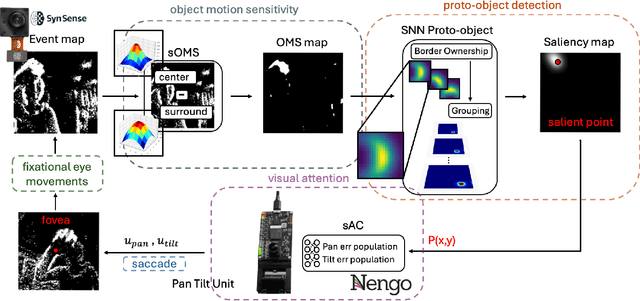


Active vision enables dynamic visual perception, offering an alternative to static feedforward architectures in computer vision, which rely on large datasets and high computational resources. Biological selective attention mechanisms allow agents to focus on salient Regions of Interest (ROIs), reducing computational demand while maintaining real-time responsiveness. Event-based cameras, inspired by the mammalian retina, enhance this capability by capturing asynchronous scene changes enabling efficient low-latency processing. To distinguish moving objects while the event-based camera is in motion the agent requires an object motion segmentation mechanism to accurately detect targets and center them in the visual field (fovea). Integrating event-based sensors with neuromorphic algorithms represents a paradigm shift, using Spiking Neural Networks to parallelize computation and adapt to dynamic environments. This work presents a Spiking Convolutional Neural Network bioinspired attention system for selective attention through object motion sensitivity. The system generates events via fixational eye movements using a Dynamic Vision Sensor integrated into the Speck neuromorphic hardware, mounted on a Pan-Tilt unit, to identify the ROI and saccade toward it. The system, characterized using ideal gratings and benchmarked against the Event Camera Motion Segmentation Dataset, reaches a mean IoU of 82.2% and a mean SSIM of 96% in multi-object motion segmentation. The detection of salient objects reaches 88.8% accuracy in office scenarios and 89.8% in low-light conditions on the Event-Assisted Low-Light Video Object Segmentation Dataset. A real-time demonstrator shows the system's 0.12 s response to dynamic scenes. Its learning-free design ensures robustness across perceptual scenes, making it a reliable foundation for real-time robotic applications serving as a basis for more complex architectures.